Help Do vs Help To Do vs Help Doing Something can make learners scratch their head when they ask the right way to use the English language. Many people find themselves standing at a crossroads with three different signs showing separate paths. These paths are labeled help do, help to do, and help doing, which can create confusion for learners trying to understand the correct usage.
The verb help is usually followed by another verb in different forms. The direct forms help do and help to do are both correct and often express the same thing. They are commonly used in everyday speech and written English. For example, “Can you help me carry this?” is a natural way to request assistance in daily communication.
On the other hand, help doing is often connected with an ongoing action or a repeated habit. For example, “He helps me doing my homework every night” describes a regular activity. In my experience with English learning, understanding these small verb patterns makes it easier to choose the right phrase and avoid making the explanation more murkier.
This article will guide you on how to use each form and understand their subtle differences. The meaning and nuance of these expressions depend on the situation, so knowing their place in a sentence helps you convey your ideas more naturally and correctly.
Short Answer
Let’s start with the big picture.
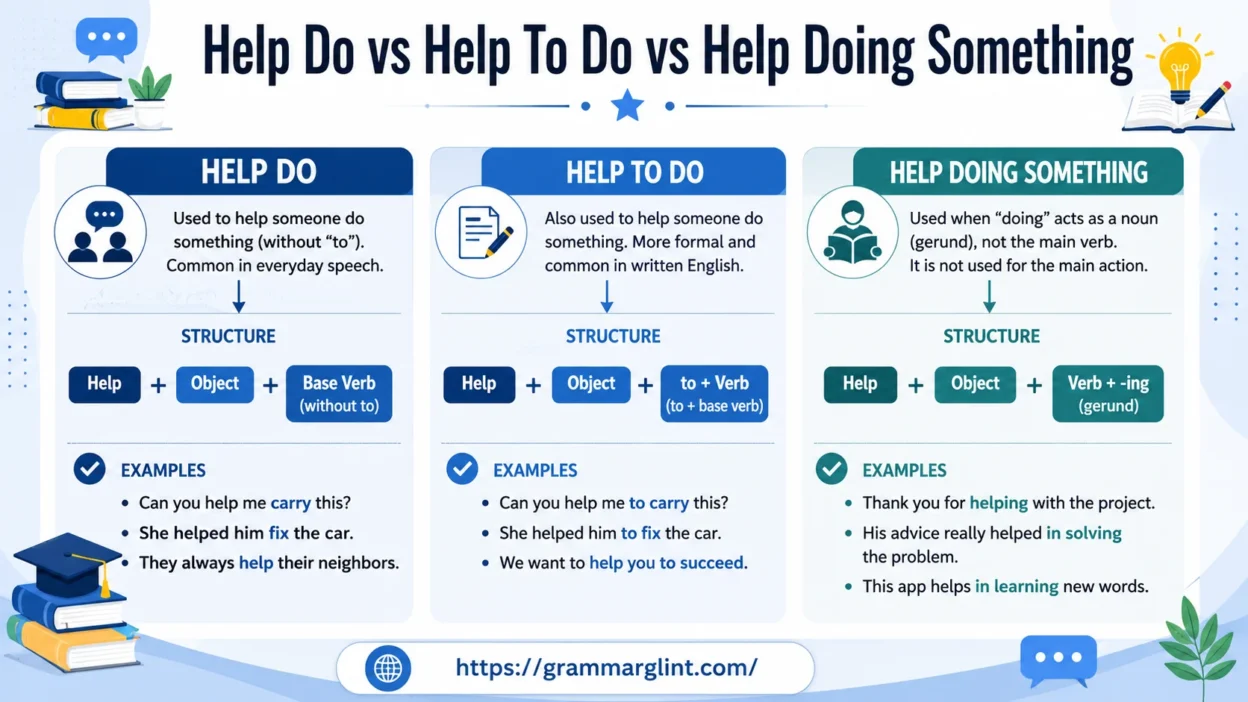
The verb help can connect with other verbs in three main ways:
- help + base verb → help do something
- help + to + base verb → help to do something
- help + verb-ing → help doing something
All three are grammatically possible, but they don’t behave the same way in tone, frequency, or naturalness.
Think of it like three doors leading to the same room. You end up in the same place, but each door feels slightly different.
The Core Grammar Rule
Here’s the core truth most textbooks oversimplify:
“Help” is a flexible verb. It does not lock you into one structure.
That flexibility comes from how English evolved. Unlike rigid grammar systems, English allows variation based on tone, region, and context.
You will commonly see:
- Help do (most natural in spoken English)
- Help to do (slightly formal but correct)
- Help doing (less common but still used in certain contexts)
A useful way to think about it:
“Help” behaves like a bridge verb. It connects people and actions in more than one valid way.
Help Do Something (Base Verb Form) Explained
Let’s start with the most natural and widely used structure.
What it looks like
help + base verb
Examples:
- I helped him fix the bike.
- She helped me finish my homework.
- They helped us move the furniture.
Why it sounds natural
This structure feels direct. No extra words slow it down. It mirrors how people speak in real life.
Imagine a conversation:
“Can you help me carry this?”
“Sure, I’ll help you carry it.”
No one says “to carry it” in casual speech unless they want to sound more formal.
When you should use “help do”
Use this form when:
- You are speaking casually
- You want natural flow
- You are writing conversational English
- You are talking with friends, coworkers, or family
Real-life mini case study
A student writes two sentences:
- ❌ I helped him to complete the assignment.
- ✔ I helped him complete the assignment.
Both are correct. But the second one feels smoother, faster, and more natural. That’s why native speakers prefer it in everyday use.
Key insight
“Help do” dominates spoken English because speed and clarity matter more than structure.
Help To Do Something (Full Infinitive Form)
Now let’s move to the slightly more formal version.
What it looks like
help + to + base verb
Examples:
- I helped him to fix the bike.
- She helped me to understand the lesson.
- We helped them to organize the event.
Why “to” appears here
The word “to” signals a full infinitive structure. Many English verbs require it:
- want to go
- need to eat
- decide to leave
So learners often assume “help” must follow the same pattern.
But here’s the twist: it doesn’t always need it.
Read More: On Weekdays or In Weekdays? (Correct Preposition Explained)
When “help to do” works best
Use this form when:
- You write formal documents
- You write academic essays
- You want slightly structured English
- You want to emphasize clarity in writing
Tone difference
Compare these two:
- I helped him finish the report.
- I helped him to finish the report.
The second one feels slightly more deliberate. Almost like the action was planned or structured.
Important fact
British English historically uses “help to do” more often than American English. However, modern usage in both regions mixes freely.
Simple takeaway
“Help to do” is correct but slightly more formal and less common in speech.
Help Doing Something (Gerund Form Explained)
Now we reach the least understood structure.
What it looks like
help + verb-ing
Examples:
- I helped him cleaning the kitchen.
- She helped me organizing the files.
- They helped us preparing the room.
But here’s the truth
This form is tricky. In standard modern English, it is less common and sometimes considered informal or non-standard depending on context.
Many native speakers actually avoid it unless the sentence structure demands it in a specific way.
When it appears
You might see this form when:
- The focus is on an ongoing activity
- The speaker is using informal or regional English
- The action feels continuous rather than completed
Important clarification
In many cases, native speakers prefer:
- ✔ I helped him clean the kitchen
instead of - ❌ I helped him cleaning the kitchen
So while you may encounter “help doing,” it is not the safest default choice.
Real-life example
A learner says:
“I helped him cleaning his room.”
A native speaker naturally responds:
“I helped him clean his room.”
That small difference makes the sentence sound more natural.
Comparison Table
Let’s break it down clearly.
| Structure | Example | Tone | Naturalness | Usage Level |
| Help do | I helped him finish it | Natural, direct | Very high | Most common |
| Help to do | I helped him to finish it | Slightly formal | High | Common |
| Help doing | I helped him finishing it | Informal/awkward in many cases | Low–medium | Rare |
This table shows something important:
👉 Native speakers mostly rely on the first two forms.
Do These Forms Change Meaning?
Here’s a surprising truth:
They do NOT change core meaning.
All three versions express assistance. The difference lies in:
- Tone
- Flow
- Formality
- Regional preference
Think of it like saying:
- “start” vs “begin”
- “buy” vs “purchase”
Same idea. Different style.
In Real-Life English
Let’s bring this into real situations so it sticks.
Workplace example
You email a colleague:
- I helped Sarah complete the presentation slides.
This sounds natural and professional.
Now slightly formal:
- I helped Sarah to complete the presentation slides.
This works better in formal reports or documentation.
Classroom example
Teacher says:
- I helped the student solve the equation.
Not:
- I helped the student solving the equation.
Everyday life example
You talk to a friend:
- I helped my brother fix his phone.
That’s it. Simple and natural.
British vs American English Usage Patterns
English varies by region, and “help” is no exception.
American English
- Strong preference for help do
- “Help to do” appears less often
- Spoken language is more direct
British English
- Uses both forms more evenly
- “Help to do” feels slightly more natural in writing
- Spoken English still favors “help do”
Reality check
Modern English globally is blending. Social media, movies, and online communication have reduced strict regional differences.
Common Mistakes
Let’s fix the errors you’ll actually see in real writing.
Mistake 1: Overusing “to”
❌ I helped him to fixing the car
✔ I helped him fix the car
Mistake 2: Using gerund incorrectly
❌ I helped him cleaning the house
✔ I helped him clean the house
Mistake 3: Mixing forms randomly
❌ I helped him to fixing the project
✔ I helped him fix the project
Quick fix rule
If you are unsure:
👉 Use help + base verb
It is the safest and most natural choice.
Why English Allows All These Forms
English is not a rigid system. It evolves based on usage.
The verb “help” became flexible because:
- It connects two actions (help + action)
- Speakers prioritized speed in conversation
- Grammar rules adapted over time
Linguists often describe “help” as a semi-auxiliary verb, meaning it behaves partly like a helper verb and partly like a main verb.
That explains the flexibility.
Quick Decision Guide
Use this simple mental shortcut:
- Talking casually? → help do
- Writing formally? → help to do
- Unsure? → help do
- Avoiding mistakes? → avoid help doing
Simple. Fast. Reliable.
Practice Examples (Test Yourself)
Try choosing the correct form:
- I helped him ___ (finish / to finish / finishing) his homework.
- She helped me ___ (organize / to organize / organizing) the event.
- They helped us ___ (move / to move / moving) the sofa.
Answers:
- finish
- organize
- move
If you got them right, you already understand the core pattern.
My Personal Experience as an English Language Specialist
As an English language specialist, I’ve found that the verb help is one of the grammar points that frequently confuses learners. Many students hesitate between help do, help to do, and help doing because they assume each form has a completely different meaning. Through teaching and reviewing learners’ writing, I’ve noticed that understanding the grammar pattern behind these structures helps students become much more confident in choosing the correct form.
From my experience, the most effective way to teach these expressions is by using real-life examples instead of relying solely on grammar rules. Learners quickly recognize that help do and help to do are usually interchangeable, while help doing has more limited uses and should not replace the other two in most sentences. With regular practice and exposure to authentic English, students naturally develop a better sense of which structure sounds correct in different situations.
FAQs
1. What is the difference between help do, help to do, and help doing?
Help do and help to do usually have the same meaning and show that someone assists with an action. Help doing usually describes an ongoing activity or a regular habit.
2. Is help do grammatically correct?
Yes, help do is grammatically correct and commonly used in everyday English. It is often considered a direct and natural form.
3. Is help to do more formal than help do?
Sometimes help to do can sound slightly more formal or polished, especially in written English, but both forms are correct.
4. Can I use help doing in every sentence?
No, help doing is generally used when talking about an ongoing action or repeated activity. It does not always replace help do or help to do.
5. Which form should I use in daily conversation?
In daily speech, help do is very common because it sounds simple and natural.
6. Are help do and help to do interchangeable?
Yes, in many situations they can be used interchangeably because they often convey the same meaning and context.
7. What does help doing describe?
Help doing usually describes a continuous action, routine, or someone’s repeated habit.
8. Why do learners get confused about these phrases?
Learners often get confused because English verb patterns can have small differences, and choosing the correct phrase depends on the situation.
9. Can help be followed by another verb?
Yes, the verb help can be followed by another verb in different forms, including help do, help to do, and help doing.
10. How can I remember the correct usage?
Focus on the context, the action being described, and whether you are talking about direct assistance, a specific action, or an ongoing activity.
Conclusion
Understanding help do, help to do, and help doing doesn’t have to be difficult. Once you know the grammar behind each pattern, choosing the right form becomes much more natural. In most situations, help do and help to do are interchangeable, although help do is more common in everyday English. Help doing, however, follows different grammatical rules and should only be used in specific contexts where the -ing form functions as a noun (gerund), not as the main verb after help.
The best way to master these expressions is through regular practice. Read authentic English, listen to native speakers, and create your own example sentences. Over time, you’ll begin to recognize which pattern sounds right without having to think about the rule. With consistent exposure and practice, using these expressions correctly will become second nature, making your spoken and written English sound more fluent and confident.

Aria Jane is a senior language writer and grammar specialist at Grammar Glint. She focuses on English grammar, spelling variations, vocabulary, and writing clarity. Through detailed research and practical examples, Aria helps readers understand language rules and avoid common mistakes. Her articles are designed to make English learning accessible for students, professionals, and everyday writers seeking reliable language guidance.