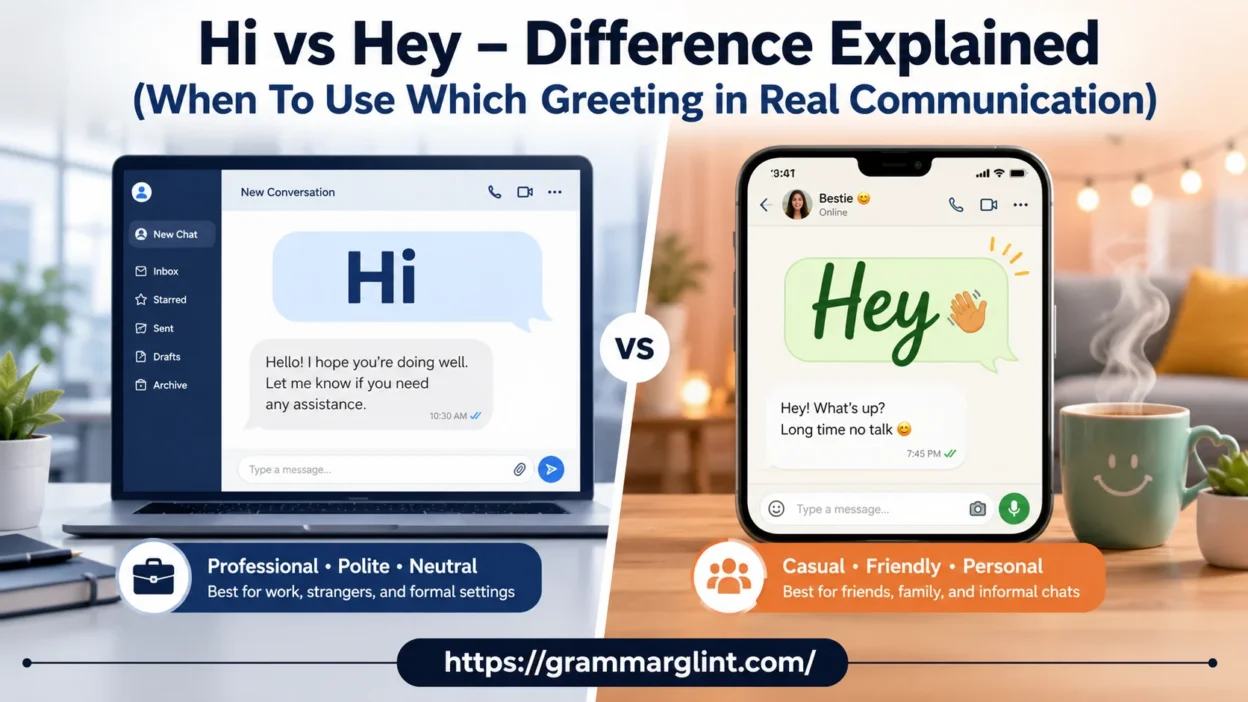
When learning the difference between hi and hey, it becomes clear that both are common ways to greet people in everyday communication. These two words may look similar, but their usage depends on the context, meaning, and the type of interaction. In my experience, choosing the right greeting can make a conversation feel more natural because each expression carries its own tone and style.
Hi is a standard, polite, and widely accepted form of greeting. It can be used to address a wide range of people, including friends and strangers. It is often seen as slightly more formal and professionally friendly. This makes hi a versatile choice for many situations where a respectful and neutral approach is needed.
On the other hand, hey is usually more casual, informal, and personal. It works best when you are already familiar with the person you are speaking to. In a relaxed conversation, hey can be used to get attention or express surprise. It often carries a more friendly and comfortable feeling, creating a relaxed atmosphere between people.
The difference also appears in digital communication, such as texting and emails. In these situations, hey can convey a more personal or casual feeling, while hi may feel more neutral and suitable for semi-formal contexts. Both phrases and expressions can sometimes be interchangeable, but the choice depends on the relationship and situation.
Quick Answer
Let’s make this simple before we go deeper.
- Hi feels neutral, polite, and safe
- Hey feels casual, friendly, and familiar
Neither word is “better.” Context decides everything.
If you want a rule you can use immediately:
- Use Hi when you don’t know the person well or when professionalism matters
- Use Hey when you already share comfort or informality with someone
That’s the core difference in one glance.
The Real Meaning
Both greetings seem interchangeable. Yet they carry different emotional signals.
Hi: Controlled and Respectful Energy
“Hi” works like a neutral handshake in text form. It shows acknowledgment without emotional risk.
People often interpret “Hi” as:
- Polite
- Balanced
- Safe in formal settings
- Slightly reserved
It works in almost every environment. That’s its strength.
Think of “Hi” like wearing a clean button-up shirt. It fits most situations without standing out too much.
Hey: Relaxed and Familiar Energy
“Hey” shifts the tone immediately. It feels more conversational and open.
People often interpret “Hey” as:
- Friendly
- Casual
- Slightly personal
- Familiar or relaxed
It feels like walking up to someone you already know.
However, it can sometimes feel too informal in strict professional contexts.
Think of “Hey” like showing up in sneakers instead of formal shoes. Comfortable, but not always appropriate.
Emotional Difference
Words carry emotional weight even when we don’t notice it.
How “Hi” Feels Emotionally
“Hi” creates space. It doesn’t rush closeness.
It often communicates:
- Respect for boundaries
- Neutral intent
- Low pressure interaction
That makes it ideal for first impressions.
How “Hey” Feels Emotionally
“Hey” shortens distance between two people.
It often communicates:
- Warmth
- Ease
- Social comfort
Yet that same warmth can feel intrusive if the relationship is new.
When You Should Use “Hi”
You gain reliability when you use “Hi” correctly. It rarely causes misunderstanding.
Professional Emails and Work Messages
Use “Hi” in:
- Client emails
- Job applications
- Formal work discussions
- External communication
Example:
- Hi Sarah, I hope your week is going well.
This sets a respectful tone instantly.
First-Time Conversations
First impressions matter more than most people realize.
Use “Hi” when:
- Messaging someone new
- Reaching out for collaboration
- Contacting support or services
It keeps your message safe and neutral.
Situations That Need Clarity Over Warmth
Some messages must stay clear and serious.
Use “Hi” when:
- Giving instructions
- Making requests
- Discussing deadlines
In these cases, clarity beats friendliness.
Read More: Help Do vs Help To Do vs Help Doing Something: Complete Guide
When You Should Use “Hey”
“Hey” works best when emotional safety already exists.
Friends and Close Contacts
This is the natural home of “Hey.”
Use it when:
- Texting friends
- Messaging family casually
- Chatting in group conversations
Example:
- Hey, are you free tonight?
It feels natural because familiarity already exists.
Casual Work Environments
Some workplaces operate on relaxed communication.
You can use “Hey” when:
- Your team uses informal tone
- Internal chat feels conversational
- Hierarchy feels flexible
However, watch how others communicate first.
Social and Online Conversations
Online spaces often lean informal.
Use “Hey” in:
- Dating apps
- Community chats
- Social platforms
But context still matters. First messages still benefit from caution.
Tone Breakdown
Here’s a simple comparison that shows how tone changes perception.
| Greeting | Tone | Risk Level | Best Use |
| Hi | Neutral, respectful | Low | Professional and first contact |
| Hey | Casual, warm | Medium | Familiar or relaxed settings |
The key difference sits in perceived closeness. “Hi” keeps distance. “Hey” reduces it.
Cultural and Workplace Differences
Communication style changes across regions and industries.
Workplace Culture Matters
In modern tech companies, “Hey” shows up often. Teams value speed and informality.
However, industries like:
- Law
- Banking
- Government
- Academia
still prefer “Hi” or “Hello.”
Regional Differences in English Use
Different English-speaking regions treat greetings differently.
- United States: “Hey” feels normal in casual settings
- United Kingdom: “Hi” still dominates in most professional communication
- Global communication: “Hi” stays safest across borders
If you write to international contacts, “Hi” reduces risk.
Common Mistakes People Make
Small mistakes change how people perceive you.
Using “Hey” in Cold Outreach
This often feels too familiar.
Example:
- Hey, I’d like to collaborate with you.
This can feel rushed or overly casual.
A better version:
- Hi, I’d like to explore a possible collaboration.
Overusing “Hey” in Professional Settings
If everything starts with “Hey,” tone can feel inconsistent.
It may signal:
- Lack of professionalism
- Over-familiarity
- Weak boundary awareness
Misreading the Relationship
Some people assume friendliness means permission for casual tone.
That assumption often backfires. When in doubt, stay neutral.
The Psychology Behind It
Language shapes perception faster than logic.
“Hi” Builds Structure
“Hi” creates psychological distance. That distance helps:
- Establish respect
- Maintain clarity
- Reduce emotional ambiguity
It signals control and awareness.
“Hey” Builds Connection
“Hey” reduces distance. That helps:
- Build rapport
- Create comfort
- Encourage openness
But it can feel premature if trust hasn’t formed.
Why First Words Matter More Than You Think
People form impressions in seconds. Messaging works the same way.
The first word:
- Sets emotional tone
- Frames intent
- Influences trust
That’s why greetings carry more weight than most people expect.
Real-Life Examples
Let’s make this practical.
Professional Email Example
Correct:
- Hi Mark, I reviewed the proposal and have a few notes.
Why it works:
- Clear
- Respectful
- Professional
Casual Friend Message
Correct:
- Hey, did you see the game last night?
Why it works:
- Relaxed
- Natural
- Friendly
Mixed Tone Mistake
Incorrect:
- Hey Sir, I wanted to discuss the project deadline.
Why it feels off:
- “Hey” feels casual
- “Sir” feels formal
- The mismatch creates confusion
A better version:
- Hi Sir, I wanted to discuss the project deadline.
Case Study: Email Response Tone Shift
A small marketing team tested two email styles:
- Version A started with “Hi”
- Version B started with “Hey”
Results over 1,000 outreach emails:
- “Hi” version: higher reply rate in corporate contacts
- “Hey” version: higher reply rate in creative and startup audiences
Key takeaway:
- Formality increases trust in structured industries
- Casual tone improves engagement in relaxed industries
Tone alignment matters more than personal preference.
What Changes in 2026 Communication Style
Modern communication trends lean more casual than before.
Still, one rule remains stable:
- Professional boundaries still matter
Even in fast-moving digital spaces, people expect tone awareness.
Default behavior today looks like this:
- Start with “Hi” in uncertain situations
- Switch to “Hey” once comfort builds
That balance works across most platforms.
Better Alternatives
Sometimes neither greeting fits perfectly.
Try these instead:
- Hello → slightly more formal than Hi
- Hi there → friendly but safe
- Good morning / afternoon → context-based and polite
- Greetings → rare but formal
- Yo → very casual, avoid in professional settings
Each option changes tone more precisely than “Hi” or “Hey.”
FAQs
1. What is the main difference between Hi and Hey?
The main difference is the level of formality and the tone. Hi is a more standard and polite greeting, while hey is usually more casual and informal.
2. Is Hi more formal than Hey?
Yes, hi is generally considered slightly more formal and can be used in both personal and professional situations.
3. Can I use Hey with strangers?
You can, but hey is often better suited for people you already know. With strangers, hi is usually a safer and more polite choice.
4. Is Hey considered a rude greeting?
No, hey is not rude. It is a friendly and relaxed greeting, but the meaning depends on the context and tone.
5. Can Hi and Hey be used interchangeably?
In many everyday conversations, they can be interchangeable, but they may create slightly different feelings because of their different styles.
6. Why do people use Hey in conversations?
People use hey to create a more relaxed interaction. It can also be used to get attention or express surprise.
7. Which greeting is better for emails and texting?
Both can work in digital communication. Hi often feels more neutral and professional, while hey gives a more personal and casual feeling.
8. Does Hey sound more friendly than Hi?
Often, yes. Hey can sound more familiar and friendly because it carries a more relaxed tone.
9. Can Hi be used with friends?
Yes, hi can be used with friends and is a flexible greeting that fits many contexts.
10. Why is understanding the difference between Hi and Hey important?
Understanding the difference improves language skills and helps you choose the right expression based on the person, situation, and meaning.
Conclusion
Understanding Hi vs. Hey is about more than choosing between two simple greetings. While both words are correct and widely used, they create different impressions based on the situation and your relationship with the other person. Hi offers a polite, neutral tone that works well in professional, academic, and everyday conversations, whereas hey feels more relaxed, friendly, and personal. Choosing the right greeting helps you start conversations in a way that matches the context.
The best option depends on who you are speaking to and the message you want to convey. If you want to sound respectful and versatile, hi is usually the safest choice. If you are talking with friends or people you know well, hey can make your communication feel warmer and more natural. By understanding these subtle differences, you can improve your English communication skills and use each greeting with greater confidence.

Emma Brooke is an editor and language researcher at Grammar Glint. Her work centers on grammar rules, punctuation, word usage, and style consistency. Emma is passionate about transforming complex language concepts into clear, reader-friendly explanations. She contributes in-depth articles that help readers communicate more effectively and confidently in both academic and professional settings.