Sufficient vs Enough shows the difference between sufficient and enough, with a subtle distinction in usage and meaning for better communication. At first, these two words may seem almost the same because both explain the idea of having the right quantity or the amount that is needed. However, their context and purpose can change how they work in a sentence.
The understanding of these words becomes easier when we study their comparison. Both are connected with having what is required and completing a specific purpose, but they are not always completely interchangeable. In my experience, learners often face confusion because these synonyms look similar, yet the correct word choice depends on the situation.
Knowing the correct use of each word helps polish your English and improves how you express yourself clearly and effectively. For example, saying “sufficient funds” may sound more professional because it implies an amount that meets requirements exactly. In contrast, “enough money” feels simpler and more suitable for regular communication.
This distinction also supports better grammar, vocabulary, and sentence structure. The choice between these words depends on the rules of language, the context of the conversation, and the intended expression. Understanding this difference makes writing smoother and helps speakers choose the most appropriate term at the right time.
Why These Two Words Confuse So Many People
You might hear someone say:
- “Do we have enough time?”
- “There is sufficient time to complete the task.”
Both sentences feel correct. Both express a similar idea. Yet they don’t feel identical.
Here’s why confusion happens:
- Both words mean “meeting a need”
- Both answer questions about adequacy
- Both can describe quantity, time, or resources
But the way they feel and the situations where they appear are different.
Think of it like this:
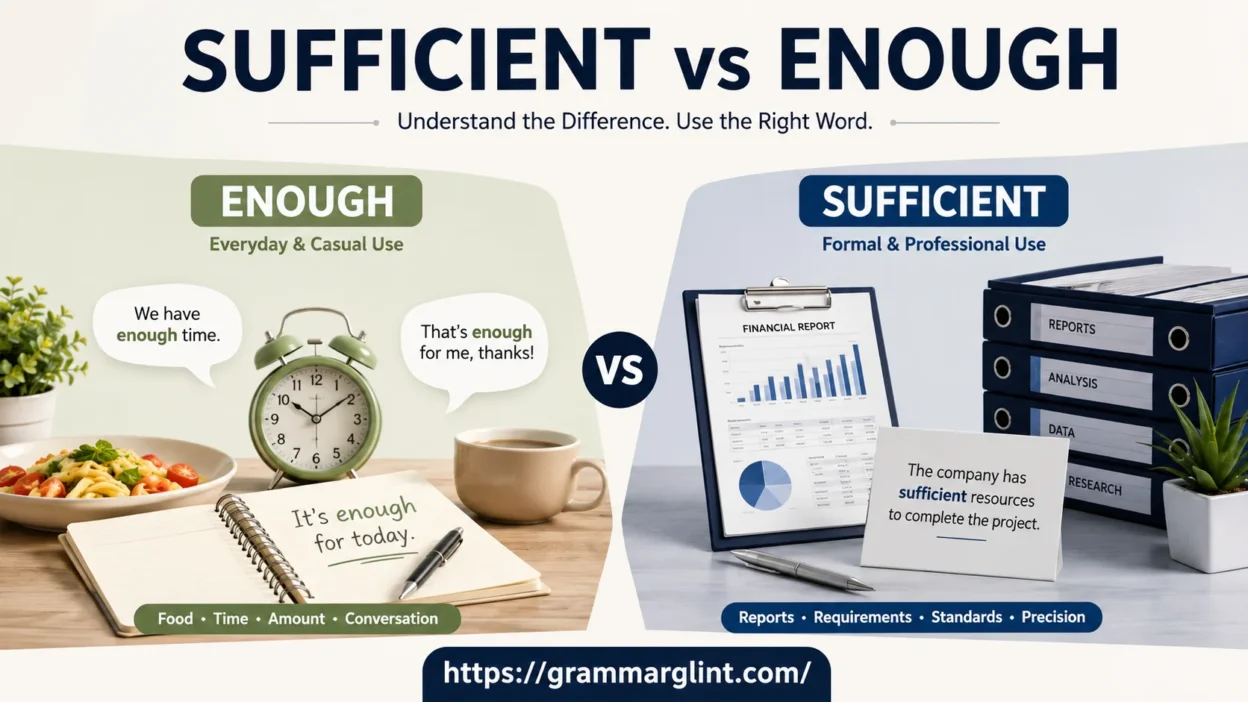
“Enough” lives in everyday conversation.
“Sufficient” lives in formal systems and structured communication.”
That simple distinction shapes everything.
Enough Meaning: Simple, Natural, and Everyday English
When you use enough, you talk like a real person having a normal conversation. It feels natural, flexible, and easy.
Enough Meaning Explained
Enough means:
- As much as needed
- Meeting a requirement in a practical sense
- Not too little, not necessarily perfect
It focuses on real-life usefulness, not strict standards.
How “Enough” Feels in Daily Communication
You’ll notice “enough” appears everywhere people talk casually:
- At home
- With friends
- In quick decisions
- In emotional speech
It feels human, It feels fast and It feels natural.
For example:
- “I’ve had enough sleep.”
- “Do you have enough money for coffee?”
- “This shirt is warm enough for winter.”
Nothing sounds stiff. Everything flows like normal speech.
Grammar Patterns of “Enough” (Important for Real Use)
“Enough” behaves differently depending on what follows it.
Enough + noun
- enough food
- enough water
- enough space
👉 “We don’t have enough food for everyone.”
Adjective + enough
- strong enough
- fast enough
- smart enough
👉 “She isn’t tall enough to reach the shelf.”
Enough + to + verb
- enough to eat
- enough to finish
- enough to survive
👉 “He saved enough to buy a car.”
Quick Real-Life Analogy
Think of “enough” like filling your phone battery.
If your phone reaches 100%, you stop worrying. You don’t ask if it reached “technical requirement standards.” You just know it works.
That’s exactly how “enough” behaves. Practical. Instant. Clear.
Sufficient Meaning: Formal, Structured, and Requirement-Based
Now let’s move to sufficient. This word changes the tone immediately.
Sufficient Meaning Explained
Sufficient means:
- Enough to meet a defined requirement or standard
- Meeting a formal or expected threshold
- Often tied to rules, systems, or evaluation criteria
It doesn’t just ask “Is it okay?”
It asks “Does it meet the required standard?”
Where You Commonly See “Sufficient”
You won’t hear “sufficient” much in casual conversations. Instead, you’ll see it in:
- Academic writing
- Legal documents
- Reports and evaluations
- Technical or scientific contexts
- Professional communication
For example:
- “There is sufficient evidence to support the claim.”
- “The system lacks sufficient power for operation.”
- “We do not have sufficient data for analysis.”
Tone of “Sufficient”: Why It Feels Different
“Sufficient” carries a controlled, precise tone. It feels:
- Formal
- Objective
- Measured
- Slightly distant
It avoids emotion and focuses on structure.
You wouldn’t usually say:
- “Do we have sufficient snacks?”
But you would say:
- “The report contains sufficient data.”
That difference matters more than people realize.
Grammar Patterns of “Sufficient”
Unlike “enough,” “sufficient” stays more stable.
Sufficient + noun
- sufficient evidence
- sufficient funds
- sufficient resources
👉 “The lab has sufficient equipment for testing.”
Read More: Help Do vs Help To Do vs Help Doing Something: Complete Guide
Passive or formal structures
- “It is sufficient to conclude…”
- “There is sufficient justification…”
This is why it often shows up in academic writing.
Real-Life Analogy for “Sufficient”
Think of “sufficient” like passing a certification exam.
You don’t just “feel okay” about it. You meet a defined score. A rule decides whether you pass or fail.
That’s sufficient: structured, rule-based adequacy.
The Real Difference Explained Clearly
Now let’s break the confusion once and for all.
Core Meaning Difference
Both words point toward “adequacy,” but the source of that adequacy changes.
- Enough = personal or practical adequacy
- Sufficient = standard-based or formal adequacy
Tone Difference
| Feature | Enough | Sufficient |
| Tone | Casual | Formal |
| Usage | Daily speech | Academic, legal, technical |
| Emotion level | High (natural speech) | Low (neutral tone) |
| Flexibility | Very flexible | Structured |
Meaning Difference in Real Context
Let’s compare the same idea:
- “We have enough time to finish.”
- “We have sufficient time to finish.”
Both correct. But they feel different.
- First sentence = conversation between friends
- Second sentence = project report or business document
Subtle Psychological Difference
Here’s something interesting.
- “Enough” often depends on your feeling
- “Sufficient” depends on external standards
That’s why professionals prefer “sufficient” in formal settings. It removes ambiguity.
Side-by-Side Comparison Table
| Situation | Enough | Sufficient |
| Talking to friends | “Do we have enough food?” | Rare |
| Writing essay | Possible but informal | Preferred |
| Legal document | Not ideal | Standard |
| Workplace email | Depends on tone | Often preferred |
| Casual planning | Perfect | Sounds stiff |
| Technical report | Weak choice | Strong choice |
When to Use it in Real Life
Let’s make this practical so you never hesitate again.
Use “Enough” When You Want Natural Speech
You should choose enough when:
- You speak casually
- You text someone
- You describe everyday needs
- You want a relaxed tone
Examples:
- “Is this jacket warm enough?”
- “We don’t have enough chairs.”
- “I’ve had enough work for today.”
Use “Sufficient” When You Need Precision
Use sufficient when:
- Writing reports or essays
- Communicating professionally
- Describing technical requirements
- Making formal statements
Examples:
- “There is sufficient funding for the project.”
- “The data is not sufficient for conclusion.”
- “We require sufficient justification.”
Workplace Example Case Study
Imagine two employees reporting to a manager:
Employee A (informal tone):
“We have enough staff for the event.”
Employee B (formal tone):
“We have sufficient staff for the event.”
Both correct. However:
- Employee A sounds conversational
- Employee B sounds professional and report-ready
In structured workplaces, Employee B’s version often wins.
Common Mistakes
Even advanced learners slip here.
Mistake: Using “Sufficient” in Casual Speech
❌ “Do we have sufficient water?”
✔ “Do we have enough water?”
Why it feels wrong:
- It adds unnecessary formality to a simple question
Mistake: Using “Enough” in Formal Writing
❌ “There is enough evidence to support this claim.”
✔ “There is sufficient evidence to support this claim.”
Why it weakens tone:
- “Enough” feels subjective
- “Sufficient” feels structured and academic
Mistake: Mixing Both in One Idea
❌ “We have sufficient enough resources.”
This creates redundancy. You only need one.
Memory Trick: Never Confuse Again
Here’s a simple mental shortcut:
- Enough = everyday life
- Sufficient = structured systems
Or even easier:
Enough = “Do I feel okay?”
Sufficient = “Does it meet the rule?”
Practice Section: Test Your Understanding
Choose the correct word:
- “We don’t have ___ time to finish the project.”
- “There is ___ evidence to support the claim.”
- “Is this chair strong ___?”
Answers
- enough
- sufficient
- enough
Why?
- Sentence 1 = casual decision → enough
- Sentence 2 = formal evaluation → sufficient
- Sentence 3 = physical everyday check → enough
Why Both Words Exist in English
English didn’t create these words randomly. It evolved to handle different communication needs.
Here’s the key idea:
- Humans speak casually most of the time → “enough”
- Institutions need precision and clarity → “sufficient”
So language separated them naturally.
This split helps avoid confusion in:
- Legal systems
- Academic research
- Engineering and technical fields
Without this distinction, communication would get messy fast.
My Personal Experience as an English Language Specialist
As an English language specialist, I’ve noticed that Sufficient vs Enough is one of those word pairs that learners understand in theory but often misuse in real communication. Many students assume the two words are completely interchangeable because they both refer to having the required amount. However, after reviewing countless essays, emails, and conversation exercises, I’ve found that the real challenge lies in choosing the word that matches the context and tone.
In my teaching and editing experience, I encourage learners to think about their audience before selecting either word. If they’re speaking with friends or writing everyday messages, enough almost always sounds more natural. When they’re preparing academic papers, business reports, or formal documents, sufficient usually creates a more professional impression. I’ve seen students improve the clarity and credibility of their writing simply by making this small vocabulary adjustment. That’s why I recommend practicing both words in real-life situations instead of memorizing definitions alone. Once you understand the difference in tone, choosing between sufficient and enough becomes almost automatic.
FAQs
1. What is the main difference between sufficient and enough?
The main difference is that sufficient sounds more formal and is often used in official or technical situations, while enough is more common in everyday language and conversations.
2. Are sufficient and enough interchangeable?
They can sometimes be interchangeable because both describe an adequate amount, but their usage depends on the context and the type of expression you want to use.
3. Is sufficient more formal than enough?
Yes, sufficient is generally considered more formal and is often used in professional, academic, and technical contexts.
4. Can enough be used in everyday conversations?
Yes, enough is commonly used in everyday conversations because it sounds natural and simple when discussing quantity.
5. What does sufficient mean?
Sufficient means having an amount that is needed or required to complete something or meet specific requirements.
6. What does enough mean?
Enough means having as much as is necessary or an adequate amount for a particular purpose.
7. Which word should I use in formal writing?
In formal writing, sufficient is often preferred because it gives a more professional and precise meaning.
8. Can sufficient and enough change the meaning of a sentence?
Yes, the words can slightly change the tone and expression of a sentence depending on the context and situation.
9. How can I remember the difference between sufficient and enough?
You can remember that sufficient is linked with formal or exact requirements, while enough is linked with common speech and normal communication.
10. Why is understanding this difference important?
Understanding this distinction improves grammar, vocabulary, and overall communication by helping you select the right word.
Conclusion
Understanding Sufficient vs Enough helps you choose words that fit both the situation and your audience. While both describe having the required amount, enough is the preferred choice for everyday conversations because it sounds natural and friendly. Sufficient, however, is more formal and works better in professional, academic, legal, and technical writing where precision matters. Recognizing this difference makes your English sound more accurate and appropriate.
The easiest way to remember the distinction is to think about the context. If you are speaking casually, enough is usually the best option. If you are writing a report, business document, or official message, sufficient is often the better fit. By practicing both words in different sentences, you will build stronger vocabulary, improve your grammar, and communicate with greater confidence.

Aria Jane is a senior language writer and grammar specialist at Grammar Glint. She focuses on English grammar, spelling variations, vocabulary, and writing clarity. Through detailed research and practical examples, Aria helps readers understand language rules and avoid common mistakes. Her articles are designed to make English learning accessible for students, professionals, and everyday writers seeking reliable language guidance.