The phrase “In the Park” vs “At the Park” explains how prepositions guide location and meaning in the English language and help people clearly communicate. These small words may appear simple, but they often create confusion because their use can change the whole idea of a sentence. Understanding such differences helps improve accuracy and makes everyday communication smoother.
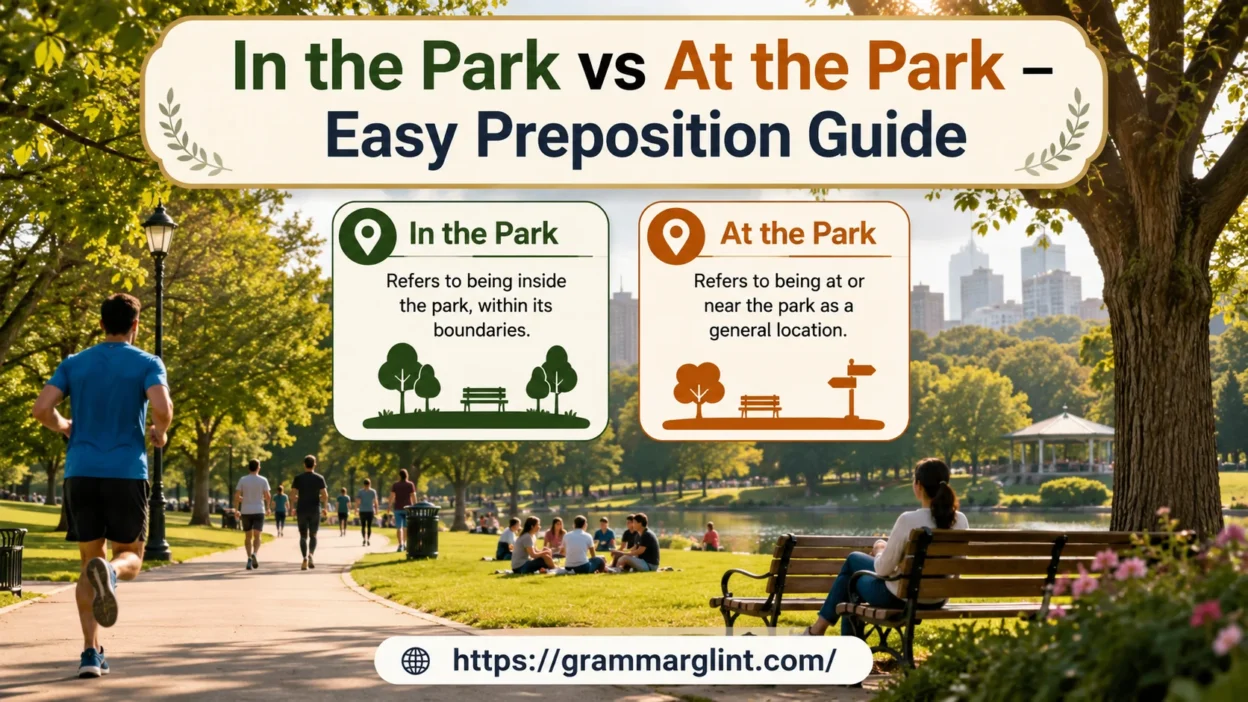
Both phrases are grammatically correct and commonly used phrases, but the choice between them depends on the context. In the Park focuses on being inside or within the boundaries of a place. It gives attention to the exact position and suggests that someone is surrounded by the space of the park. At the Park, however, shows a more general position and presence in the area without explaining the exact spot.
These dark horses of the English language have an essential influence because their powerful effect keeps changing how people describe locations. When a person says they are in the park, it suggests they are enclosed in the space, surrounded by trees, sitting on a bench, or walking through paths. The phrase highlights being within the actual environment of the park.
On the other hand, saying someone is at the park gives a wider idea, such as being near the entrance, nearby, or somewhere around the location without knowing exactly where they are. To understand these differences, remember to focus on how in connects with being inside and at connects with a general location. This simple distinction makes conversations clearer and helps avoid common mistakes.
The Core Idea
Before rules, you need one mental shift.
English prepositions don’t always follow strict logic. They follow how speakers visualize space and purpose.
Here’s the easiest way to think about it:
- In the park = inside the physical space
- At the park = general location or meeting point
That’s it.
But here’s where it gets interesting.
Native speakers don’t always think about geometry. They think about focus:
- Are you talking about what you’re doing inside?
- Or are you talking about where you are in general?
That mindset decides everything.
“In the Park” Meaning and Usage (Inside the Action Zone)
When you say “in the park,” you zoom into the space itself.
You’re imagining grass, benches, trees, walking paths, and everything happening inside that boundary.
Physical presence inside the park
Use “in the park” when someone or something is physically inside the area.
Examples:
- The kids are playing in the park.
- I saw a dog running in the park.
- She was sitting quietly in the park reading a book.
Notice something important: all of these describe activity happening inside.
Activities that happen inside the park
This is where “in the park” becomes very natural.
Common activities:
- Jogging
- Walking
- Picnics
- Reading
- Photography
- Cycling
Examples:
- We had a picnic in the park near the lake.
- People were jogging in the park early in the morning.
- I love taking photos in the park during sunset.
The focus stays on what happens inside the space, not just the location.
When “in the park” feels more detailed
Use “in the park” when you want to describe experience, not just presence.
Compare:
- I am at the park. (neutral location)
- I am in the park enjoying the flowers. (experience inside)
One is factual. The other paints a picture.
Read More: I Graduated vs I Have Graduated: Which Is Correct?
“At the Park” Meaning and Usage (Location + Purpose Focus)
Now let’s flip the lens.
When you say “at the park,” you zoom out.
You’re no longer focused on what’s happening inside. You’re talking about:
- A location
- A meeting point
- A general destination
General location reference
Use “at the park” when you just want to say where someone is.
Examples:
- I am at the park.
- She is at the park right now.
- We stayed at the park for an hour.
No detail. No action. Just place.
Meeting someone or giving directions
This is one of the most common real-life uses.
Examples:
- Let’s meet at the park at 5 PM.
- I’ll wait for you at the park entrance.
- He is waiting at the park bench near the gate.
Here, “at” behaves like a meeting marker.
Events and organized activities
When the park becomes an event space, “at” takes over.
Examples:
- There is a concert at the park tonight.
- A food festival is happening at the park this weekend.
- We went to a wedding at the park.
Now the park is not just a space. It’s a venue.
Simple Comparison Table
This table makes the difference crystal clear.
| Expression | Focus | Meaning | Example |
| In the park | Inside activity | Action happening within park space | Kids are playing in the park |
| At the park | Location/event | General place or meeting point | We are at the park |
If you only remember one thing, remember this:
“In” = inside experience. “At” = location focus.
The Decision Rule That Always Works
Here’s a simple mental checklist you can use in real time.
Ask yourself:
1 Step: Am I describing action or location?
- Action → use in
- Location → use at
2 Step: Am I focusing on inside details?
- Yes → in the park
- No → at the park
3 Step: Am I talking about meeting someone?
- Yes → always at the park
Quick flow shortcut
- Playing, walking, eating → in the park
- Meeting, arriving, saying location → at the park
Simple. Fast. Practical.
Common Mistakes Learners Make (And Why They Happen)
Let’s fix the real problems, not theory.
Mistake 1: Overusing “at” for everything
❌ I am at the park playing football
✔ I am playing football in the park
Why it happens:
Learners treat “at” like a universal location word.
Mistake 2: Overthinking movement vs location
❌ I am in the park now (when just arriving or checking location)
✔ I am at the park now
Why it happens:
People confuse “inside physical space” with “general presence.”
Mistake 3: Translating from native language
Some languages don’t distinguish “in” vs “at” clearly.
So learners produce sentences like:
- I am in the station (should be “at the station” in most cases)
- I am at the park jogging (should be “in the park”)
Read More: In the Website or On the Website? The Complete Usage Guide
Real-Life Conversations (How Native Speakers Actually Talk)
Let’s bring this into real speech.
Scenario 1: Meeting a friend
A: Where are you?
B: I’m at the park. Come over.
A: What are you doing?
B: I’m sitting in the park waiting for you.
Scenario 2: Morning routine
“I go to the park every morning. I run in the park for 30 minutes. Then I sit at the park bench and relax.”
Scenario 3: Casual chat
A: Where did you take the photo?
B: I took it in the park near the fountain.
What Native Speakers Actually Prefer
Here’s something most learners miss.
Native speakers often default to “at the park” in casual conversation.
Why?
Because it’s faster and simpler.
But when they start describing details, they switch to “in the park.”
So both are natural. The difference is depth of description.
Special Situations You Should Know
English doesn’t always stay consistent. Context wins.
Large famous parks
People often say:
- at Central Park
- at Hyde Park
Even though they are physically large spaces, they behave like named locations.
Small neighborhood parks
More detail-oriented speech:
- in the small park near my house
- in the playground park
Event-heavy usage
Once an event is involved:
- at the park becomes dominant
Example:
- at the park festival
- at the park concert
Mini Case Study: Why One Sentence Sounds Better Than the Other
Let’s compare:
Sentence A:
“I met my friends at the park and we had a picnic in the park.”
Sentence B:
“I met my friends in the park and we had a picnic in the park.”
Both are correct, but A sounds more natural because:
- “at the park” sets the meeting point
- “in the park” describes the activity
Native speakers mix both naturally to avoid repetition and improve flow.
Quick Cheat Sheet (Save This in Your Memory)
- in the park → inside + activity + experience
- at the park → location + meeting + event
- If unsure → choose at the park in casual speech
- If describing actions → use in the park
Practice Section – Test Yourself
Try filling in the blanks:
- The kids are playing ___ the park.
- I will meet you ___ the park at 6 PM.
- She is reading a book ___ the park bench.
- We had a concert ___ the park last night.
- I love walking ___ the park in the evening.
Answers:
- in
- at
- in
- at
- in
My Personal Experience as an English Language Specialist
From my experience as an English language specialist, I have found that prepositions are among the most challenging parts of English for learners. Many students understand grammar rules but still hesitate when choosing between “in the park” and “at the park.” Over the years, I have noticed that this confusion usually comes from translating directly from their native language rather than thinking about the context. Once learners begin focusing on whether they are describing an activity inside the park or simply identifying a location, their confidence improves quickly, and they start using these expressions naturally.
I have also seen that the fastest way to master English prepositions is through real-life examples instead of memorizing long grammar rules. During lessons and writing practice, I encourage learners to imagine the scene before selecting a preposition. This simple habit helps them understand the subtle differences that native speakers use every day. In my experience, practicing with everyday situations such as meeting friends, giving directions, or describing activities makes the distinction between “In the Park” and “At the Park” much easier to remember and apply in both speaking and writing.
FAQs
1. What is the difference between “In the Park” and “At the Park”?
In the Park means someone is inside the park area, while At the Park means someone is present at the park location in a more general way.
2. Is “In the Park” grammatically correct?
Yes, In the Park is grammatically correct and is used when talking about being within the boundaries of a park.
3. Is “At the Park” grammatically correct?
Yes, At the Park is also grammatically correct and refers to being at that place without focusing on the exact position.
4. When should we use “In the Park”?
Use In the Park when describing activities or situations happening inside the park, such as walking on paths, sitting on a bench, or enjoying the trees.
5. When should we use “At the Park”?
Use At the Park when the main idea is someone’s presence at the location, such as meeting someone there.
6. Can “In the Park” and “At the Park” be used interchangeably?
Sometimes they can be similar, but they have a different focus. In highlights the inside area, while At gives a general location.
7. Why do learners confuse “In” and “At”?
Learners often confuse them because both are prepositions connected with location, but their meanings depend on context.
8. Does “In the Park” describe a specific location?
Yes, In the Park usually gives a clearer idea that someone or something is within the park space.
9. Does “At the Park” tell the exact position?
No, At the Park does not explain the exact spot. A person could be at the entrance, nearby, or anywhere around the park.
10. How can someone remember the difference?
Remember that In focuses on being inside or within an area, while At focuses on being present at a general location.
Conclusion
The difference between “In the Park” vs “At the Park” is small, but it can make your English sound more natural and precise. While both expressions are grammatically correct, they serve different purposes. “In the park” tells the listener that someone is inside the park, enjoying or moving through the space, whereas “at the park” simply identifies the park as a general location without focusing on the exact position. Knowing when to use each phrase helps you communicate your ideas more clearly in everyday conversations and writing.
As with many English prepositions, the best way to remember the difference is to pay attention to context. Reading, listening, and practicing with real-life examples will help you develop a natural feel for these expressions. Once you understand how “In the Park” vs “At the Park” changes the meaning of a sentence, you’ll make fewer mistakes and speak with greater confidence and accuracy.

Aria Jane is a senior language writer and grammar specialist at Grammar Glint. She focuses on English grammar, spelling variations, vocabulary, and writing clarity. Through detailed research and practical examples, Aria helps readers understand language rules and avoid common mistakes. Her articles are designed to make English learning accessible for students, professionals, and everyday writers seeking reliable language guidance.