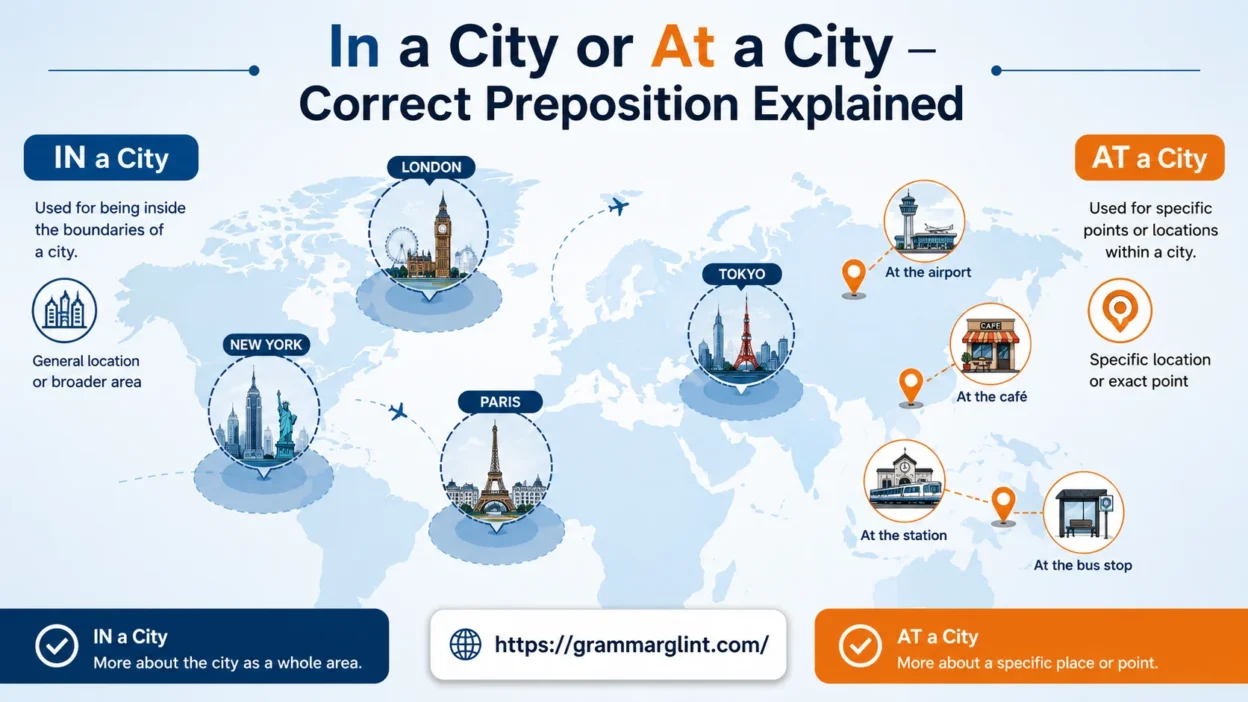
English prepositions are tiny words with big jobs because they link nouns, pronouns, and phrases in a sentence. When discussing In a City or At a City, learners often face common confusion while talking about cities and locations. The right preposition feels tricky, but understanding the correct use improves clear communication and everyday English skills.
From my grammar learning experience, in a city shows a general location and broader location context, while at may create confusion when a point location is implied. Learning simple rules, usage rules, and grammar rules helps avoid awkward sentences and improves sentence structure with better expression usage.
The best way to master this distinction is by using clear examples, usage examples, and practical examples from a language guide. Language learning and grammar awareness create stronger language understanding, better communication clarity, and confidence in writing English and speaking English. British English, American English, and Indian English may show different usage patterns, but contextual meaning and sentence meaning help learners choose the correct preposition.
The Core Grammar Rule Explained Simply
Let’s make this simple right away:
You almost always use “in” with cities, not “at.”
Why?
Because a city is treated like a large enclosed area, not a single point.
Think of it like this:
- A city = a container
- You are inside that container
So you say:
- I live in New York
- She works in Tokyo
- They stayed in Paris
Now compare that with “at”:
- “At” means a specific point or exact location, not a large area
That’s why “at a city” sounds wrong most of the time.
Why “In” Works for Cities (The Mental Model You Need)
To really master this, you need to stop memorizing and start visualizing.
Imagine a city like a giant map boundary. You’re not standing “on” the city like a dot. You are inside it.
So English uses “in” to show inclusion inside boundaries.
Simple visualization
- 🏙️ City = big area
- 📍 “In the city” = inside that area
- 🎯 “At” = a precise point inside or near it
That’s the key difference.
Examples that make it clear
- I grew up in Karachi
- She studied in London
- We spent the weekend in Istanbul
You can feel how natural “in” sounds in every case.
Now try replacing it with “at”:
- ❌ I grew up at Karachi
- ❌ She studied at London
It instantly feels off.
When “At” Is Actually Correct (And Why It’s Rare With Cities)
Here’s where things get interesting.
Even though “at a city” is usually wrong, “at” is not useless. It just works differently.
You use “at” when you’re talking about a specific point inside a city, not the city itself.
Read More: Sufficient vs Enough: The Real Difference with Examples
Correct uses of “at” in city contexts
- At a landmark:
- I met her at the Eiffel Tower in Paris
- At a venue:
- We are at a concert in Los Angeles
- At a transport hub:
- He is at the airport in Dubai
- At a specific building:
- She works at a hospital in Chicago
Key idea
“At” zooms in. “In” zooms out.
If you zoom out, you talk about the whole city → use in
If you zoom in, you talk about a precise point → use at
Clear Comparison Table
Let’s simplify everything into one powerful table.
| Situation | Correct Preposition | Example |
| General city location | in | I live in Lahore |
| Living or staying | in | She stayed in Dubai |
| Traveling within city | in | We traveled in New York |
| Specific place (venue) | at | at a hotel in Dubai |
| Transport location | at | at the airport in Istanbul |
| Event in city | at | at a festival in Karachi |
This table alone solves 90% of confusion.
Common Mistakes People Make
Let’s talk about real mistakes people repeat again and again.
1 Mistake: Using “at” for cities
- ❌ I live at Paris
- ❌ She works at Tokyo
2 Mistake: Mixing “in” and “at” randomly
- ❌ We stayed at New York for a week
3 Mistake: Translating directly from native language
Many languages don’t distinguish between “in” and “at” the same way English does. So learners often copy structure directly.
Why these mistakes happen
- Native language interference
- Overthinking grammar rules
- Trying to simplify English too much
Special Cases That Confuse Even Advanced Learners
Now let’s go deeper. This is where most guides stop—but you’ll actually understand how native speakers think.
Arrival vs Location Difference
This is a big one.
- Arrival uses “in”
- Point location uses “at”
Examples:
- I arrived in Paris yesterday
- I am at the airport in Paris
Why?
Because arrival refers to entering a city as a whole. But the airport is a specific point.
City vs Landmark Logic
English treats cities differently from landmarks.
| Type | Preposition | Example |
| City | in | in Rome |
| Landmark | at | at the Colosseum |
| Neighborhood | in | in Manhattan |
So you don’t just think “location.” You think level of detail.
Big Cities vs Small Places
Sometimes learners assume smaller places change the rule. They don’t.
- Still use in for cities
- Still use at for points
Examples:
- in Dubai
- in Tokyo
- at Burj Khalifa
- at Shinjuku Station
Transportation Contexts
Transport adds another layer.
- at the airport in Istanbul
- at the bus stop in Karachi
- in the city during travel
You can see both prepositions working together, each serving a different role.
Mental Shortcut: How to Choose “In a City or At a City” Instantly
You don’t need to overthink this. Use this simple mental trick.
Ask yourself:
Question 1: Am I talking about the whole city?
- Yes → use in
Question 2: Am I pointing to a specific place?
- Yes → use at
Memory Trick
- IN = Inside the city
- AT = A target point
Think of it like a map:
- “in” = shading the whole area
- “at” = dropping a pin
Real-Life Examples: Correct vs Incorrect Usage
Let’s make this practical.
Correct Examples
- I live in New York
- She works in London
- We met at a café in Paris
- He is at the airport in Dubai
- They stayed in Istanbul for a week
Incorrect Examples
- I live at New York ❌
- She works at London ❌
- We stayed at Paris for a week ❌
Mini Case Study: Why One Sentence Sounds Natural and the Other Doesn’t
Let’s break down a real communication scenario.
Scenario:
You’re telling a friend about your trip.
Natural English:
“I spent three days in Rome, and I met a friend at a café in the city.”
Unnatural English:
“I spent three days at Rome, and I met a friend in a café at the city.”
What changed?
Even though the meaning is similar, the second version feels off because:
- “at Rome” wrongly treats a city as a point
- “at the city” breaks spatial logic
Native speakers don’t consciously think about rules. They feel them.
How Native Speakers Actually Think About This Rule
Native speakers don’t memorize grammar charts.
They think in mental images:
- Cities = spaces you live inside
- Buildings = points you go to
- Events = moments happening at a place
That’s it.
So when they say:
- “I’m in London” → they see themselves inside the city
- “I’m at Heathrow Airport” → they see a specific location
Practice Section: Test Yourself
Fill in the blanks:
- I live ___ London
- We met ___ the airport
- She studied ___ Tokyo
- They are ___ a concert in Paris
- He works ___ New York
Answers:
- in
- at
- in
- at
- in
My Personal Experience as an English Language Specialist
Over the years, working as an English language specialist has shown me that prepositions are one of the most challenging parts of English for learners. I’ve noticed that many students confidently understand grammar rules but still hesitate when choosing between in, at, and on because these small words often don’t translate directly from their native language. The confusion between in a city and at a city is one of the questions I hear most often, especially from learners who rely on literal translations instead of understanding how English expresses location.
In my teaching and editing experience, the biggest breakthrough happens when learners stop memorizing rules and start visualizing them. I encourage students to picture a city as a large area that you can be inside, which naturally leads to using in. Once they understand that at points to a specific place within that city, such as an airport, hotel, or train station, the distinction becomes much easier to remember. I’ve seen this simple mental approach improve both writing accuracy and speaking confidence, making learners feel more natural and fluent in everyday English.
Read More: In the Website or On the Website? The Complete Usage Guide
FAQs
1. What is the difference between “In a City” and “At a City”?
In a City is used for being inside or within a city area, while At a City is rarely used and usually appears in special contexts.
2. Why do learners get confused between “In a City” and “At a City”?
Learners often get confused because both are related to locations, but each preposition gives a different meaning in a sentence.
3. When should I use “In a City”?
Use In a City when describing a person, object, or activity that exists within the boundaries of a city.
4. Is “At a City” grammatically correct?
Yes, At a City can appear in some contexts, but it is uncommon when talking about being inside a city.
5. Which preposition is more common for cities?
The preposition in is more common when referring to cities because it shows a general location.
6. Can “At” describe a city location?
Sometimes at can describe a specific point or stop connected with a city, but it does not usually mean living inside the city.
7. Does English dialect affect the use of “In” and “At”?
Yes, some English dialects may use these phrases differently, but standard British English and American English generally prefer In a City.
8. How can I improve my understanding of city prepositions?
Studying examples, practicing sentence structure, and learning grammar rules can improve correct usage.
9. Is “I live at New York City” correct?
No, the natural sentence is “I live in New York City” because it shows the place where someone lives.
10. Why are prepositions important in English?
Prepositions connect words and help express clear meaning, making communication easier and more accurate.
Conclusion
Choosing between in a city and at a city becomes simple once you understand what each preposition expresses. In most situations, in a city is the correct choice because it describes someone or something located within the city. At is generally used for specific places, addresses, landmarks, or points on a journey rather than the city itself. Paying attention to context will help you make the right choice every time.
As you continue learning English, practice using these prepositions in everyday conversations and writing. Reading authentic English content and creating your own example sentences will reinforce the rule naturally. With regular practice, you’ll develop a stronger understanding of English prepositions and communicate with greater accuracy and confidence.

Aria Jane is a senior language writer and grammar specialist at Grammar Glint. She focuses on English grammar, spelling variations, vocabulary, and writing clarity. Through detailed research and practical examples, Aria helps readers understand language rules and avoid common mistakes. Her articles are designed to make English learning accessible for students, professionals, and everyday writers seeking reliable language guidance.