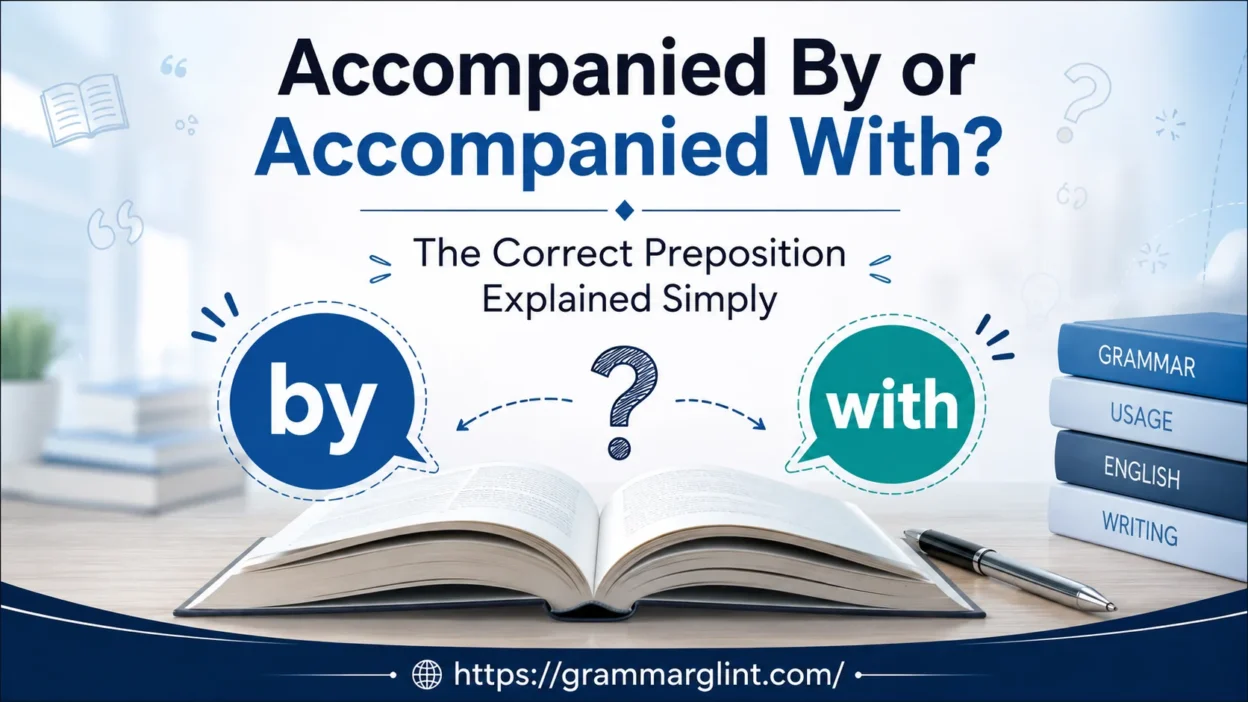
In English, small words like prepositions can sometimes create confusion because they affect the meaning and sentence structure. The choice between Accompanied By or Accompanied With? depends on the context, meaning, and the way a sentence is formed. Although both expressions are grammatically correct, they have different roles and are used in different situations.
The phrase accompanied by is more common in everyday language and formal writing. It is generally used to describe a person escorting another person or an object that comes with something else. This phrase works as a natural expression and makes the usage easier to understand through practical examples.
The phrase accompanied with is also used, but its usage depends on the situation and the intended message. It can explain a connection where two inanimate objects come together or supplement each other. The focus is usually on the combination or connection between different objects rather than a person guiding another.
Understanding these differences helps learners recognize how small word choices influence communication. The correct expression creates a smoother sentence, improves accuracy, and strengthens understanding of English structure.
Why It Confuses So Many People
This confusion doesn’t happen randomly. It comes from how we naturally speak.
In everyday conversation, people often mix “with” into almost everything that involves togetherness.
For example:
- I came with my friend
- She sat with her family
- He traveled with his team
So when people see the verb accompany, their brain tries to force the same pattern:
“accompany + with”
It feels right. It sounds natural. But English grammar doesn’t follow that instinct here.
Another reason for the confusion is translation. Many languages use one word equivalent for “with” across all these situations. English splits the meaning into different structures depending on the verb.
So your brain isn’t wrong. English just plays by stricter rules here.
The Correct Answer
Let’s be clear and direct.
The correct and standard phrase is: accompanied by
This applies in:
- Formal writing
- Academic essays
- News reports
- Professional communication
- Exams like IELTS, TOEFL, and school tests
What it looks like in real use:
- She was accompanied by her teacher
- The report is accompanied by detailed charts
- The actor arrived accompanied by security guards
- The dish is accompanied by fresh salad
This structure stays consistent across contexts.
What “Accompanied By” Actually Means in Simple Terms
The verb accompany means:
To go somewhere with someone or something, or to exist together with something.
But in formal grammar, it doesn’t stop there. It builds a specific structure:
Standard grammar pattern:
be + accompanied + by + noun
This structure shows a clear relationship:
- One thing exists alongside another
- One person is present with another
- One item comes together with something else
Think of it like a formal pairing system. English uses “by” to connect the main subject with what is attached to it.
Read More: Hi vs Hey: Difference Explained (When To Use Which)
Easy analogy:
Imagine “accompanied by” like a VIP entrance list.
You don’t just show up “with” someone casually. You are officially linked to them in that moment.
That’s why “by” works better. It feels structured, official, and complete.
Why “Accompanied With” Sounds Wrong in Standard English
Now let’s tackle the controversial one: “accompanied with.”
You may still hear it in speech or casual writing. But in standard grammar, it is generally avoided.
Why?
Because the verb accompany already includes the idea of “with.”
So when you say:
- ❌ accompanied with
It becomes redundant, like saying:
“go together with with”
English dislikes that kind of duplication.
What grammar experts say
Most modern grammar references agree:
- “Accompanied by” = correct standard usage
- “Accompanied with” = outdated or nonstandard in formal writing
It may appear in older texts or regional speech, but it does not belong in polished English.
Common Incorrect Examples Using “Accompanied With”
Let’s look at what NOT to do:
- ❌ He was accompanied with his father
- ❌ The soup is accompanied with bread
- ❌ The presentation came accompanied with visuals
These sentences feel okay in casual speech, but they don’t pass formal grammar standards.
Now compare with the correct version:
- ✔ He was accompanied by his father
- ✔ The soup is accompanied by bread
- ✔ The presentation was accompanied by visuals
The correction is small, but the tone upgrade is huge.
When “With” Is Actually Correct (And Why People Get Tricked)
Here’s where most learners get confused.
“With” is absolutely correct in English—but not with the verb “accompany.”
Correct uses of “with”:
- She came with her friend
- He sat with his family
- I traveled with colleagues
These are simple verb + with structures.
But notice the difference:
| Sentence Type | Example | Structure |
| Correct informal | She came with her friend | come + with |
| Correct formal | She was accompanied by her friend | be + accompanied + by |
| Incorrect mix | She was accompanied with her friend | ❌ wrong structure |
So the confusion happens because both express similar ideas—but use different grammar systems.
Grammar Breakdown: How “Accompanied By” Works
Let’s simplify the structure so you never forget it again.
Formula:
Subject + be verb + accompanied + by + noun
Examples:
- The manager was accompanied by his assistant
- The child is accompanied by her parents
- The documents were accompanied by a cover letter
Why “by” works grammatically:
“By” often shows:
- Agent (who performs an action)
- Association (who is connected)
- Support (what comes along with something)
So “by” naturally fits the role of linking two connected elements.
Quick Comparison Table
| Phrase | Correct? | Usage Level | Meaning | Example |
| accompanied by | ✔ Yes | Formal, standard | Together in a structured way | She was accompanied by her brother |
| accompanied with | ❌ Usually wrong | Nonstandard | Redundant or awkward | ✘ She was accompanied with her brother |
| came with | ✔ Yes | Informal | Together casually | She came with her brother |
This table alone clears up 90% of confusion.
Real-Life Usage: Where You’ll See “Accompanied By”
This phrase shows up more than you think. Let’s look at real contexts.
Medical reports
- The patient was accompanied by a nurse
- Symptoms were accompanied by fever and fatigue
Business communication
- The proposal was accompanied by financial data
- The report was accompanied by charts and analysis
Travel and events
- The diplomat was accompanied by security staff
- The guest arrived accompanied by an interpreter
Academic writing
- The theory is accompanied by experimental data
- The study was accompanied by statistical evidence
You’ll notice one pattern: formal, structured situations prefer “by.”
Common Mistakes Learners Make
Let’s make this practical.
Mistake 1: Overusing “with”
Learners rely on “with” because it feels universal.
Fix: Ask yourself—am I writing formally? If yes, switch to “by.”
Mistake 2: Translating directly from native language
Many languages don’t separate “by” and “with” the same way.
Fix: Learn the verb pattern, not word-for-word translation.
Mistake 3: Mixing informal and formal structures
Example:
- ❌ She was accompanied with her team during the event
Fix:
- ✔ She was accompanied by her team during the event
Memory Trick: Never Forget the Rule Again
Here’s a simple trick that actually works:
Think of “accompanied by” as a formal escort system
- “By” = official connection
- “With” = casual company
So:
- Dinner → “with”
- Report → “by”
- Friend trip → “with”
- Ceremony or document → “by”
Once you separate formal vs informal contexts, the confusion fades.
Mini Practice Section
Try choosing the correct option:
- She was accompanied ___ her colleague
- The meal comes ___ rice and salad
- The guest was accompanied ___ security staff
- I went ___ my friend to the market
- The report is accompanied ___ detailed charts
Answer key:
- by
- with
- by
- with
- by
Case Study: How One Small Preposition Changes Tone
Let’s compare two versions of a professional sentence.
Version A (incorrect):
The CEO was accompanied with senior staff during the meeting.
Version B (correct):
The CEO was accompanied by senior staff during the meeting.
Now notice the difference.
Version A feels slightly off. It sounds like spoken English that slipped into writing.
Version B feels clean, professional, and credible.
In business writing, that small change affects how readers judge your attention to detail.
My Personal Experience as an English Language Specialist
As an English language specialist, I have reviewed thousands of grammar questions from students, writers, bloggers, and professionals. One of the most common mistakes I notice is the confusion between accompanied by and accompanied with. Many learners assume that because with is used after verbs like come, go, and travel, it should also follow accompany. That assumption sounds logical, but it doesn’t match standard English usage.
Over the years, I have found that teaching grammar through real-life examples rather than memorizing rules helps learners understand these differences much faster. In my editing work, replacing accompanied with with accompanied by is one of the simplest changes that instantly makes writing sound more natural and professional. My advice is to learn the verb pattern instead of translating directly from another language. Once you become familiar with the structure be accompanied by, choosing the correct preposition becomes automatic in both speaking and writing.
FAQs
1. What is the difference between accompanied by and accompanied with?
Accompanied by is more common and usually refers to a person or thing being together with another. Accompanied with is less common and often relates to things that exist together.
2. Is accompanied by grammatically correct?
Yes, accompanied by is grammatically correct and widely used in English sentences.
3. Is accompanied with wrong in English?
No, accompanied with is not wrong, but it is less common and may sound unusual in some contexts.
4. When should accompanied by be used?
Use accompanied by when describing a person escorting another person or an object coming with something else.
5. Can accompanied with be used for objects?
Yes, accompanied with can describe a connection where objects appear together or support each other.
6. Which phrase is more common in everyday English?
Accompanied by is more common in everyday communication, writing, and formal situations.
7. Does context change the meaning of accompanied by and accompanied with?
Yes, the context and sentence structure influence which expression fits naturally.
8. Why does accompanied with sometimes sound awkward?
It may sound awkward because native English usage often prefers accompanied by in many situations.
9. How does grammar help in choosing the right phrase?
Understanding grammar, prepositions, and sentence patterns helps select the correct expression.
10. Are both expressions useful for learning English?
Yes, learning both expressions improves understanding of English usage and helps create clearer sentences.
Conclusion
Understanding the difference between Accompanied By or Accompanied With helps you write more naturally and accurately. Although both phrases appear in English, accompanied by is the standard and preferred choice in most situations. It is commonly used when someone is escorted by another person or when one thing comes together with another. In contrast, accompanied with has limited use and is mostly found in specific contexts, such as describing symptoms, conditions, or characteristics that occur together.
When you are unsure which expression to use, choose accompanied by because it is widely accepted in everyday conversation, academic writing, and professional communication. Learning this small grammar difference improves sentence clarity, strengthens your writing skills, and helps you communicate with greater confidence in both spoken and written English.

Aria Jane is a senior language writer and grammar specialist at Grammar Glint. She focuses on English grammar, spelling variations, vocabulary, and writing clarity. Through detailed research and practical examples, Aria helps readers understand language rules and avoid common mistakes. Her articles are designed to make English learning accessible for students, professionals, and everyday writers seeking reliable language guidance.