Any Time vs Anytime is a common English grammar question that many learners ask when they begin learning English and want clearer writing.
If you are learning English as a new language, you may become confused by the common confusion between Any Time and Anytime. The important question is which form to choose and when to use it correctly. While reviewing written English, I have noticed that this small decision often improves proper writing and clearer communication.
A good habit is to pause, think, and examine the context of a sentence before you decide. If Anytime can be replaced with its definition, at any time, then the answer is yes, and the correct choice is the one word form. Otherwise, leave a space and write Any Time as two words. This distinction improves understanding, prevents misunderstanding, and helps people, learners, English learners, writers, and experienced writers produce better writing.
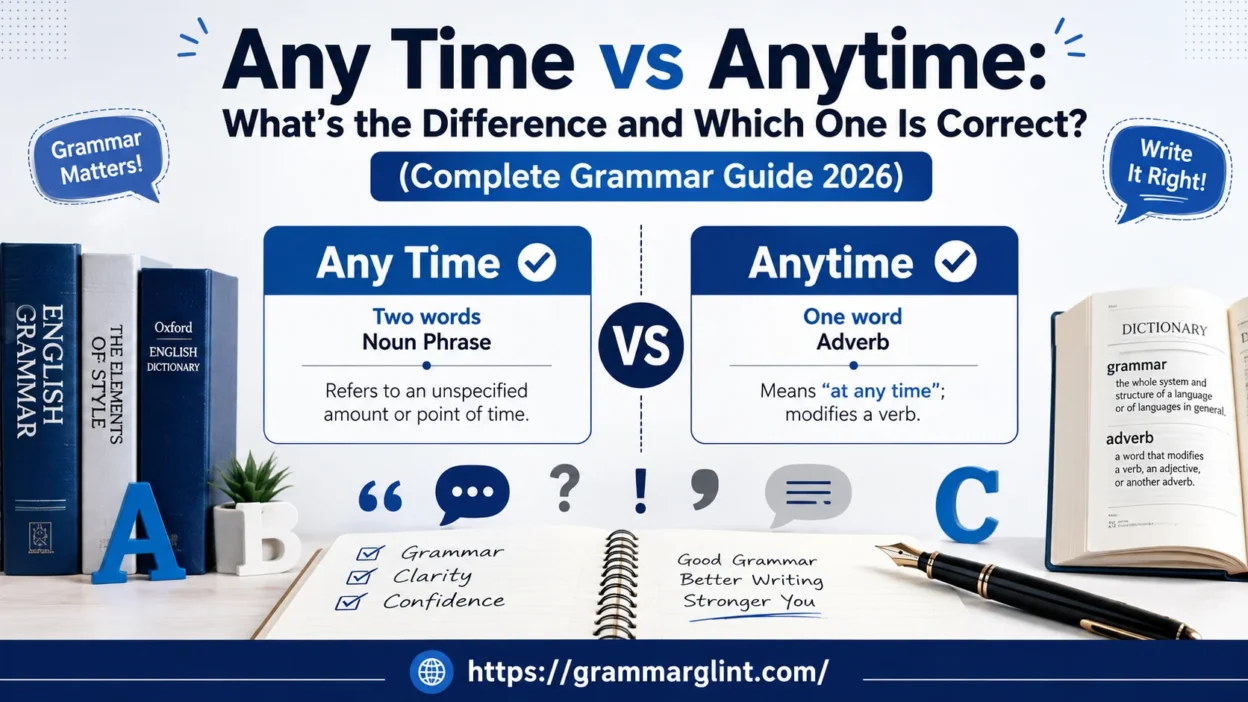
In English grammar, Any Time is a noun phrase in which the adjective any modifies the noun time, while Anytime is an adverb that modifies a verb or verb phrase. Understanding this meaning leads to correct usage, correct form, proper form, stronger English usage, better grammar, grammar rules, usage, usage rules, improved word choice, accurate spelling, and richer vocabulary. Whether you are writing to a person or preparing professional content, paying attention to the phrase, given sentence, and overall language will help you make the right choice every time. Using the incorrect form is a common mistake that can make your work look grammatically incorrect, even when the message is clarified.
Quick Answer
If you only remember one rule, remember this:
- Use any time when referring to an amount or period of time.
- Use anytime when you mean whenever.
Here’s a simple comparison.
| Expression | Part of Speech | Meaning | Example |
| Any time | Noun phrase | Any amount or period of time | I don’t have any time this afternoon. |
| Anytime | Adverb | Whenever | You can visit anytime. |
A quick substitution test also helps.
If you can replace the phrase with whenever, use anytime.
Example:
- Visit anytime.
- Visit whenever.
Both sound natural.
If you cannot replace it with whenever, use any time.
Example:
- I don’t have any time today.
- I don’t have whenever today.
The second sentence makes no sense, so any time is the correct choice.
Any Time vs Anytime at a Glance
The following table summarizes the most important differences between these commonly confused expressions.
| Feature | Any Time | Anytime |
| Word Type | Two words | One word |
| Grammar Role | Noun phrase | Adverb |
| Meaning | Any amount or period of time | Whenever |
| Formal Writing | Preferred in many formal situations | Widely accepted but slightly less formal in some style guides |
| Can Follow Prepositions | Yes | Usually no |
| Can Replace “Whenever” | No | Yes |
| Common Example | I don’t have any time today. | Stop by anytime. |
Although both forms appear frequently in everyday English, their grammatical functions differ. Understanding those functions makes choosing the correct form much easier.
What Does Any Time Mean?
The phrase any time consists of two separate words.
Here, time functions as a noun, while any acts as a determiner modifying that noun. Together, they refer to an unspecified amount of time or an unspecified point in time.
Think of it this way.
If someone asks whether you’re free this week, you might answer:
“I don’t have any time until Friday.”
In this sentence, you’re talking about available time as a thing. That makes time the noun.
Another example is:
“Do you have any time to discuss the project?”
Again, the sentence refers to available time, not to the meaning of whenever.
Definition
Any time means:
- Any amount of time
- Any period of time
- Any unspecified point in time
Grammar Function
Because time remains a noun, the phrase behaves like other noun phrases.
For example:
- some time
- enough time
- little time
- more time
- any time
Each phrase revolves around the noun time.
Common Contexts
You’ll often see any time used when discussing schedules, availability, deadlines, meetings, appointments, work, travel, and personal plans.
Common examples include:
- Do you have any time tomorrow?
- We didn’t have any time to prepare.
- She rarely has any time for herself.
- Is there any time left before the meeting?
Notice that every example refers to time as something measurable.
Example Sentences
Here are several correct examples.
- We barely had any time to finish the assignment.
- She doesn’t have any time during the morning.
- Is there any time available next week?
- They spent almost any time they could outdoors during summer.
- You’ll need any time you can spare for this project.
In every sentence above, time functions as a noun.
What Does Anytime Mean?
Unlike any time, anytime is written as a single word.
In modern English, anytime usually functions as an adverb. It carries the meaning of whenever, at any moment, or regardless of the exact time.
Rather than referring to time as a noun, it describes when an action may happen.
For example:
“You can call me anytime.”
This simply means:
“You can call me whenever you want.”
The sentence doesn’t discuss an amount of time. Instead, it explains when calling is acceptable.
Definition
Anytime means:
- Whenever
- At any moment
- Whenever it is convenient
Grammar Function
Because anytime functions as an adverb, it modifies verbs rather than nouns.
Examples include:
- Visit anytime.
- Come anytime.
- Call anytime.
- Return anytime.
Notice how anytime answers the question:
“When?”
Common Contexts
You’ll commonly encounter anytime in casual conversations, customer service, invitations, emails, advertisements, websites, and social media.
Businesses frequently write phrases such as:
- Open anytime.
- Contact us anytime.
- Available anytime.
- Call anytime.
- Chat anytime.
Each example tells readers that the action may happen whenever they choose.
Example Sentences
These examples show proper usage.
- You’re welcome to visit anytime.
- Feel free to text me anytime.
- We can schedule another meeting anytime next month.
- Stop by anytime you’re nearby.
- Customers may contact support anytime.
Every sentence uses anytime as an adverb describing when an action happens.
Any Time vs Anytime: The Main Differences
Although the spelling differs by only one space, the grammar changes significantly.
Understanding these distinctions helps eliminate nearly every mistake.
Meaning
The biggest difference lies in what each expression actually means.
Any time refers to a quantity or amount of time.
Example:
“I don’t have any time.”
Anytime means whenever.
Example:
“Visit anytime.”
One discusses available time.
The other discusses the timing of an action.
Part of Speech
Grammar plays an equally important role.
| Expression | Part of Speech |
| Any time | Noun phrase |
| Anytime | Adverb |
Knowing this difference often solves confusion immediately.
If your sentence needs a noun, choose any time.
If your sentence needs an adverb describing when, choose anytime.
Sentence Position
Another noticeable difference involves placement.
Anytime often appears at the beginning or end of a clause.
Examples:
- Anytime is fine with me.
- Call me anytime.
- Anytime you need help, let me know.
Meanwhile, any time usually appears where a noun phrase naturally belongs.
Examples:
- We don’t have any time left.
- She found some extra time.
- Is there any time available?
Formal vs Informal Usage
Modern dictionaries recognize anytime as a standard English word.
However, some professional editors still prefer any time in very formal writing whenever the sentence allows either version.
For example:
- You may contact us at any time.
Although You may contact us anytime is widely accepted in American English, legal documents, academic papers, and formal reports often favor the two-word form after prepositions.
Understanding your audience helps you make the best stylistic choice.
Can They Replace Each Other?
Sometimes they can.
Sometimes they cannot.
Consider these examples.
Correct:
- Visit anytime.
- Visit at any time.
Both communicate the same idea.
Now compare these.
Correct:
- I don’t have any time today.
Incorrect:
- I don’t have anytime today.
The second sentence fails because time must remain a noun.
A simple way to decide is to ask yourself one question.
Am I talking about available time, or am I talking about whenever something happens?
That single question will guide you toward the correct choice almost every time.
Grammar Rules
Grammar often looks intimidating until you break it into simple rules. Fortunately, the distinction between any time and anytime follows a predictable pattern. Once you understand how each expression functions in a sentence, you’ll rarely make this mistake again.
Why Any Time Is a Noun Phrase
The phrase any time contains two words.
- Any is a determiner.
- Time is the noun.
Together, they create a noun phrase that refers to an unspecified amount or period of time.
Think of these similar expressions:
- some time
- enough time
- little time
- more time
- much time
Notice the pattern. Every phrase revolves around the noun time.
For that reason, any time can serve as the subject, object, or complement of a sentence.
Examples:
- We don’t have any time before lunch.
- Is there any time available this week?
- She spent any time she could with her family.
- Finding any time to relax feels impossible during finals.
In each example, time refers to something measurable rather than describing when an action occurs.
Why Anytime Functions as an Adverb
Unlike the two-word phrase, anytime is a single-word adverb.
Its primary job is to answer one question:
When?
Examples:
- Come anytime.
- Call me anytime.
- Visit anytime you’re in town.
- You can leave anytime after the presentation.
Notice that anytime modifies the verb rather than naming a thing.
A useful replacement test makes this even easier.
Replace anytime with whenever.
Example:
- Stop by anytime.
- Stop by whenever.
Both sentences mean essentially the same thing.
Now try the same replacement here:
- I don’t have anytime today.
- I don’t have whenever today.
The sentence immediately falls apart. That tells you any time is required instead.
Using Any Time After Prepositions
One of the easiest grammar rules involves prepositions.
When time follows a preposition such as at, for, in, during, before, or after, the two-word form is almost always correct.
Examples:
- Come at any time.
- You may arrive at any time today.
- We can meet at any time after lunch.
- She didn’t call at any time yesterday.
- You may leave at any time.
Here, time remains the object of the preposition.
That’s why the two-word spelling is preferred.
Compare these examples.
| Correct | Incorrect |
| At any time | At anytime |
| For any time | For anytime |
| During any time | During anytime |
| Before any time | Before anytime |
Many grammar experts recommend remembering this single rule first because it solves a large percentage of common mistakes.
Can Anytime Begin a Sentence?
Yes.
Because anytime functions as an adverb, it can appear at the beginning of a sentence when introducing a clause.
Examples:
- Anytime you need advice, call me.
- Anytime you’re ready, we’ll begin.
- Anytime works for our team.
- Anytime after six is perfect.
In these sentences, anytime introduces the time at which an action may occur.
This usage sounds natural in both conversation and modern writing.
Read More: In a City or At a City: Correct Preposition Usage in English
Common Grammar Patterns
Learning patterns helps more than memorizing isolated rules.
Here are some of the most common structures you’ll encounter.
1. Pattern: Verb + Anytime
- Visit anytime.
- Call anytime.
- Text anytime.
- Return anytime.
- Stop by anytime.
2. Pattern: At + Any Time
- At any time today.
- At any time next week.
- At any time during business hours.
3. Pattern: Have + Any Time
- Have any time?
- Don’t have any time.
- Didn’t have any time.
- Won’t have any time.
Pattern 4: Need + Any Time
- Need any time?
- Need any time off?
- Need any time to prepare?
Recognizing these patterns makes correct usage feel almost automatic.
Which One Is Correct: Any Time or Anytime?
The answer depends entirely on your sentence.
Neither expression is universally correct.
Instead, grammar determines which one belongs.
Let’s examine the most common situations.
Situations Where Only Any Time Is Correct
Whenever time functions as a noun, write it as two words.
Examples:
- I don’t have any time today.
- She couldn’t find any time to study.
- Do you have any time this afternoon?
- We hardly had any time before boarding.
- There wasn’t any time left.
Try replacing time with another noun.
For example:
- I don’t have any money.
- I don’t have any patience.
The sentence structure remains the same.
That’s because time behaves like every other noun.
Situations Where Only Anytime Is Correct
Use anytime whenever it means whenever or at any moment.
Examples:
- Call me anytime.
- Visit anytime.
- You’re welcome anytime.
- Feel free to stop by anytime.
- Customers may contact us anytime.
These examples answer the question:
When?
Since the word functions as an adverb, the one-word spelling is appropriate.
Situations Where Both Are Acceptable
Modern American English sometimes accepts either form.
For example:
- Call me anytime.
- Call me at any time.
Both sentences communicate nearly identical meanings.
Another example:
- You may visit anytime.
- You may visit at any time.
Although both are grammatically correct, the second version sounds slightly more formal.
Professional editors often choose the wording that best matches the tone of the document.
Business contracts, legal documents, and academic papers frequently prefer at any time, while emails, websites, blogs, and everyday conversations often use anytime.
Any Time vs Anytime in American and British English
English changes from one country to another. Spelling, punctuation, vocabulary, and style all evolve differently. Fortunately, the distinction between any time and anytime remains fairly consistent across major English varieties.
Still, there are some interesting differences worth knowing.
American English Usage
American English widely accepts anytime as one word.
You’ll see it everywhere, including:
- Newspapers
- Business websites
- Marketing materials
- Blogs
- Customer support pages
- Everyday emails
Examples include:
- Contact us anytime.
- Visit anytime.
- Call anytime if you have questions.
Most American dictionaries list anytime as a standard adverb.
However, the two-word phrase remains necessary whenever time functions as a noun.
Examples:
- We don’t have any time.
- Is there any time available tomorrow?
British English Usage
British English also recognizes anytime, although many British writers still favor at any time in more formal contexts.
You’ll often encounter sentences such as:
- You may leave at any time.
- Guests may arrive at any time.
In casual conversation, however, British speakers increasingly use anytime, especially in digital communication.
Language naturally changes over time, and modern English reflects that evolution.
Style Guide Recommendations
Professional style guides generally agree on one principle:
Choose the spelling that matches the grammar.
Here’s a practical summary.
| Situation | Preferred Form |
| Referring to a period or amount of time | Any time |
| Meaning “whenever” | Anytime |
| After the preposition at | At any time |
| Formal legal or academic writing | Usually at any time |
| Casual writing | Anytime is widely accepted |
If you’re writing for a broad audience, following these recommendations will satisfy nearly every editor.
Common Collocations with Any Time and Anytime
Native speakers don’t memorize grammar rules every time they write. Instead, they become familiar with word combinations that naturally occur together. These combinations are called collocations.
Learning common collocations helps your writing sound more fluent and natural.
Common Phrases with Any Time
These expressions appear frequently because time functions as a noun.
- any time soon
- any time now
- any time available
- any time left
- any time today
- any time tomorrow
- any time this week
- any time during the meeting
- at any time
- before any time limit
Examples:
- We won’t know the results any time soon.
- Do you have any time available tomorrow?
- You may leave at any time.
- I don’t expect changes any time soon.
Common Phrases with Anytime
When anytime functions as an adverb, it commonly appears with verbs.
Some frequent combinations include:
- call anytime
- visit anytime
- stop by anytime
- come anytime
- text anytime
- return anytime
- leave anytime
- ask anytime
- contact us anytime
- join anytime
Examples:
- Feel free to call anytime.
- You can visit anytime during the summer.
- Students may ask anytime during class.
- Customers can contact us anytime through live chat.
Fixed Expressions You Should Know
Certain expressions have become so common that native speakers recognize them instantly.
These include:
- Anytime soon
- Anytime now
- At any time
- Any time at all
- Anytime you like
- Anytime you need help
- At any time of day
The more you read quality English, the more familiar these patterns become. Instead of stopping to think about grammar, you’ll naturally choose the form that fits the sentence.
Real-Life Examples
Grammar rules become much easier to remember when you see them in real situations. That’s because English isn’t just about memorizing definitions. It’s about recognizing patterns that native speakers use every day.
Whether you’re writing an email, sending a text, preparing a report, or posting on social media, choosing the correct form helps your writing sound polished and professional.
Let’s look at how any time and anytime appear in different contexts.
Everyday Conversations
Most daily conversations use relaxed language. You’ll often hear anytime because it naturally means whenever.
Examples:
- Call me anytime.
- Stop by anytime you’re free.
- You’re welcome anytime.
- Visit us anytime this weekend.
- Let me know anytime you need help.
However, when discussing available time, speakers naturally switch to the two-word phrase.
Examples:
- I don’t have any time today.
- Do you have any time tomorrow morning?
- She barely had any time to eat.
- We finally found some time, but we never found any time yesterday.
Notice how the grammar changes even though the pronunciation stays the same.
Business Emails
Professional communication values clarity. Using the correct expression prevents confusion and demonstrates strong writing skills.
Examples:
Correct
- Please contact me anytime if additional questions arise.
- You may reach our support team at any time.
- I don’t have any time available this afternoon.
- If you need assistance, feel free to email anytime.
- We appreciate your patience during this process.
Although anytime is acceptable in many business emails, formal organizations often prefer at any time in official documents, contracts, and policies.
Academic Writing
Universities and academic publishers generally encourage precise grammar.
Examples:
- Researchers may withdraw from the study at any time.
- Participants were not given any time to revise their responses.
- Students may contact the instructor at any time during office hours.
- The committee didn’t have any time to review additional evidence.
Academic writing often favors the two-word form after prepositions because it aligns with traditional style recommendations.
Social Media and Text Messages
Digital communication is much less formal.
You’ll frequently see:
- DM me anytime.
- Text me anytime.
- Join us anytime.
- Come over anytime.
- Ask anytime if you’re confused.
This shorter spelling feels natural in conversations and online messaging.
News and Published Writing
Professional journalists carefully distinguish between the two forms.
Examples include:
- Officials may reopen the highway at any time.
- Citizens can submit feedback at any time.
- Analysts don’t expect prices to fall any time soon.
- Readers may subscribe anytime through the website.
Notice another common phrase:
Any time soon
Even though it sounds similar to anytime, this expression uses two words because time remains a noun.
Any Time vs Anytime Examples in Sentences
The fastest way to master this grammar rule is by reading plenty of correct examples.
The following sentences show how experienced writers use each expression naturally.
15 Correct Examples Using Any Time
- I don’t have any time before my afternoon meeting.
- Do you have any time to review this report?
- She couldn’t spare any time for a vacation.
- We hardly had any time to prepare.
- Is there any time available on Friday?
- They didn’t leave any time for questions.
- Our team doesn’t have any time to waste.
- You’ll need any time you can get before the deadline.
- We never found any time to discuss the proposal.
- I haven’t had any time to finish the book.
- She spends any time she can outdoors.
- There wasn’t any time left after lunch.
- Did you have any time to call your parents?
- The teacher didn’t allow any time for revisions.
- We couldn’t find any time that worked for everyone.
A pattern quickly appears.
Every sentence treats time as a noun.
15 Correct Examples Using Anytime
Now compare those with these examples.
- Call me anytime.
- You’re welcome anytime.
- Feel free to visit anytime.
- Stop by anytime after work.
- You can ask questions anytime during the presentation.
- Come back anytime.
- Customers may contact us anytime.
- We’ll help you anytime you need support.
- Text me anytime this evening.
- Join us anytime this month.
- I’ll be available anytime after lunch.
- Feel free to return anytime.
- Our online services are available anytime.
- You may register anytime before classes begin.
- Visit our office anytime during business hours.
Each sentence answers the question:
When?
That confirms anytime functions as an adverb.
Side-by-Side Sentence Comparisons
These paired examples make the difference easier to spot.
| Any Time | Anytime |
| I don’t have any time today. | Call me anytime today. |
| We never had any time to relax. | Visit anytime you’re nearby. |
| Do you have any time this week? | Stop by anytime this week. |
| She couldn’t find any time for lunch. | You’re welcome anytime. |
| There isn’t any time left. | Contact us anytime. |
Reading the two columns together helps you notice the grammatical difference much faster than memorizing rules alone.
Common Mistakes and How to Avoid Them
Many writers confuse any time and anytime because pronunciation offers no clues. The mistake usually comes from assuming both spellings always work interchangeably.
They don’t.
Here are the errors that appear most often.
Mistake: Writing Anytime After a Preposition
This is one of the most frequent grammar mistakes.
Incorrect
- You may leave at anytime.
- The service is available during anytime.
- Visitors may arrive before anytime tomorrow.
Correct
- You may leave at any time.
- The service is available during any time of the event.
- Visitors may arrive before any time tomorrow.
Whenever a preposition introduces the phrase, time usually remains a noun.
Remember this simple rule:
Preposition + any time is almost always the safest choice.
Mistake: Using Any Time as an Adverb
Another common error involves using the two-word phrase where an adverb should appear.
Incorrect
- Call me any time.
- Visit us any time.
- Come back any time.
While these sentences are widely understood and often accepted in informal English, many editors prefer the one-word adverb in these cases.
Preferred
- Call me anytime.
- Visit us anytime.
- Come back anytime.
In modern American English, the one-word spelling usually reads more smoothly whenever it means whenever.
Mistake: Assuming Both Forms Always Mean the Same Thing
Many learners believe the difference is only stylistic.
Consider these examples.
Correct
- I don’t have any time today.
- You’re welcome anytime.
Now switch the spellings.
Incorrect
- I don’t have anytime today.
- You’re welcome any time.
The first sentence is grammatically wrong because time must function as a noun.
The second sentence isn’t necessarily incorrect in all contexts, but anytime better expresses the meaning of whenever.
Always ask yourself one question:
Am I talking about an amount of time or the timing of an action?
The answer usually reveals the correct spelling immediately.
Mistake: Confusing Style Preference with Grammar Rules
Sometimes grammar checkers suggest changing one form to the other.
That doesn’t always mean your sentence is wrong.
Different publishers follow different style guides.
For example:
- Some editors consistently write at any time in formal documents.
- Others accept anytime in nearly every modern context where it functions as an adverb.
Understanding the grammar matters more than blindly accepting automatic suggestions.
A human editor asks whether the word functions as a noun phrase or an adverb. That’s the real distinction.
Quick Checklist Before You Write
Use this checklist whenever you’re unsure.
- Is “time” acting as a noun? → Use any time.
- Can you replace it with “whenever”? → Use anytime.
- Does the phrase follow “at,” “before,” “during,” or another preposition? → Use any time.
- Does the sentence describe when an action happens? → Use anytime.
- Are you writing a formal legal or academic document? → Consider at any time where appropriate.
These five questions will help you choose the correct form with confidence in almost every writing situation.
Easy Memory Tricks for Any Time vs Anytime
You don’t need to memorize dozens of grammar rules to choose the correct form. A few simple tricks can help you make the right decision almost every time.
The “Whenever” Test
This is the easiest and most reliable trick.
If you can replace the word with whenever, use anytime.
Example
- You can call me anytime.
- You can call me whenever.
Both sentences mean the same thing.
Now try another example.
- I don’t have any time today.
- I don’t have whenever today.
The second sentence doesn’t make sense, so any time is the correct choice.
The Preposition Test
Look at the word immediately before the phrase.
If you see a preposition such as:
- at
- before
- after
- during
- for
- in
then the two-word form is usually correct.
Examples:
- You may leave at any time.
- Visitors can arrive at any time.
- We can talk after any time that works for you.
- The policy applies during any time of the contract.
This simple pattern prevents many common grammar mistakes.
The Noun Test
Ask yourself one question.
Can I count or measure the time being discussed?
If the answer is yes, use any time.
Examples:
- I don’t have any time.
- She never has any time for herself.
- We need any time we can get.
Here, time is something measurable.
The Adverb Test
Ask another question.
Is the sentence answering “When?”
If yes, use anytime.
Examples:
- Visit anytime.
- Come back anytime.
- Email me anytime.
Each sentence explains when an action can happen.
One Rule to Remember Forever
If you’re still unsure, remember this sentence:
If it means “whenever,” write “anytime”, If it refers to available time, write “any time.”
That single rule solves most cases you’ll encounter.
Pronunciation Guide for Any Time and Anytime
One reason these expressions confuse so many writers is that they sound exactly alike.
There is no pronunciation difference between them.
The only difference appears in writing and grammar.
IPA Pronunciation
Both forms share the same pronunciation.
| Word | IPA |
| Any time | /ˈɛni taɪm/ |
| Anytime | /ˈɛni taɪm/ |
Whether you write one word or two, native speakers pronounce them identically.
Syllable Breakdown
The pronunciation breaks into three syllables.
Any
EN-ee
Time
TYME
Combined pronunciation:
EN-ee-TYME
The stress naturally falls on the first syllable of any and the single syllable time.
Do They Sound Different?
No.
Native speakers cannot hear whether you intend:
- any time
- anytime
Only the surrounding sentence reveals which spelling is correct.
For example, these two spoken sentences sound identical.
- Call me anytime.
- Call me any time.
That’s why grammar, not pronunciation, determines the correct spelling.
Word History and Etymology
English constantly evolves. Many words that were once written separately eventually became single words.
Examples include:
- everyday
- maybe
- already
- altogether
The same process happened with anytime.
Understanding this history explains why both forms still exist today.
Origin of Any Time
The phrase any time has existed for centuries.
Originally, English treated it simply as two separate words.
- Any described the noun.
- Time remained the noun.
This structure appeared in literature, newspapers, letters, and official documents long before anytime became common.
Examples from older English writing typically used expressions such as:
- at any time
- any time during the year
- any time afterward
These constructions remain grammatically correct today.
How Anytime Became One Word
As English evolved, speakers frequently used any time to mean whenever.
Over time, repeated usage caused the phrase to merge into the single-word adverb anytime.
This process is called lexicalization, where a commonly used phrase gradually becomes recognized as a single word.
Many English words have followed the same path.
For example:
| Older Form | Modern Form |
| every day (adverbial phrase) | everyday (adjective) |
| any more | anymore |
| some time | sometime |
| all together | altogether |
Language changes because people naturally simplify expressions they use often.
Modern Usage Trends
Today, dictionaries recognize both spellings.
However, each serves a different grammatical purpose.
Modern American English increasingly accepts anytime in casual and professional writing whenever it functions as an adverb.
Meanwhile, any time remains necessary whenever time functions as a noun.
This distinction has become the standard recommendation in most modern grammar references.
Similar Word Pairs People Often Confuse
The confusion between any time and anytime isn’t unique.
English contains several similar word pairs where spacing changes grammar and meaning.
Learning these related examples helps reinforce the same grammatical pattern.
Every Day vs Everyday
This pair causes confusion for many learners.
| Every Day | Everyday |
| Adverbial phrase | Adjective |
| Happens each day | Ordinary or common |
Examples:
- I exercise every day.
- These are my everyday shoes.
Some Time vs Sometime
These expressions also differ.
| Some Time | Sometime |
| A period of time | At an unspecified future time |
Examples:
- It’ll take some time.
- Let’s meet sometime next week.
Any More vs Anymore
American English distinguishes these forms clearly.
| Any More | Anymore |
| Additional quantity | No longer |
Examples:
- Do you need any more coffee?
- We don’t live there anymore.
Every Time vs Everytime
This mistake appears frequently online.
The correct spelling is always:
Every time
The one-word form everytime is not considered standard English.
Correct:
- Every time I visit, it rains.
Incorrect:
- Everytime I visit, it rains.
Remembering this exception prevents another common writing error.
Read More: In the Park vs At the Park: Easy Preposition Guide
Expert Writing Tips
Professional editors don’t rely on guesswork. They use grammar, context, and consistency to choose the correct spelling.
The following tips can help you write with greater confidence.
How Professional Editors Choose Between Them
Editors often ask two questions.
- Is time functioning as a noun?
- Does the word mean whenever?
If time is a noun, they choose any time.
If the expression means whenever, they choose anytime.
This approach keeps writing consistent and grammatically accurate.
Tips for Students
If you’re writing essays or research papers:
- Prefer at any time in formal contexts.
- Use any time whenever discussing available time.
- Avoid switching between spellings without a grammatical reason.
- Proofread carefully because spell-checkers don’t always catch contextual errors.
Tips for Business Professionals
Clear communication builds credibility.
When writing emails, proposals, or reports:
- Use anytime in friendly customer communication.
- Use at any time in policies, contracts, and legal documents.
- Keep your usage consistent throughout the document.
- Choose clarity over unnecessary complexity.
Tips for Bloggers and Content Writers
Online readers appreciate natural language.
For SEO articles, blog posts, and website copy:
- Use anytime naturally when inviting readers to take action.
- Use any time whenever discussing schedules, availability, or time limits.
- Don’t overuse either form just to include keywords.
- Focus on readability first because search engines reward helpful, well-written content.
Good writing isn’t about following complicated rules. It’s about choosing the form that matches your meaning. When grammar and context work together, your message becomes clearer and more professional.
FAQs
1. What is the difference between Any Time and Anytime?
Any Time is a two-word noun phrase that refers to an unspecified amount or point of time. Anytime is a one-word adverb that means “at any time.”
2. Is Anytime one word or two words?
It depends on how you use it. Use Anytime as an adverb and Any Time as a noun phrase.
3. Can I replace Anytime with at any time?
Yes. If “at any time” fits naturally in the sentence, then Anytime is usually the correct choice.
4. Is Any Time grammatically correct?
Yes. Any Time is grammatically correct when any modifies the noun time.
5. Which form is more common in everyday English?
Anytime is very common in casual speech and writing, while Any Time appears when the sentence requires a noun phrase.
6. Do native English speakers confuse Any Time and Anytime?
Yes. Even experienced writers sometimes pause to check which form is correct because the two look very similar.
7. Does using the wrong form change the meaning?
Usually not. Most readers will still understand your message, but using the wrong form can make your writing look less polished.
8. Is Anytime acceptable in formal writing?
Yes. As long as it is used correctly as an adverb, Anytime is acceptable in both formal and informal writing.
9. What is the easiest way to remember the rule?
Replace Anytime with “at any time.” If the sentence still sounds natural, use the one-word form. If not, use Any Time.
10. How can I avoid making this mistake?
Read your sentence carefully, identify whether you need a noun phrase or an adverb, and proofread your work before publishing or sending it.
Conclusion
Understanding the difference between Any Time and Anytime is easier than it first appears. The key is knowing the role each form plays in a sentence. Any Time functions as a noun phrase, while Anytime works as an adverb meaning “at any time.” Once you learn this simple distinction and practice it in everyday writing, choosing the correct form becomes natural. Whether you are writing emails, academic papers, or blog posts, using the right version will improve your grammar, make your message clearer, and help you write with greater confidence.

Aria Jane is a senior language writer and grammar specialist at Grammar Glint. She focuses on English grammar, spelling variations, vocabulary, and writing clarity. Through detailed research and practical examples, Aria helps readers understand language rules and avoid common mistakes. Her articles are designed to make English learning accessible for students, professionals, and everyday writers seeking reliable language guidance.