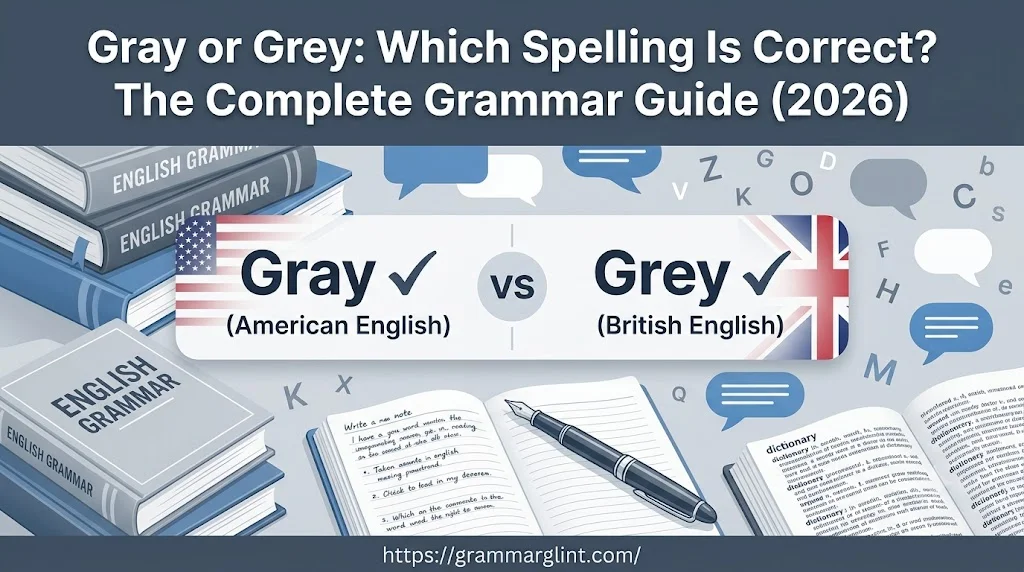
Gray or Grey is the same word with the same meaning; the only real difference is spelling, and both are accepted in English writing today.
If you compare Gray and Grey, the answer to which is correct simply depends on the type of English you use. American English prefers Gray as the correct spelling, while British English uses Grey as the usual spelling. This spelling variation, spelling variant, and other spelling variations have existed for hundreds of years, becoming the predominant choice in different places without changing the pronunciation.
Both are pronounced the same, using the long “a” sound, even though one uses letter A and the other letter E. Trusted dictionaries accept both forms, so it is important to choose one variant and use it consistently in your writing. From my editing experience, I have found that keeping one spelling throughout an article looks more professional, and QuillBot Grammar Checker, grammar, and checker tools make that much easier.
Whether you use Gray or Grey, both words describe the shade between black and white as an adjective, refer to the color or colour as a noun, or work as a verb when something is becoming that shade, such as hair that has grayed or greyed over the years. You can write gray cat or grey cat, and the meaning stays the same because there is no difference in pronunciation difference or accepted usage. Some people believe the spellings represent different colors or different colours, but there is no accepted standardization, and that idea is not widely used. Unlike many color names such as pink and red, this example remains a unique feature of the language.
Quick Answer
If you’re looking for the short answer, here it is:
- Gray is the preferred spelling in American English.
- Grey is the preferred spelling in British English and most other English-speaking countries.
- Both spellings refer to the same color.
- Both are accepted by major dictionaries.
- The pronunciation is identical regardless of spelling.
If you’re writing for readers in the United States, use gray, If your audience is in the United Kingdom, Australia, Ireland, or New Zealand, use grey. The most important rule is to stay consistent throughout your writing.
Gray vs. Grey at a Glance
| Feature | Gray | Grey |
| Preferred in | United States | United Kingdom, Australia, New Zealand, Ireland |
| Meaning | A neutral color between black and white | Same meaning |
| Pronunciation | /ɡreɪ/ | /ɡreɪ/ |
| Dictionary Status | Correct | Correct |
| Grammar | Adjective, noun, verb | Adjective, noun, verb |
| Formality | Standard | Standard |
Do They Both Mean the Same Thing?
Yes. Gray and grey mean exactly the same thing. They describe a color that falls between black and white on the color spectrum.
Neither spelling changes the definition. The only difference lies in where people typically use each version.
For example:
- The sky turned gray before the storm.
- The sky turned grey before the storm.
Both sentences are equally correct. The choice depends entirely on the variety of English you’re using.
Definition of Gray
In American English, gray is the standard spelling for the neutral color between black and white.
It can describe:
- Hair color
- Clouds
- Animals
- Clothing
- Buildings
- Mood or atmosphere
Examples:
- She wore a gray sweater.
- His gray hair made him look distinguished.
- The mountains appeared gray in the distance.
The word can also describe figurative ideas.
Examples include:
- A gray area in the law.
- Gray market products.
- A gray mood during winter.
In each case, the spelling remains gray for American publications.
Definition of Grey
Grey carries the exact same meaning but follows British spelling conventions.
Examples:
- She bought a grey coat.
- The weather stayed grey all afternoon.
- His grey beard gave him a wise appearance.
British newspapers, publishers, universities, and government organizations almost always use grey.
Is There Any Difference in Meaning?
No.
Many people assume that gray and grey describe different shades of the color. That idea has become popular online, especially among designers and artists.
However, there is no official linguistic rule supporting this claim.
Professional dictionaries define both spellings as the same word.
Any slight difference in shade comes from branding, paint manufacturers, or individual style choices rather than English grammar.
Is One More Correct Than the Other?
Neither spelling is more correct.
Instead, each spelling is considered standard in different regions.
Think of it like these spelling pairs:
| American English | British English |
| Color | Colour |
| Honor | Honour |
| Favorite | Favourite |
| Center | Centre |
| Gray | Grey |
Each version follows the spelling conventions of its region.
Why Are There Two Spellings?
English has borrowed words from many languages over hundreds of years. During that time, spelling wasn’t standardized. Different writers recorded words differently, and multiple spellings often existed side by side.
The story of gray and grey follows this pattern.
Centuries ago, English writers used several spellings, including:
- Gray
- Grey
- Graie
- Grai
Eventually, English dictionaries standardized two main versions.
When American English developed its own spelling conventions in the eighteenth and nineteenth centuries, gray became the preferred form. British English continued using grey.
That regional split remains today.
Historical Development
Old English included words similar to grǣg, which eventually evolved into the modern spelling.
As English changed through the Middle English period, spelling became much more flexible. Writers often spelled words according to pronunciation because no universal dictionary existed.
Once printing became widespread, publishers gradually settled on standard spellings.
American printers later simplified many spellings to create greater consistency.
How American and British English Diverged
One of the biggest influences on American spelling was Noah Webster, who believed English spelling should be simpler and more logical.
His dictionaries encouraged spellings such as:
| British | American |
| Colour | Color |
| Labour | Labor |
| Theatre | Theater |
| Centre | Center |
| Grey | Gray |
Not every change became universal, but many of Webster’s recommendations shaped modern American English.
Why Both Spellings Survived
Unlike some older spellings that disappeared completely, both gray and grey remained widely used because each became the standard in different parts of the English-speaking world.
Today, international communication means you’ll regularly encounter both spellings online.
Neither indicates poor grammar.
Instead, each reflects the writer’s regional language conventions.
Read More: Has Been vs Have Been: Which One Is Correct?
The Real Differences
Although the meanings match perfectly, several practical differences matter when you’re writing professionally.
Regional Usage
This is the biggest difference.
Use gray when writing for:
- United States
- American businesses
- American universities
- US government publications
- AP Style content
Use grey when writing for:
- United Kingdom
- Australia
- New Zealand
- Ireland
- Most Commonwealth countries
Matching your audience’s expectations helps your writing appear more polished and professional.
Dictionary Preference
Every major English dictionary recognizes both spellings.
However, dictionaries usually list the preferred version based on their primary audience.
For example:
- American dictionaries commonly list gray first.
- British dictionaries usually list grey first.
That doesn’t mean the second spelling is incorrect. It simply reflects regional usage.
Style Guide Recommendations
Professional writers often follow style guides instead of personal preference.
Here is how major style guides generally approach the spelling:
| Style Guide | Preferred Form |
| AP Style | Gray |
| Chicago Manual of Style | Gray (US publications) |
| APA Style | Gray |
| Oxford Style | Grey |
| BBC Style | Grey |
If you’re writing for a publisher, always follow the organization’s style guide rather than switching spellings.
Brand and Proper Name Exceptions
Proper names don’t always follow regional spelling rules.
For example:
- Grey Goose uses Grey because it’s the official brand name.
- Gray Television uses Gray because that’s the company’s legal name.
- Greyhound keeps its spelling regardless of the country where it’s mentioned.
Always preserve the official spelling of names, trademarks, businesses, books, and organizations.
Changing a proper noun’s spelling creates an error.
Consistency Matters More Than Preference
Imagine reading an article that begins with gray, switches to grey halfway through, and then changes back again.
Most readers won’t notice consciously, but editors certainly will.
Consistency builds credibility.
Choose one spelling based on your audience and use it throughout your article, report, assignment, or website.
Professional editors consider consistency one of the simplest signs of high-quality writing.
A single spelling choice may seem small, yet it shapes how polished your work appears. When every detail aligns with your audience’s expectations, your writing feels more natural, trustworthy, and easier to read.
Which Countries Use Gray and Which Use Grey?
Although gray and grey mean the same thing, different English-speaking countries have settled on different spellings over time. Knowing your audience helps you choose the version that feels natural to readers.
| Country | Preferred Spelling | Notes |
| United States | Gray | Standard in education, media, and government |
| United Kingdom | Grey | Standard British spelling |
| Canada | Grey (more common) | Gray also appears, especially in American-influenced content |
| Australia | Grey | Preferred in schools, media, and publishing |
| New Zealand | Grey | Standard spelling |
| Ireland | Grey | Follows British English conventions |
| South Africa | Grey | Generally follows British English |
If you’re writing for an international audience, don’t switch between the two spellings. Pick one based on your primary readers and use it consistently.
A Quick Rule to Remember
A simple memory trick works surprisingly well:
- Gray = America
- Grey = England
It’s not a grammar rule. It’s simply an easy way to remember regional preferences.
Which Spelling Should You Use?
The right choice depends less on the word itself and more on who will read your writing.
Gray or Grey in Academic Writing
Universities expect consistency.
If you’re studying in the United States, professors generally expect gray. Students at British, Australian, and many Canadian universities usually write grey.
If your institution follows a particular style guide, always follow that guide.
Gray or Grey in Business Writing
Companies usually establish their own editorial standards.
For example:
- A marketing agency based in New York should consistently use gray.
- A London advertising agency should consistently use grey.
Maintaining one spelling across websites, emails, brochures, and reports creates a more professional brand image.
Gray or Grey in Journalism
News organizations rarely leave spelling to chance.
American publications generally follow AP Style, which uses gray.
British newspapers naturally use grey because they follow British spelling conventions.
Editors often use automated proofreading tools to ensure every article follows the same spelling style.
Gray or Grey in Creative Writing
Creative writers have more flexibility.
A novelist writing an American character would naturally write:
The old gray house stood at the end of the street.
A British character would more likely describe it as:
The old grey house stood at the end of the street.
Matching the spelling to the character’s background makes dialogue and narration feel authentic.
Gray or Grey in School Assignments
Students often lose marks because they unintentionally mix American and British spellings.
Imagine writing:
- My favorite color is gray.
- The grey clouds covered the sky.
- The theatre looked gray inside.
Your teacher may notice the inconsistency immediately.
Before submitting an assignment, check that every spelling follows the same language standard.
Gray vs. Grey in Grammar
One reason this word confuses people is that it serves several grammatical functions. Fortunately, those functions stay exactly the same regardless of spelling.
Gray or Grey as an Adjective
Most often, gray or grey functions as an adjective describing a noun.
Examples:
- A gray jacket.
- A grey horse.
- Gray clouds gathered overhead.
- Grey walls made the room feel larger.
In each sentence, the word describes something.
Gray or Grey as a Noun
The word can also function as a noun referring to the color itself.
Examples:
- Gray is one of my favorite colors.
- She decorated the room using several shades of grey.
- Dark gray pairs well with white.
- Warm grey creates a calm atmosphere.
As a noun, it names the color rather than describing another word.
Gray or Grey as a Verb
Although much less common, both spellings can act as verbs.
Examples:
- His beard began to gray with age.
- Her hair slowly greyed over the years.
You’ll encounter this usage more often in literature than in everyday conversation.
Plural Forms
When referring to different shades, writers sometimes use plural nouns.
Examples:
- Warm grays complement wooden furniture.
- Several greys appeared in the artist’s palette.
This usage is especially common in interior design, photography, painting, and fashion.
Compound Words
The spelling also carries over into compound words.
American English generally uses:
- Gray-haired
- Grayish
- Grayness
- Grayscale
- Gray market
British English generally uses:
- Grey-haired
- Greyish
- Greyness
- Greyscale
- Grey market
Notice that the entire compound changes to match the regional spelling.
Pronunciation: Do Gray and Grey Sound Different?
This is one of the easiest questions to answer.
No.
Both words have exactly the same pronunciation.
IPA Pronunciation
Both spellings use the same International Phonetic Alphabet transcription:
/ɡreɪ/
The pronunciation rhymes with:
- Day
- Say
- Play
- Stay
- Away
Changing the spelling never changes the sound.
Why Doesn’t the Pronunciation Change?
English spelling doesn’t always predict pronunciation.
Many words have multiple accepted spellings while sharing the same pronunciation.
Consider these examples:
| American | British | Pronunciation |
| Color | Colour | Same |
| Honor | Honour | Same |
| Check | Cheque* | Similar depending on meaning |
| Gray | Grey | Same |
This happens because spelling evolved separately from pronunciation over many centuries.
Common Pronunciation Misconceptions
Some learners believe:
- Gray sounds more American.
- Grey sounds more British.
That’s incorrect.
Americans and Britons pronounce the word almost identically.
The only noticeable difference comes from each speaker’s accent, not the spelling itself.
Gray vs. Grey in Everyday English
You’ll see these spellings in almost every type of writing.
Daily Conversations
People use the word naturally when describing colors.
Examples:
- The sky looks gray today.
- I bought a grey sweater yesterday.
- Her cat has soft gray fur.
- His car is metallic grey.
The conversation sounds the same regardless of spelling.
Books and Literature
Authors generally follow the language standard of their publisher.
An American novel almost always uses gray.
A British novel almost always uses grey.
Classic literature reflects this pattern as well, although older works occasionally contain historical spelling variations.
Newspapers and Magazines
Professional publications rarely mix spellings.
Editors use style guides to maintain consistency across every article.
That’s why readers of an American newspaper repeatedly see gray, while readers of a British newspaper consistently encounter grey.
Scientific Writing
Scientific journals typically follow the regional spelling required by the publisher.
For example:
- An American medical journal will usually write gray matter.
- A British neuroscience journal may write grey matter.
The scientific meaning remains exactly the same.
Marketing and Advertising
Brands adapt their spelling to the audience they want to reach.
A company selling paint in the United States may advertise Classic Gray.
The same product marketed in Britain could appear as Classic Grey.
This simple adjustment helps brands feel more familiar to local customers.
A Real-World Case Study: Why Consistency Matters
Imagine an online furniture retailer based in Chicago that launches a blog targeting American homeowners.
One article uses these phrases:
- Gray sofa
- Grey cushions
- Gray walls
- Grey curtains
Nothing is technically incorrect. However, the mixed spellings create an inconsistent reading experience. Customers may wonder whether different products refer to different shades.
Now imagine the same article using gray consistently throughout.
The content feels polished, intentional, and easier to trust.
This example highlights an important lesson: choosing the right regional spelling matters less than using it consistently. Professional writing isn’t just about correct grammar. It’s also about creating a smooth, reliable experience for your readers.
Examples of Gray in Sentences
If you’re writing for an American audience, these examples show how gray naturally appears in everyday English.
Everyday Examples
- The sky turned gray just before the rain started.
- She painted the living room a light gray.
- His gray hoodie matched his sneakers perfectly.
- The old dog had soft gray fur around its face.
- We bought a gray couch because it matches almost everything.
- The mountains looked gray in the early morning fog.
- My favorite winter coat is charcoal gray.
- The clouds became darker and gray as the storm approached.
Academic Examples
- Researchers observed several gray regions in the satellite images.
- The report describes the gray coloration of the mineral sample.
- Students highlighted the gray sections of the diagram for comparison.
- The biology textbook explains the role of gray matter in the brain.
Professional Examples
- The company’s new logo uses dark gray instead of black.
- Employees should wear gray business attire during the conference.
- The architect selected warm gray tones for the office design.
- The design team recommended a soft gray background to improve readability.
Examples of Grey in Sentences
If you’re writing in British English, use grey in the same situations.
Everyday Examples
- The weather stayed grey all afternoon.
- She wore a beautiful grey scarf.
- The old castle stood beneath a grey sky.
- His grey backpack was easy to spot.
- The rabbit had soft grey fur.
- The sea looked dark grey during the storm.
British English Examples
- The motorway disappeared into the grey mist.
- He bought a grey suit for the wedding.
- The village looked peaceful beneath the grey clouds.
- The painter preferred warm grey tones for the interior walls.
Professional Examples
- The designer recommended a light grey background.
- The report highlighted the grey sections of the chart.
- The company updated its branding with darker grey accents.
- The office furniture featured modern grey finishes.
Common Mistakes Writers Make
Although gray and grey are simple words, writers often make avoidable mistakes.
Understanding these errors helps you write with greater confidence.
Mixing American and British Spellings
This is the most common mistake.
For example:
❌ The gray walls matched the grey carpet.
Instead, keep the spelling consistent.
American English:
- The gray walls matched the gray carpet.
British English:
- The grey walls matched the grey carpet.
Consistency always looks more professional.
Assuming One Spelling Is Wrong
Many learners believe gray is correct and grey is a mistake.
Others believe exactly the opposite.
Neither assumption is true.
Both spellings are accepted by respected dictionaries and language experts. The only difference is regional preference.
Ignoring Your Audience
Suppose you’re writing a travel guide for readers in London.
Using gray throughout the article won’t make your content incorrect, but it may feel unfamiliar to your audience.
Likewise, using grey throughout a website aimed at American readers may appear slightly inconsistent with local expectations.
Think about your readers before choosing a spelling.
Copying Multiple Sources
Many articles combine information from American and British publications.
Without careful editing, the spelling often changes throughout the article.
Editors frequently catch this issue during proofreading.
Before publishing your work, search for both gray and grey to make sure you’ve used only one version consistently.
Believing Search Results Determine Correctness
Some people assume whichever spelling appears more often in search results must be the correct one.
That’s not how language works.
Search results vary depending on:
- Your country
- Your browser settings
- Your search history
- Your target audience
- Local language preferences
Search engines recognize both spellings as valid regional variants.
Gray or Grey in Popular Style Guides
Professional editors rely on style guides to maintain consistency across books, newspapers, magazines, and academic publications.
Here’s how the most widely used style guides approach the word.
| Style Guide | Preferred Spelling | Primary Audience |
| AP Style | Gray | American journalism |
| Chicago Manual of Style | Gray | US publishing |
| APA Style | Gray | Academic writing in the US |
| MLA Handbook | Gray | American education |
| Oxford Style | Grey | British publishing |
| BBC News Style Guide | Grey | British journalism |
If you’re writing for an organization, always follow its editorial style guide instead of personal preference.
Dictionary Comparison
Every major English dictionary recognizes both spellings.
The difference lies in which version appears first.
| Dictionary | Gray | Grey | Notes |
| Merriam-Webster | ✓ Primary | ✓ Accepted | American dictionary |
| American Heritage | ✓ Primary | ✓ Accepted | US English |
| Cambridge Dictionary | ✓ Accepted | ✓ Primary | British preference |
| Oxford English Dictionary | ✓ Accepted | ✓ Primary | British English |
| Collins Dictionary | ✓ Accepted | ✓ Primary | British English |
This agreement among dictionaries confirms an important point:
Neither spelling is incorrect.
Etymology of Gray and Grey
The history of these spellings stretches back more than a thousand years.
Understanding their origin explains why both forms remain acceptable today.
Old English Origins
The modern word comes from the Old English grǣg, which referred to the color between black and white.
Like many Old English words, its spelling varied because standardized dictionaries didn’t exist.
Different scribes often wrote the same word differently.
Germanic Roots
Linguists trace the word even further back to the Proto-Germanic language family.
Several Germanic languages still contain similar words for the same color.
For example:
| Language | Word |
| German | Grau |
| Dutch | Grijs |
| Swedish | Grå |
| Danish | Grå |
These similarities show the shared linguistic ancestry of many European languages.
Evolution Through Middle English
During the Middle English period, spelling became even less consistent.
Writers recorded words according to pronunciation, local dialects, and personal habits.
Historical texts include several variations, such as:
- Gray
- Grey
- Graie
- Grai
Over time, two spellings became dominant.
Modern Standardization
By the eighteenth and nineteenth centuries, dictionaries helped standardize English spelling.
American lexicographer Noah Webster promoted gray as the preferred American spelling.
British publishers continued using grey, preserving their traditional convention.
Those decisions still influence modern English today.
Read More: Anyway vs Anyways: Which One Is Correct?
Memory Tricks to Remember Gray vs. Grey
If you frequently forget which spelling belongs to which region, these simple tricks can help.
The “A for America” Rule
The letter A appears in both:
- Gray
- America
If you’re writing for American readers, choose gray.
The “E for England” Rule
The letter E appears in both:
- Grey
- England
If your audience follows British English, choose grey.
When These Tricks Don’t Apply
Memory tricks are helpful, but they aren’t absolute rules.
Always keep these exceptions in mind:
- Brand names keep their official spelling.
- Book titles should never be altered.
- Company names remain unchanged.
- Product names follow the spelling chosen by the manufacturer.
For example, Grey Goose remains Grey Goose even in American publications, while Gray Television keeps its official spelling everywhere.
These exceptions exist because proper nouns always retain their original spelling regardless of regional language conventions.
Related Words and Commonly Confused Spellings
Once you understand the difference between gray and grey, you’ll notice the same spelling pattern in related words. These words follow the same regional conventions, so choosing one spelling means you should apply it consistently throughout your writing.
Grayish vs. Greyish
Both words describe something that is somewhat gray or grey, rather than completely that color.
American English examples:
- The walls have a grayish tint.
- His beard became grayish over the winter.
British English examples:
- The sky had a greyish appearance.
- The water looked greyish under the clouds.
Gray-haired vs. Grey-haired
Both compound adjectives describe someone with gray or grey hair.
Examples:
- My grandfather is a gray-haired veteran. (American English)
- The grey-haired gentleman greeted everyone warmly. (British English)
Grayness vs. Greyness
These nouns refer to the quality or condition of being gray or grey.
Examples:
- The grayness of the morning reflected the gloomy weather.
- The greyness of the landscape created a peaceful mood.
Grayscale vs. Greyscale
This spelling difference is especially common in photography, printing, graphic design, and digital imaging.
American English:
- Convert the image to grayscale.
British English:
- Print the document in greyscale.
Both terms refer to an image displayed using only shades between black and white.
Gray Matter vs. Grey Matter
This phrase appears frequently in biology and neuroscience.
American English:
- Scientists continue studying gray matter development.
British English:
- Researchers examined changes in grey matter after treatment.
The meaning is identical. Only the spelling changes.
FAQs
1. Is Gray or Grey correct?
Yes. Both are correct spellings of the same word. Gray is the preferred spelling in American English, while Grey is standard in British English.
2. Why do Americans write Gray instead of Grey?
American English follows Gray as the standard spelling. It is simply a regional spelling preference rather than a difference in meaning.
3. Why do British writers use Grey?
British English has traditionally used Grey. Most publications, dictionaries, and style guides in the UK follow this spelling.
4. Do Gray and Grey have different meanings?
No. They have exactly the same meaning and pronunciation. Both refer to the color between black and white.
5. Is there a difference in pronunciation between Gray and Grey?
No. Both words are pronounced the same way. The only difference is how they are spelled.
6. Should I use both spellings in the same article?
It’s better not to. Pick one spelling based on your audience and use it consistently throughout your writing.
7. Which spelling is better?
Neither spelling is universally better. If your audience is mainly in the United States, use Gray. For readers in the United Kingdom and many other English-speaking countries, use Grey.
8. Is Gray or Grey a noun, adjective, or verb?
Both spellings can function as all three. They can describe a color (adjective), name the color itself (noun), or describe the process of becoming gray or grey (verb).
9. Why do dictionaries list both Gray and Grey?
Modern dictionaries recognize both spellings because they are accepted regional variants of the same English word.
10. How can I remember which spelling to use?
A simple trick is to match the A in Gray with America and the E in Grey with England. While not a perfect linguistic rule, it is an easy way to remember the regional preference.
Conclusion
Choosing between Gray and Grey is much simpler than it first appears. Both spellings are correct, both have the same meaning, and both are accepted by major dictionaries. The only real difference is the variety of English you are writing for. Use Gray if your audience is primarily American, and choose Grey if you’re writing for British readers. Whatever you decide, stay consistent throughout your document. Consistent spelling improves readability, looks more professional, and helps maintain a polished writing style.

Aria Jane is a senior language writer and grammar specialist at Grammar Glint. She focuses on English grammar, spelling variations, vocabulary, and writing clarity. Through detailed research and practical examples, Aria helps readers understand language rules and avoid common mistakes. Her articles are designed to make English learning accessible for students, professionals, and everyday writers seeking reliable language guidance.