In English, Make Sure vs Be Sure though they seem very similar expressions, there are certain differences between them. At first look, both phrases feel almost the same, but small changes in use and tone make them slightly different in real communication. This is where learners often get confused, especially when both are commonly used in daily English.
This article will exemplify and clear up doubts about how vast is the gap between them and whether one or both forms are grammatically correct or even if are both correct in different situations. Many learners wonder if they should stick to one phrase, but in reality, both are widely accepted in English. The key is understanding when and how each one fits naturally in a sentence.
These phrases are used for the same thing in most contexts and often have it, meaning they both help someone confirm or ensure something is done properly. In many cases, it is correct in many cases to use either one without changing the meaning of the sentence. This makes them flexible in everyday speaking and writing, especially in instructions or advice.
When used as a command, a person is told to ensure an action they have to do actually comes to pass and not be careless with it, so everything is correct. In real-life usage, this often appears when giving reminders, instructions, or guidance to someone. The goal is always to make sure the intended action is completed properly and nothing is missed or done wrongly.
Why This Confuses So Many People
Let’s be honest. English doesn’t always play fair.
You hear someone say:
- “Make sure you call me later.”
- “I’m sure he’ll call later.”
Both sound close. Both use everyday words. So your brain thinks they must be interchangeable.
They’re not.
The confusion comes from three things:
- Both phrases use “sure”
- Both appear in similar contexts
- Both can translate loosely into other languages as “ensure” or “certain”
But here’s the key difference you need to lock in:
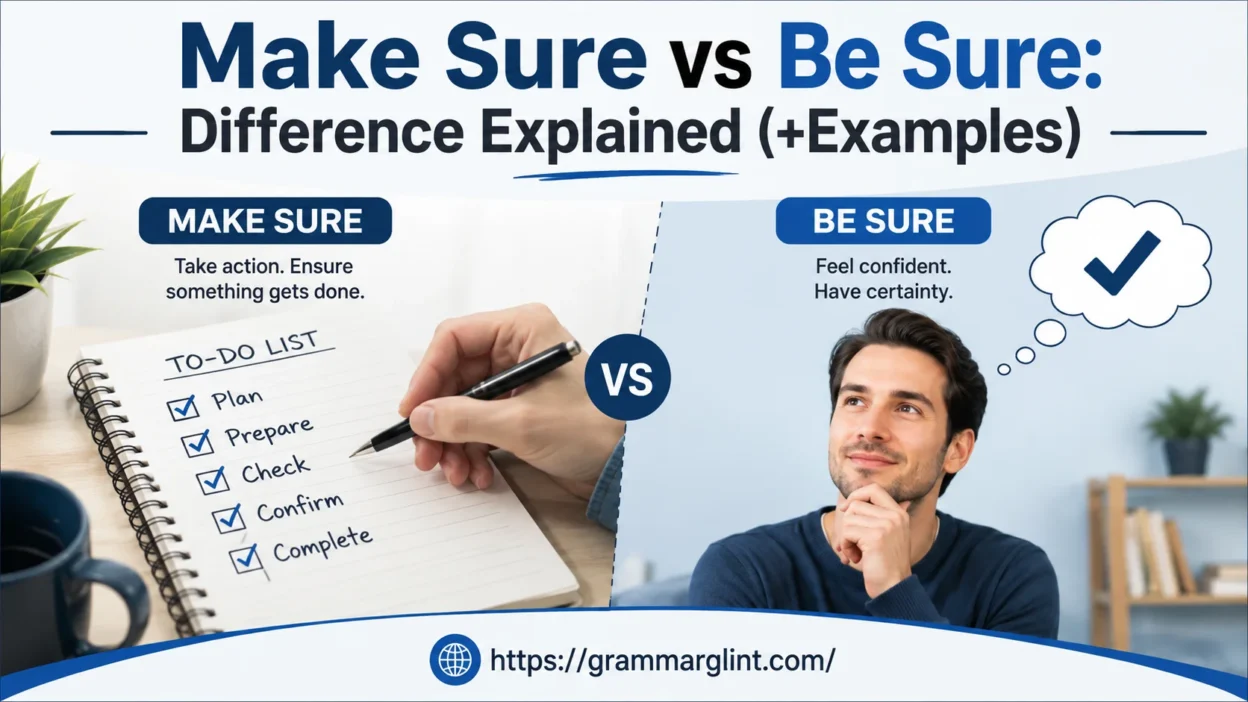
“Make sure” is about doing something.
“Be sure” is about feeling something.
That one idea clears up 80% of the confusion.
Read More: Any Time vs Anytime: Which One Is Correct?
Quick Answer You Can Use Immediately
If you’re in a hurry, remember this:
- Make sure = Check, confirm, or take action
- Be sure = Feel confident or certain
Think of it like this:
- You make sure your phone is charged before leaving.
- You are sure your phone is in your bag.
One is external action. The other is internal belief.
Simple, right? Now let’s go deeper.
What “Make Sure” Really Means in English
The phrase make sure focuses on action. You use it when someone needs to verify something or take steps to prevent a mistake.
It often appears in instructions, reminders, and responsibilities.
Core Meaning of Make Sure
At its heart, make sure means:
- Confirm something is true
- Take steps so something happens
- Avoid mistakes by checking
It works like a mental checklist.
You don’t just think about it. You do something about it.
Grammar Patterns for Make Sure
You’ll usually see these structures:
- Make sure + that + clause
- Make sure + to + verb
Examples:
- Make sure that you close the gate.
- Make sure to save your work.
- Make sure the lights are off.
Notice something important: it always pushes you toward action.
Real-Life Examples of Make Sure
Let’s bring it into daily life:
- Make sure you drink enough water during summer.
- Make sure you double-check your answers before submitting.
- I’ll make sure the meeting starts on time.
- Make sure to bring your passport to the airport.
These aren’t opinions. They are instructions or responsibilities.
Where You See “Make Sure” Most Often
You’ll find make sure in:
- Workplace instructions
- Safety guidelines
- Teachers giving assignments
- Parents giving reminders
- Apps and notifications
For example:
- “Make sure your password contains at least 8 characters.”
- “Make sure you have internet connection.”
It acts like a gentle command.
A Simple Analogy for Make Sure
Think of make sure like a security guard.
A guard doesn’t assume the door is locked. He checks it.
That’s what “make sure” does. It checks reality and locks it in place.
What “Be Sure” Really Means in English
Now let’s flip the meaning.
Be sure is not about action. It’s about certainty. It lives inside your thoughts, not your tasks.
Core Meaning of Be Sure
“Be sure” means:
- Feel confident about something
- Believe something is true
- Have no doubt
It’s emotional and mental, not physical.
Grammar Patterns for Be Sure
You’ll commonly see:
- Be sure of + noun
- Be sure about + noun
- Be sure + that + clause (less formal in speech)
Examples:
- I’m sure of my decision.
- Are you sure about this plan?
- She is sure that he will come.
Real-Life Examples of Be Sure
Let’s make it practical:
- I’m sure I left my keys on the table.
- She is sure about her career choice.
- Are you sure this is the right address?
- He’s sure that his team will win.
No action is required here. It’s all about belief.
Where You See “Be Sure” Most Often
You’ll hear be sure in:
- Conversations about opinions
- Emotional reassurance
- Personal decisions
- Predictions
For example:
- “I’m sure you’ll do great.”
- “Are you sure about that?”
It expresses confidence, not instruction.
A Simple Analogy for Be Sure
Think of be sure like a compass inside your mind.
It doesn’t change the world outside. It tells you what direction you believe is right.
Key Differences Explained Clearly
Now let’s put them side by side so you can see the contrast clearly.
Meaning Difference
- Make sure = Action to confirm something
- Be sure = Confidence in something
Usage Difference
- You use make sure when giving instructions or reminders
- You use be sure when expressing belief or certainty
Tone Difference
- Make sure sounds practical and directive
- Be sure sounds personal and reflective
Quick Comparison Table
| Feature | Make Sure | Be Sure |
| Focus | Action | Belief |
| Purpose | Prevent mistakes | Express certainty |
| Tone | Instructional | Personal |
| Common context | Work, safety, tasks | Opinions, feelings |
| Example | Make sure you call him | I’m sure he’ll call |
Common Mistakes
Even advanced learners slip here. Let’s fix the most common errors.
Mistake 1: Using Be Sure for Instructions
❌ Be sure to lock the door.
✔ Make sure to lock the door.
Why? Because instructions need action language.
Mistake 2: Using Make Sure for Opinions
❌ Make sure I will pass the exam.
✔ I’m sure I will pass the exam.
Why? Because confidence doesn’t require action.
Mistake 3: Mixing Both in One Sentence Wrongly
❌ Make sure you are sure about your answer.
This sounds awkward and repetitive.
✔ Instead say:
- Make sure you check your answer.
- Be sure about your final choice.
In Real-Life Scenarios
Let’s see how both phrases behave in real situations.
At Home
- Make sure you turn off the stove before leaving.
- I’m sure I turned it off already.
One prevents danger. The other expresses belief.
At Work
- Make sure you send the email before noon.
- I’m sure the client will respond today.
One is task-driven. The other is expectation.
While Traveling
- Make sure you reach the airport early.
- I’m sure the flight will be on time.
One is preparation. The other is confidence.
In Study Life
- Make sure you revise your notes.
- I’m sure I studied this topic before.
One pushes effort. The other reflects memory or belief.
How to Choose Instantly
Here’s a simple mental test you can use anytime.
Ask yourself:
“Am I telling someone to do something, or am I expressing belief?”
- If you’re telling someone to act → use make sure
- If you’re expressing confidence → use be sure
That’s it. No overthinking needed.
Easy Memory Trick
Let’s make this stick.
- Make = Do something
- Be = Exist in a state
So:
- Make sure → you do something to confirm
- Be sure → you are confident
Short. Clean. Easy to remember.
Bonus: Related Words You Might Confuse
Let’s clear up nearby confusion too.
Ensure vs Make Sure
- Ensure = more formal, often used in writing
- Make sure = casual, everyday speech
Example:
- Ensure safety compliance (formal)
- Make sure you stay safe (casual)
Be Certain vs Be Sure
- Both mean the same thing
- “Be certain” sounds more formal
Example:
- I’m sure he will come.
- I’m certain he will come.
Check vs Make Sure
- Check = look at something
- Make sure = confirm result after checking
Example:
- Check the door.
- Make sure it is locked.
Case Study: Miscommunication in a Real Workplace
A small marketing team once sent this instruction:
“Be sure the report gets submitted by Friday.”
One intern misunderstood it as confidence, not instruction. He thought it meant someone was already sure about the submission, so no action was needed from him.
Result? The report went late.
After that, the manager changed all instructions to:
“Make sure the report gets submitted by Friday.”
Clear. Direct. No confusion.
This shows something important:
Small grammar choices can change outcomes in real life.
My Personal Experience as an English Language Specialist
After teaching English grammar and editing thousands of sentences for students, writers, and professionals, I’ve noticed that make sure and be sure are among the most commonly confused expressions. Most learners understand the individual words, but they struggle to recognize the subtle difference in meaning when these phrases appear in real conversations or written instructions.
From my experience, the easiest way to master them is to focus on their purpose rather than memorizing grammar rules. Whenever you’re asking someone to take action or verify that something is done, make sure is usually the best choice. On the other hand, when you’re expressing confidence, certainty, or offering a polite reminder, be sure sounds more natural. I’ve seen learners improve their fluency quickly once they start thinking about action versus certainty instead of trying to translate the phrases directly from their native language.
One technique I often recommend is paying attention to authentic English. Notice how teachers, customer support agents, news presenters, and native speakers use these expressions in context. You’ll frequently hear sentences like, “Make sure you save your work before closing the program,” because the speaker wants you to complete an action. In contrast, you’ll hear, “I’m sure everything will be fine,” when someone is expressing confidence rather than giving an instruction.
In my own editing work, I also encourage writers to choose the phrase that best matches their intention instead of treating them as perfect synonyms. This small adjustment makes writing clearer, more professional, and more natural. With consistent reading, listening, and practice, distinguishing between make sure and be sure becomes almost automatic, helping you communicate with greater confidence in both spoken and written English.
Read More: Gray or Grey: Which Spelling Is Correct?
FAQs
1. What is the main difference between Make sure and Be sure?
Both are similar, but Make sure is often used for instructions, while Be sure is slightly more formal or personal in tone.
2. Are Make sure and Be sure grammatically correct?
Yes, both Make sure vs Be sure are grammatically correct and widely used in English.
3. Can we use them interchangeably?
In most cases, yes. However, context and tone can decide which one sounds more natural.
4. Which one is more common in daily English?
Make sure is more commonly used in everyday spoken and informal English.
5. Is Be sure more formal than Make sure?
Yes, Be sure often sounds a bit more polite or formal compared to Make sure.
6. Do both phrases give commands?
Yes, both can be used to give instructions or commands to ensure something is done correctly.
7. Can Make sure be used in writing instructions?
Yes, Make sure is very common in instructions, guides, and directions.
8. Does Be sure change the meaning of a sentence?
No, it does not change meaning much; it only slightly changes tone and style.
9. Are both used in spoken English?
Yes, both are used in spoken English, but Make sure is more frequent.
10. Why do learners get confused between them?
Because both phrases look and feel similar and are used for the same purpose of ensuring an action is completed correctly.
Conclusion
Understanding the difference between make sure and be sure can make your English sound more natural and precise. While both expressions are grammatically correct and are sometimes interchangeable, make sure focuses on ensuring that an action is completed, whereas be sure often expresses certainty or serves as a polite reminder. Paying attention to this small distinction helps you choose the expression that best fits the situation.
The easiest way to remember the difference is this: use make sure when you want someone to check or ensure that something happens, and use be sure when expressing confidence or politely encouraging someone to do something. With regular practice and exposure to real-life examples, you’ll quickly develop a natural sense of when to use each phrase correctly in both speaking and writing.

Emma Brooke is an editor and language researcher at Grammar Glint. Her work centers on grammar rules, punctuation, word usage, and style consistency. Emma is passionate about transforming complex language concepts into clear, reader-friendly explanations. She contributes in-depth articles that help readers communicate more effectively and confidently in both academic and professional settings.