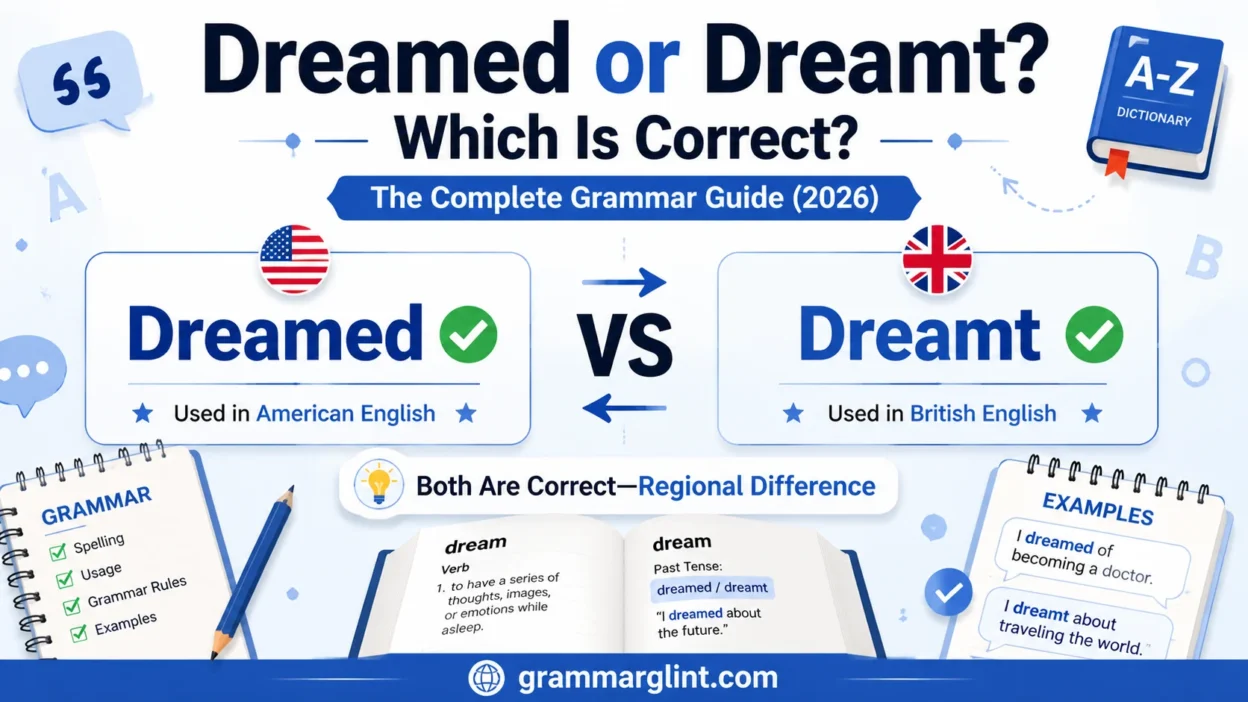
Dreamed or Dreamt can both describe past experiences during sleep, but their difference mainly comes from usage, language, and regional preference rather than meaning.
In American English, dreamed is the preferred and more common form for Americans, while dreamt is often more popular and favored by Brits in British English. Both words are past tense forms of the verb dream, and both past tense versions have the same meaning when you are talking about sleeping, seeing images, or experiencing events during sleep. The U.S., United States, and Britain show this regional difference clearly, although both forms remain correct in everyday English. This can cause controversy for learners who want to understand proper grammatical usage, but the choice becomes easier when you consider the speaker’s regional dialect and audience.
For example, if you are talking about a new car you saw last night, both “I dreamed about a new car” and “I dreamt about a new car” are correct sentences. The first version is more common overall, while dreamt may appear in a more hopeful or literary sense. One useful detail is that dreamt is one of the few English words that ends with the letters mt. From my experience explaining grammar, I find that learners understand these verb forms more easily when they focus on context, the writer, and the speaker’s dialect instead of searching for one fixed rule. Either choice is an equally valid form, so simply use the form that best fits your variety of English.
Quick Answer
If you only need the short answer, here it is.
Both dreamed and dreamt are correct past tense and past participle forms of the verb dream.
- Dreamed is the preferred spelling in American English.
- Dreamt is more common in British English, Australian English, and several other Commonwealth countries.
- Neither word changes the meaning of the sentence.
- Choose one form and remain consistent throughout your writing.
For example:
✅ I dreamed about traveling around the world.
✅ I dreamt about traveling around the world.
Both sentences communicate exactly the same idea.
Dreamed vs. Dreamt at a Glance
| Feature | Dreamed | Dreamt |
| Grammar | Correct | Correct |
| Meaning | Same as dreamt | Same as dreamed |
| American English | Preferred | Less common |
| British English | Accepted | Preferred |
| Australian English | Less common | Preferred |
| Canadian English | Both accepted | Both accepted |
| Academic Writing | Common | Accepted |
| Everyday Speech | Very common in the US | Very common in the UK |
| Formal Writing | Appropriate | Appropriate |
The table makes one thing clear. This isn’t about right versus wrong. It’s simply about regional preference and writing style.
Are Dreamed and Dreamt Different?
This question appears in grammar forums almost every day. Surprisingly, the answer is simpler than many people expect.
Do They Have the Same Meaning?
Yes.
Both words describe:
- Sleeping and experiencing dreams
- Imagining something desirable
- Hoping for the future
- Fantasizing about possibilities
Consider these examples.
- She dreamed about becoming a doctor.
- She dreamt about becoming a doctor.
The meaning remains identical.
Is There Any Difference in Usage?
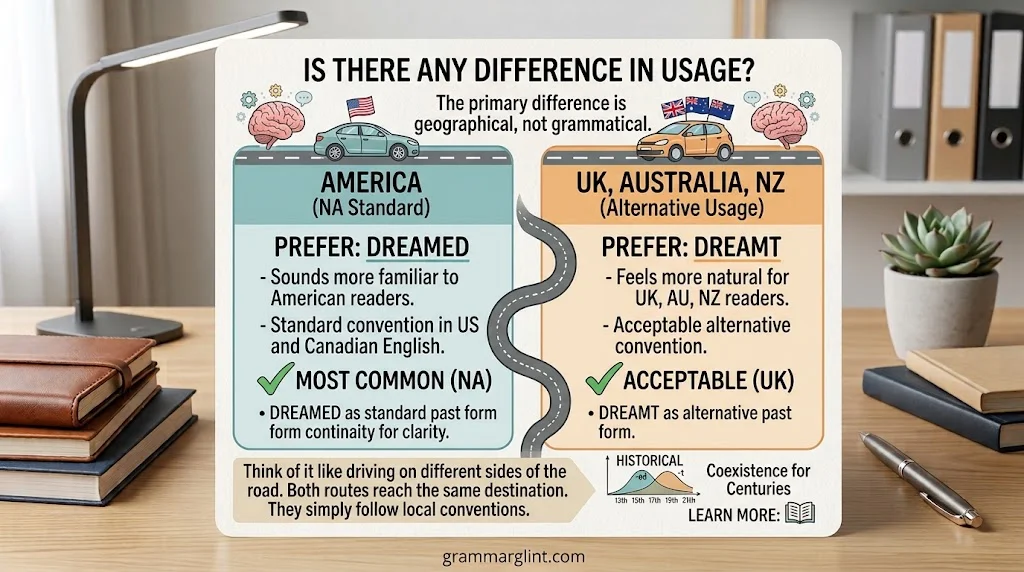
The primary difference is geographical rather than grammatical.
If your audience is mainly American, dreamed sounds more familiar.
If you’re writing for readers in the United Kingdom, Australia, or New Zealand, dreamt often feels more natural.
Think of it like driving on different sides of the road. Both routes reach the destination. They simply follow local conventions.
Why Does English Allow Both Forms?
English developed from several languages over many centuries. Some verbs kept older endings ending in -t, while others gradually adopted the regular -ed ending.
As English spread around the world, different countries favored different forms.
That’s why both remain acceptable today.
What Does Dreamed Mean?
Dreamed is the regular past tense and past participle of dream.
It follows the familiar English pattern:
- Walk → Walked
- Jump → Jumped
- Play → Played
- Dream → Dreamed
Because it follows the standard -ed rule, many English learners find it easier to remember.
Examples include:
- I dreamed about the beach.
- We dreamed of owning a cabin.
- She has dreamed of becoming an astronaut since childhood.
- They dreamed big and achieved even bigger goals.
Notice that dreamed works perfectly in simple past and perfect tenses.
Dreamed as the Past Tense
Simple past examples include:
- I dreamed all night.
- We dreamed about our vacation.
- They dreamed of success.
- He dreamed about winning the championship.
Read More: More Than vs More Then: Which One Is Correct?
Dreamed as the Past Participle
Past participles appear with helping verbs.
Examples include:
- I have dreamed about this day for years.
- She had dreamed of this opportunity.
- We have always dreamed together.
- They had never dreamed such a thing was possible.
Common Expressions with Dreamed
Native speakers frequently use these expressions.
- Dreamed about
- Dreamed of
- Never dreamed
- Always dreamed
- Dreamed big
- Dreamed up an idea
Examples:
“I never dreamed I’d meet my favorite author.”
“They dreamed up a creative marketing campaign.”
“We dreamed of visiting every national park.”
What Does Dreamt Mean?
Dreamt serves exactly the same grammatical purpose.
It is simply an alternative past tense and past participle.
Its pronunciation gives it a slightly sharper ending because of the -mt cluster.
Examples include:
- I dreamt about flying.
- She dreamt of a peaceful future.
- We had dreamt about moving abroad.
- They dreamt of changing the world.
Everything you can express with dreamed can also be expressed with dreamt.
Dreamt as the Past Tense
Examples:
- He dreamt all afternoon.
- I dreamt about school.
- They dreamt of adventure.
- She dreamt of becoming an artist.
Dreamt as the Past Participle
Examples:
- I have dreamt about this before.
- She had dreamt of freedom.
- They have dreamt together for years.
- We had never dreamt such happiness existed.
Common Expressions with Dreamt
Many classic British novels contain phrases such as:
- Dreamt about
- Dreamt of
- Never dreamt
- Dreamt up
Examples include:
“I never dreamt it would happen.”
“They dreamt of a brighter tomorrow.”
What’s the Real Difference?
Now that you know both words are correct, let’s examine what actually separates them.
Grammar Difference
There isn’t one.
Both forms function as:
- Past tense
- Past participle
Both appear in identical sentence structures.
For example:
- I dreamed about home.
- I dreamt about home.
Grammar remains unchanged.
Meaning Difference
There is no semantic difference.
Both indicate either:
- A dream experienced during sleep.
- A hope or aspiration.
Examples:
“I dreamed of becoming a pilot.”
“I dreamt of becoming a pilot.”
Again, both mean exactly the same thing.
Style Difference
This is where the distinction becomes noticeable.
Dreamed usually feels more modern and international.
Dreamt often carries a literary or traditional tone, especially in British writing.
Many novelists intentionally choose dreamt because it sounds slightly more poetic.
Compare these two lines.
“I dreamed beneath the stars.”
“I dreamt beneath the stars.”
The second sentence has a softer rhythm that many creative writers appreciate.
Regional Preference
Regional preference matters far more than grammar.
| Region | Preferred Form |
| United States | Dreamed |
| United Kingdom | Dreamt |
| Australia | Dreamt |
| New Zealand | Dreamt |
| Canada | Both |
| International English | Dreamed slightly more common |
If your audience spans multiple countries, dreamed generally offers the safest choice because international readers encounter it more frequently.
Tone and Readability
Although both forms are correct, they create slightly different impressions.
Dreamed often feels:
- Modern
- Straightforward
- Neutral
- Business-friendly
Dreamt often feels:
- Literary
- Traditional
- Expressive
- Storytelling-oriented
Neither tone is better. Match your choice to your audience.
Which One Should You Use?
Choosing between dreamed and dreamt depends less on grammar and more on context.
Ask yourself these questions:
- Who will read this?
- Which English variety am I using?
- Am I writing formally or creatively?
- Do I want a neutral or literary tone?
If you’re writing for American readers, dreamed will almost always be the expected choice.
If your audience lives in Britain or Australia, dreamt blends naturally with local writing conventions.
The key is consistency. Switching back and forth between the two forms within the same article or document can distract readers unless you’re quoting someone or intentionally reflecting different regional styles.
Dreamed or Dreamt in American English
If you write primarily for readers in the United States, dreamed should usually be your first choice.
Modern American English strongly favors regular -ed verb endings. Over time, many irregular -t forms have become less common in everyday speech and writing. As a result, you’ll see dreamed much more often in newspapers, business documents, educational materials, and online content.
Examples include:
- I dreamed about moving to New York.
- She dreamed of becoming an engineer.
- They dreamed that one day they would own a business.
- We have dreamed about this opportunity for years.
You’ll also notice dreamed in:
- News articles
- Business reports
- College essays
- Government publications
- Professional emails
- Marketing content
If you’re unsure which form to choose for an American audience, dreamed is the safest option.
In British English
British English accepts both forms, but dreamt appears more naturally in everyday writing.
Many British speakers prefer irregular verbs ending in -t, especially those that have remained part of traditional English for centuries.
Examples include:
- I dreamt about the seaside.
- She dreamt of becoming a famous painter.
- They dreamt that everything would be different.
- We had dreamt about this moment for years.
You’ll commonly encounter dreamt in:
- British novels
- Newspapers
- Magazines
- Television scripts
- Everyday conversation
That said, dreamed is still perfectly acceptable in the UK. It simply appears less frequently.
In Canadian English
Canadian English often blends American and British conventions.
Because of this influence, both dreamed and dreamt are widely accepted. Some writers lean toward American spelling, while others follow British traditions.
For example:
- I dreamed about visiting Banff.
- I dreamt about visiting Banff.
Both sentences sound natural to Canadian readers.
The most important rule is consistency. Avoid alternating between the two spellings within the same piece of writing.
In Australian and New Zealand English
Australian and New Zealand English generally follow British conventions.
As a result, dreamt appears more frequently than dreamed, especially in newspapers, literature, and everyday conversation.
Examples include:
- She dreamt about her childhood home.
- They dreamt of traveling around Europe.
- We had dreamt about this vacation for years.
However, younger writers increasingly use dreamed, particularly in digital content influenced by American media.
Which Form Is Better for International Readers?
If your audience comes from different countries, choosing the most familiar form matters.
Here’s a quick comparison.
| Audience | Recommended Form |
| American readers | Dreamed |
| British readers | Dreamt |
| Australian readers | Dreamt |
| Canadian readers | Either |
| International audience | Dreamed |
Because American English dominates much of the internet, dreamed often feels more universally recognizable.
Many international companies also use American English in their style guides.
Dreamed or Dreamt in Academic Writing
Academic writing values consistency above all else.
Most universities don’t require one form over the other. Instead, they expect you to follow the chosen style throughout your paper.
For example:
American style:
- Researchers dreamed of finding a cure.
- Scientists have dreamed about space exploration for decades.
British style:
- Researchers dreamt of finding a cure.
- Scientists have dreamt about space exploration for decades.
Mixing the two styles in one assignment creates unnecessary inconsistency.
In Creative Writing
Creative writing gives you more freedom.
Many novelists intentionally choose dreamt because its shorter ending creates a softer rhythm.
Compare these examples.
Dreamed
She dreamed beneath the stars until sunrise.
Dreamt
She dreamt beneath the stars until sunrise.
The second sentence carries a slightly more poetic tone.
This subtle difference explains why fantasy novels, historical fiction, and literary works often favor dreamt.
Grammar Rules
Understanding the grammar behind these words removes almost every source of confusion.
The verb dream has three principal forms.
| Verb Form | Example |
| Base Form | Dream |
| Present Participle | Dreaming |
| Past Tense | Dreamed / Dreamt |
| Past Participle | Dreamed / Dreamt |
Notice that both past forms are equally correct.
As Past Tense Verbs
Use either form to describe something that happened in the past.
Examples:
- I dreamed about my grandparents.
- I dreamt about my grandparents.
- She dreamed all night.
- She dreamt all night.
Each sentence is grammatically identical.
In the Present Perfect
Present perfect combines have, has, or had with the past participle.
Examples:
- I have dreamed about this for years.
- She has dreamed of becoming a doctor.
- We have dreamt about visiting Japan.
- They have dreamt of living abroad.
Both versions are correct.
In the Past Perfect
Past perfect describes an action completed before another event.
Examples:
- I had dreamed about this long before we met.
- She had dreamt about the same place years earlier.
- They had dreamed of success before launching the company.
- We had dreamt about traveling together.
Again, the grammar remains identical.
In the Future Perfect
Future perfect discusses actions completed before a future point.
Examples:
- By next year, I will have dreamed about this goal for decades.
- She will have dreamt of this achievement her entire life.
Although these constructions appear less frequently, they remain grammatically correct.
Passive Voice Examples
The verb dream rarely appears in passive voice because dreams are experiences rather than actions performed on an object.
However, passive constructions occasionally occur.
Examples:
- The future was dreamed of by generations before us.
- Success was dreamed about by millions of people.
Active voice sounds much more natural.
Instead of writing:
Success was dreamed about by millions.
Write:
Millions dreamed about success.
The active version feels clearer, stronger, and easier to read.
Common Sentence Patterns
Here are the sentence structures you’ll encounter most often.
Dream About + Noun
Examples:
- I dreamed about my family.
- She dreamt about school.
- They dreamed about their future.
Dream Of + Gerund
Examples:
- We dreamed of traveling.
- She dreamt of becoming an artist.
- He dreamed of helping others.
Dream That + Clause
Examples:
- I dreamed that I could fly.
- She dreamt that everyone disappeared.
- They dreamed that the project succeeded.
Never Dreamed
Examples:
- I never dreamed this would happen.
- We never dreamt it would end so quickly.
- She never dreamed she would become famous.
Pronunciation Guide
Even though dreamed and dreamt share the same meaning, their pronunciation differs slightly.
Learning the correct pronunciation helps you sound more natural in conversation.
How to Pronounce Dreamed
Dreamed contains two syllables for some speakers, while others pronounce it almost as one smooth sound.
IPA (American English):
/driːmd/
The ending sounds similar to these words:
- Seemed
- Beamed
- Screamed
Practice sentences:
- I dreamed about summer vacation.
- She dreamed of becoming a scientist.
- We dreamed together every night.
How to Pronounce Dreamt
Dreamt ends with a crisp -mt sound.
IPA (British English):
/dremt/ or /driːmt/ depending on accent.
It rhymes with words like:
- Tempt
- Attempt
- Exempt (ending sound)
Practice sentences:
- I dreamt about flying.
- She dreamt of home.
- They dreamt together.
The ending requires your lips to close before releasing the t sound.
IPA Pronunciation Comparison
| Word | IPA |
| Dream | /driːm/ |
| Dreamed | /driːmd/ |
| Dreamt | /dremt/ or /driːmt/ |
This small pronunciation difference is one reason some speakers naturally prefer one form over the other.
Common Pronunciation Mistakes
Many English learners make predictable mistakes when saying these words aloud.
Here are the most common ones.
Adding an extra syllable
❌ Dream-ed
✅ Dreamed
The -ed ending does not create a separate syllable here.
Dropping the final consonant
❌ I dream…
✅ I dreamed…
Always pronounce the ending clearly.
Replacing the final “t” with “d”
Some learners pronounce dreamt like dreamed.
Keep the final t crisp when saying dreamt.
Mixing British and American pronunciation
If you’re using American English, pronounce dreamed naturally throughout your conversation.
If you’re speaking British English, dreamt will sound more familiar to listeners.
A simple rule can help you remember:
Write for your audience, pronounce for your audience, and stay consistent throughout your communication.
Regional Usage Around the World
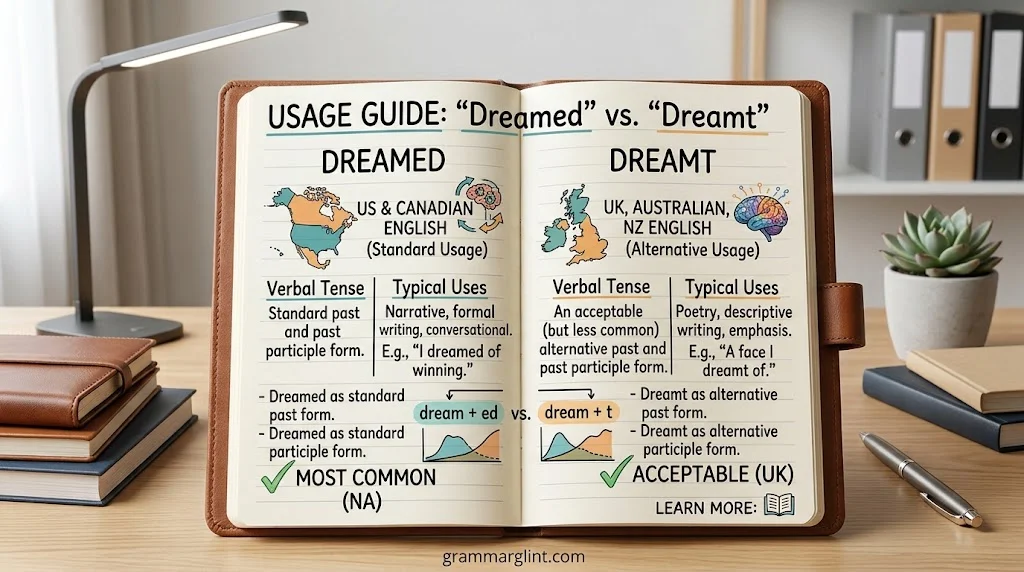
English is a global language, but not every English-speaking country prefers the same words. Dreamed and dreamt illustrate this perfectly. While both forms are grammatically correct, their popularity varies depending on where you are.
If you’re writing for a specific audience, understanding these regional preferences helps your content feel more natural and authentic.
Dreamed in the United States
In the United States, dreamed is overwhelmingly the preferred form. American dictionaries, newspapers, universities, and businesses almost always use dreamed.
Examples include:
- I dreamed about starting my own company.
- She dreamed of becoming a pilot.
- They dreamed about buying their first home.
You’ll also find dreamed in:
- Newspapers
- School textbooks
- Government publications
- Legal documents
- Academic journals
- Online articles
- Business communication
Although Americans understand dreamt, it often sounds literary or slightly old-fashioned.
Dreamt in the United Kingdom
British English embraces both forms, but dreamt remains the traditional favorite.
Many British writers naturally choose dreamt in novels, newspapers, magazines, and everyday conversation.
Examples:
- I dreamt about my childhood.
- She dreamt of visiting Scotland.
- They dreamt about life by the sea.
British readers generally view both spellings as correct, but dreamt often feels more familiar.
Read More: Gray or Grey: Which Spelling Is Correct?
Dreamt in Australia and New Zealand
Australian and New Zealand English closely follow British usage.
You’ll commonly encounter:
- dreamt
- learnt
- burnt
- spelt
Examples:
- We dreamt of exploring the Outback.
- She dreamt about her grandparents.
- They had dreamt of this opportunity for years.
American spellings continue to appear online because of global media, but dreamt still dominates traditional publishing.
Dreamed and Dreamt in Canada
Canadian English combines influences from both American and British English.
As a result, both forms appear regularly.
Canadian newspapers may use dreamed, while British-style publishers may prefer dreamt.
Neither form surprises Canadian readers.
Which Form Appears More Often Worldwide?
While dreamt remains common in several countries, dreamed appears more frequently on the internet.
Several factors explain this trend:
- American English dominates online publishing.
- Many international businesses adopt US style guides.
- Educational resources often favor American spelling.
If your audience spans multiple countries, dreamed usually provides the broadest familiarity.
In Everyday Writing
Grammar rules matter, but real-world usage matters even more.
Let’s see how these words appear across different types of writing.
Daily Conversations
Casual speech rarely causes confusion.
American English:
- I dreamed about you last night.
- We dreamed of moving somewhere warmer.
- Have you ever dreamed about flying?
British English:
- I dreamt about you last night.
- We dreamt of moving abroad.
- Have you ever dreamt about falling?
Native speakers rarely stop to think about which version they’re using because both feel natural within their dialect.
Business Communication
Professional writing values clarity and consistency.
Examples:
- Our founders dreamed of building a company that served small businesses.
- She has always dreamed about leading her own team.
- We dreamed of creating a better customer experience.
If you’re writing for an international company, dreamed generally fits better because it’s widely recognized.
Academic Writing
Research papers and university assignments usually follow a style guide.
If your institution follows American English, write:
- Scientists have dreamed about this possibility for decades.
If your institution follows British English, write:
- Scientists have dreamt about this possibility for decades.
Consistency is more important than the choice itself.
Journalism
News organizations typically follow their internal editorial style.
American newspapers almost always write:
- The inventor dreamed of changing transportation.
British newspapers often write:
- The inventor dreamt of changing transportation.
Readers immediately recognize both forms.
Literature
Creative writing offers more stylistic freedom.
Many classic British authors favored dreamt, while modern American authors often prefer dreamed.
Compare these examples.
Neutral tone
She dreamed of another life.
Literary tone
She dreamt beneath a silver moon.
Neither sentence is better. Each creates a slightly different atmosphere.
Movies and Television
Dialogue usually reflects the speaker’s nationality.
American character:
I dreamed about my hometown.
British character:
I dreamt about my hometown.
Scriptwriters often make this choice intentionally to reinforce authenticity.
More Than 50 Example Sentences
Examples help grammar become second nature.
Everyday Examples
- I dreamed about my family last night.
- She dreamed of opening a bakery.
- They dreamed about winning the lottery.
- We dreamed together every summer.
- He dreamed about college.
- I dreamed of traveling across Europe.
- She dreamed about becoming a nurse.
- They dreamed of buying a house.
- We dreamed about success.
- The children dreamed about Christmas morning.
Dreamt Examples
- I dreamt about the ocean.
- She dreamt of becoming a musician.
- We dreamt together as children.
- They dreamt about their future.
- He dreamt of climbing Everest.
- I dreamt about my old school.
- She dreamt about spring flowers.
- We dreamt of peace.
- They dreamt about adventure.
- I dreamt about my grandparents.
Formal Writing Examples
- Researchers have dreamed of solving this challenge for decades.
- Scientists dreamed about future medical breakthroughs.
- Engineers have dreamed of faster transportation systems.
- Historians have dreamt of discovering additional evidence.
- Scholars dreamt about preserving ancient languages.
Professional Examples
- Our founders dreamed of creating a better workplace.
- She dreamed about improving customer satisfaction.
- The company dreamed of global expansion.
- Investors dreamed about sustainable growth.
- Entrepreneurs have dreamed of solving everyday problems.
Literary Examples
- The old sailor dreamt beneath endless stars.
- She dreamed beyond the mountains.
- They dreamt of forgotten kingdoms.
- He dreamed beneath silent skies.
- The child dreamt of magical forests.
Common Collocations
Native speakers naturally pair dreamed and dreamt with certain words.
Learning these combinations makes your English sound more fluent.
| Expression | Example |
| Dreamed about | I dreamed about my vacation. |
| Dreamed of | She dreamed of success. |
| Dreamed that | I dreamed that I was flying. |
| Dreamt about | They dreamt about home. |
| Dreamt of | We dreamt of peace. |
| Never dreamed | I never dreamed this could happen. |
| Always dreamed | She always dreamed of becoming a writer. |
| Dreamed up | He dreamed up a brilliant solution. |
These collocations appear frequently in books, conversations, and media.
Common Mistakes
Many learners understand the basic rule but still make small errors.
Fortunately, they’re easy to avoid.
Thinking Dreamt Is Incorrect
Some learners assume dreamt is a misspelling.
It isn’t.
Major dictionaries recognize dreamt as a standard English word.
Believing Dreamed Is Only American Slang
Another misconception is that dreamed isn’t proper English.
In reality, dreamed has been part of English for centuries.
It simply became the preferred form in American English.
Mixing Regional Styles
Consider this example.
❌ She dreamt about college yesterday. Later she dreamed of becoming a lawyer.
Although grammatically correct, switching spellings within one document feels inconsistent.
Choose one form and stick with it.
Using the Wrong Verb Tense
Incorrect:
❌ I have dream yesterday.
Correct:
✅ I dreamed yesterday.
✅ I have dreamed about it before.
Confusing Literal and Figurative Meanings
Remember that dream has two meanings.
Literal:
I dreamed about flying.
Figurative:
I dreamed of becoming an architect.
Both meanings use the same grammar.
In Common Expressions
English contains many familiar phrases using the verb dream.
These expressions work with either past tense form when appropriate.
Beyond Your Wildest Dreams
Meaning: Better than you ever imagined.
Example:
- The project succeeded beyond our wildest dreams.
Dream Come True
Meaning: Something hoped for has finally happened.
Example:
- Winning the scholarship was a dream come true.
Never Dreamed Of
Meaning: Completely unexpected.
Example:
- I never dreamed I’d meet my childhood hero.
Dream Big
Meaning: Set ambitious goals.
Example:
- Successful entrepreneurs dream big and work even harder.
These expressions appear frequently in books, speeches, interviews, and everyday conversation, making them valuable additions to your vocabulary.
Etymology and History
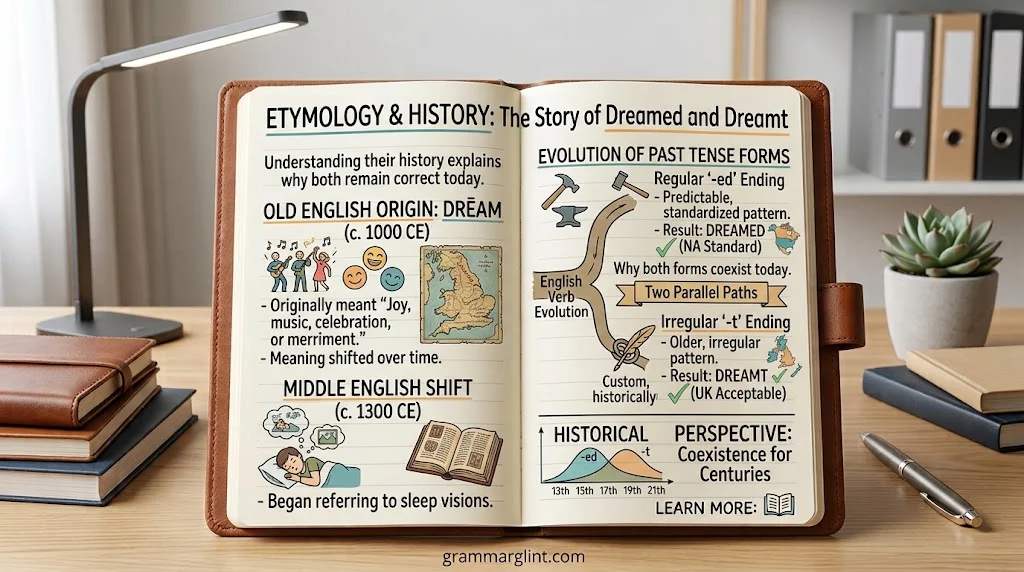
The story behind dreamed and dreamt begins long before modern English existed. Understanding their history explains why both forms remain correct today.
The verb dream comes from the Old English word drēam, which originally meant joy, music, celebration, or merriment. Over time, its meaning shifted. During the Middle English period, dream began referring to the thoughts and images people experience while sleeping.
As English evolved, many verbs developed two past tense forms:
- A regular -ed ending
- An irregular -t ending
This pattern wasn’t unique to dream. Several other verbs followed the same path.
Examples include:
| Base Verb | American English | British English |
| Learn | Learned | Learnt |
| Burn | Burned | Burnt |
| Spell | Spelled | Spelt |
| Smell | Smelled | Smelt |
| Dream | Dreamed | Dreamt |
Over time, American English moved toward regular verb forms because they were easier to learn and more predictable. British English retained many traditional -t endings, which is why dreamt remains popular today.
Rather than competing with each other, dreamed and dreamt represent two branches of the same language.
How Dreamed Became More Common in American English
American English has gradually simplified many irregular verb forms.
Linguists often point to three main reasons:
- Regular verbs are easier for learners.
- Newspapers and publishers favored consistent spelling.
- American dictionaries promoted regular -ed endings.
Because of these trends, words like dreamed, learned, and burned became the standard in schools, businesses, and media across the United States.
Today, most American readers instinctively expect dreamed.
Why Dreamt Remains Popular in British English
British English tends to preserve older forms that have been part of the language for centuries.
That’s why you’ll still encounter:
- dreamt
- burnt
- learnt
- spelt
- smelt
These spellings don’t sound old-fashioned to British readers. Instead, they feel completely natural.
Many British publishers continue to use them because they reflect established regional conventions.
Compared with Similar Verbs
If you’ve learned other English verbs with two acceptable past tense forms, you’ll notice a familiar pattern.
Learned vs. Learnt
Both are correct.
Examples:
- She learned Spanish in college.
- She learnt Spanish in college.
American English generally prefers learned, while British English often uses learnt.
Burned vs. Burnt
Again, both are correct.
Examples:
- The toast burned.
- The toast burnt.
Some style guides reserve burnt as an adjective, such as burnt toast or burnt sugar, while using burned as the verb. However, both verb forms remain acceptable.
Spelled vs. Spelt
Examples:
- I spelled the word correctly.
- I spelt the word correctly.
As with dreamed and dreamt, regional preference determines which version appears more often.
Smelled vs. Smelt
Examples:
- The flowers smelled wonderful.
- The flowers smelt wonderful.
Remember that smelt can also be a noun referring to a small fish or a verb meaning to extract metal from ore. Context usually makes the meaning clear.
A Helpful Pattern to Remember
Many English verbs ending in -ed have an alternative -t form.
If you recognize one pair, you’ll likely recognize the others as well.
Editorial Recommendation: Which Should You Choose?
Although both forms are correct, choosing the one that best matches your audience creates a smoother reading experience.
Here are practical recommendations for different situations.
Best Choice for American English
Choose dreamed.
It matches American dictionaries, educational standards, and modern publishing practices.
Examples include:
- Blogs
- School assignments
- Marketing copy
- News articles
- Technical documentation
Best Choice for British English
Choose dreamt.
It aligns with British spelling conventions and feels more natural to UK readers.
You’ll commonly see it in:
- Newspapers
- Novels
- Educational resources
- Everyday writing
Best Choice for International Audiences
If you’re writing for readers around the world, dreamed usually offers the broadest familiarity.
Many multinational companies adopt American English as their editorial standard because it reaches the largest audience.
Quick Memory Tricks for Dreamed vs. Dreamt
Simple memory aids can help you remember which form fits your audience.
Remember the “ED” Rule
Think of ED as standing for Everyday American Documents.
When writing for American readers:
Dream → Dreamed
Remember the “T” Rule
Think of the T in Dreamt as standing for Traditional British Texts.
When writing for British readers:
Dream → Dreamt
Think About Your Reader
Instead of asking, “Which word is correct?”
Ask:
“Which word will sound most natural to my reader?”
That small shift makes choosing much easier.
Cheat Sheet
| Situation | Recommended Form |
|---|---|
| American English | Dreamed |
| British English | Dreamt |
| Australian English | Dreamt |
| Canadian English | Either |
| International audience | Dreamed |
| Academic paper (US style) | Dreamed |
| Academic paper (UK style) | Dreamt |
| Business email | Dreamed |
| Creative writing (US) | Dreamed |
| Creative writing (UK) | Dreamt |
Keep this table in mind whenever you’re unsure. It provides a quick reference that covers the most common writing situations.
FAQs
1. Is dreamed or dreamt correct?
Both dreamed and dreamt are correct past tense forms of the verb dream. Your choice usually depends on regional English and personal preference.
2. Is dreamed more common than dreamt?
Yes. Dreamed is generally more common, especially in American English. Dreamt is used more often in British English.
3. Do dreamed and dreamt have different meanings?
No. In most situations, they have the same meaning. Both can describe something you experienced while sleeping or a hope or aspiration.
4. Do Americans say dreamed or dreamt?
Americans generally prefer dreamed. For example, “I dreamed about my old school last night” sounds natural in American English.
5. Do British people use dreamt?
Yes. Dreamt is especially common in British English. For example, “I dreamt about my old school last night” is perfectly natural.
6. Should I use dreamed in formal writing?
Yes. Dreamed is completely acceptable in formal writing. It is also widely understood across different varieties of English.
7. Is dreamt a real English word?
Yes. Dreamt is a standard English word and the past tense and past participle of dream. It is not an incorrect or informal spelling.
8. Which is easier for English learners, dreamed or dreamt?
Dreamed may be easier for many learners because it follows the familiar -ed pattern used with many regular verbs. However, dreamt is also correct and worth recognizing.
9. Can I use dreamed and dreamt in the same sentence?
Usually, you would choose one form based on the context. Both are grammatically correct, but mixing them unnecessarily can make your writing less consistent.
10. Is dreamt more literary than dreamed?
Dreamt can sometimes sound more literary or traditional, particularly when describing hopes, aspirations, or imaginative ideas. However, context matters.
Conclusion
Dreamed and dreamt are both correct forms of the verb dream, so there is no need to worry about choosing a “wrong” word. The main difference comes from regional usage. Dreamed is more common in American English, while dreamt is more frequently used in British English.
When you are writing, consider your audience and the variety of English you are using. If you follow American English, dreamed will usually be the natural choice. If you follow British English, dreamt may feel more natural. Ultimately, both forms communicate the same basic idea, and understanding both will make your English clearer and more flexible.

Aria Jane is a senior language writer and grammar specialist at Grammar Glint. She focuses on English grammar, spelling variations, vocabulary, and writing clarity. Through detailed research and practical examples, Aria helps readers understand language rules and avoid common mistakes. Her articles are designed to make English learning accessible for students, professionals, and everyday writers seeking reliable language guidance.