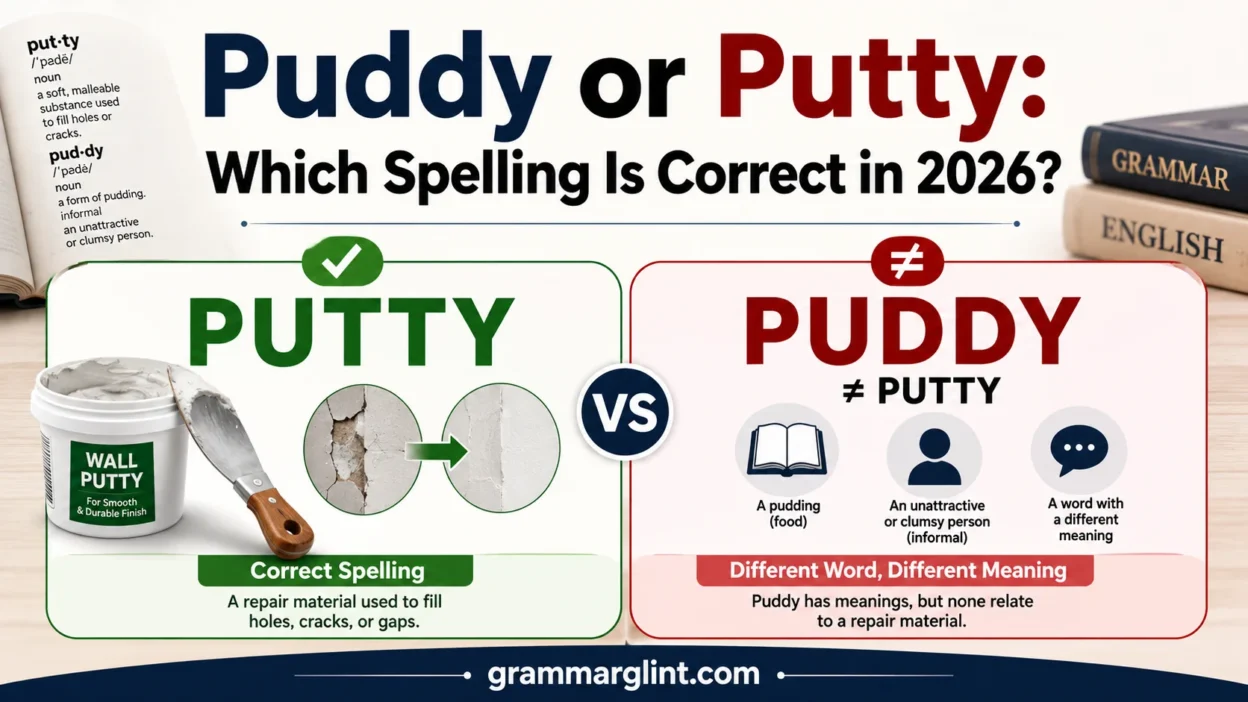
Puddy or Putty can confuse people because both words sound similar, but putty is the standard spelling used in English writing and speech. Many people search for these words because they are almost identical when spoken quickly in everyday speech. This can cause confusion, uncertainty, and spelling mistakes for English learners, students, and native speakers. If you’re staring at a computer screen and wondering which word is correct, the answer is simple: putty is the correct spelling, while puddy is usually a misspelling. In writing, choosing the right form can improve your spelling confidence and keep your writing look professional instead of careless or unprofessional.
The meaning and difference become easier to remember when you understand the context. Putty is a soft material used for filling holes, sealing glass, and repairing surfaces. Learning why this one spelling is correct helps you avoid the same mistake, make sure you choose the right word, and tell the difference in any situation.
The context can change how you understand putty. You may see this flexible material during wall repairs, when filling a crack near a window, or while doing woodworking and plumbing repairs. Children may work with modeling clay or clay, but children’s modeling clay and putty are not always the same material. PuTTY, however, has a completely different meaning because it is an SSH client used on a computer. In this linguistic and contextually different use, PuTTY, SSH, and client belong to technology rather than home repair.
This is where linguistics can help you understand how a tiny letter can create spelling landmines. If someone calls the material puddy in a DIY forum or DIY conversation, you can spot the wrong letter easily. It may sound like a magical goo, but the spelling still matters. Friends may enjoy your newfound linguistic superpowers when you know exactly which word to use. By the end of this guide, you can feel less alone and less confused when choosing, using, and reading these terms.
Quick Answer
The short answer is simple:
Use “putty” when you mean the soft material used for filling, sealing, glazing, or repairing.
Puddy is also a legitimate English word, but it has a different meaning and much lower frequency. Merriam-Webster defines puddy as an adjective meaning pudgy, while Collins describes it as a rare British adjective meaning short and podgy.
That distinction matters because a spelling comparison doesn’t always have a single winner. Sometimes two spellings are both real words with unrelated meanings.
Consider these examples:
- The carpenter used putty to fill the hole in the wood.
- The dictionary lists puddy as a rare adjective meaning pudgy.
The first sentence concerns a material. The second describes a physical appearance. Neither word replaces the other.
The easiest rule to remember
If you could reasonably put wall, wood, window, glazing, or epoxy before the word, you almost certainly mean putty.
For example:
- wall putty
- wood putty
- glazing putty
- epoxy putty
- plumber’s putty
You wouldn’t normally use puddy in these combinations.
Comparison Table
| Feature | Putty | Puddy |
| Standard dictionary word | Yes | Yes |
| Main grammatical role | Noun; also verb in some usage | Adjective |
| Common meaning | Soft material used for filling, glazing, sealing, or repair | Rare adjective meaning pudgy or podgy |
| Wall repair | Correct | Incorrect |
| Wood repair | Correct | Incorrect |
| Window glazing | Correct | Incorrect |
| Common in everyday English | Yes | No, comparatively rare |
| Common collocations | Wall putty, wood putty, putty knife | Very limited |
| Pronunciation | Commonly /ˈpʌt.i/ | Depends on dialect and dictionary tradition |
| Professional writing | Preferred for the material | Use only when its actual meaning applies |
| Proper-name use | Possible, depending on context | Possible, depending on context |
The key difference isn’t simply spelling. The words belong to different semantic categories.
Putty names a material. Puddy functions as an adjective in the dictionary definitions cited above.
What Does Putty Mean?
Putty is a soft material that can be shaped, spread, pressed, or worked into gaps before it hardens or otherwise sets, depending on its formulation.
Cambridge defines putty as a soft substance resembling clay that is used especially to hold glass in window frames or fill small holes in wood. Its American Dictionary definition similarly describes it as a thick, soft material that becomes hard when it dries.
The word covers more than one modern product. Today’s putties can have very different chemical compositions and intended uses.
For example, a product sold as putty might be designed for:
- Repairing small holes in wood
- Glazing windows
- Filling cracks or imperfections
- Sealing certain joints
- Plumbing applications
- Automotive repairs
- Model-making
- Craft projects
- Industrial applications
That means putty describes a broad class of materials rather than one universal recipe.
Traditional window glazing putty, for instance, differs substantially from modern epoxy putty. The name tells you something about the material’s form and function, but you still need to check the particular product for its composition and intended application.
Wall Putty Meaning in English
Wall putty refers to a material used to prepare or smooth a wall surface before finishing, especially painting.
It can help fill minor surface imperfections and create a more even base. In construction and home-improvement contexts, the exact formulation varies by product and region.
A wall-preparation process might involve:
- Cleaning the surface.
- Repairing major cracks or defects.
- Applying the appropriate putty or filler.
- Allowing the material to cure or dry.
- Sanding where the product instructions require it.
- Applying primer or another suitable coating.
- Painting the finished surface.
The important linguistic point is straightforward: the established term is “wall putty,” not “wall puddy.”
Wood Putty and Other Types of Putty
Wood putty is designed for filling small imperfections in wooden surfaces. Depending on the formulation, it can be used to improve the appearance of holes, dents, or other minor defects.
Other terms you’ll encounter include:
- Glazing putty — traditionally associated with securing glass in window frames.
- Plumber’s putty — a soft plumbing compound used in certain sealing applications.
- Epoxy putty — a two-part or reactive material that cures into a harder substance.
- Modeling putty — material used for shaping, sculpting, or model-making.
- Silly Putty — a well-known elastic toy material with unusual physical properties.
These products don’t necessarily behave alike. Calling all of them simply “soft filler” would miss important technical differences.
Read More: Me Either vs Me Neither: The Real Difference Explained
What Does Puddy Mean?
Here’s where the comparison gets more interesting.
Puddy is a real word, but it isn’t the standard spelling for the repair material called putty.
Merriam-Webster lists puddy as an adjective meaning pudgy. Its etymology is given as possibly related to Low German puddig, meaning swollen or pudgy.
Collins gives a related but more specifically marked definition. It labels puddy in British English as a rare adjective meaning short and podgy.
So a sentence such as:
The puddy child had round cheeks.
uses puddy in an adjectival sense.
That doesn’t make puddy an alternative spelling of the material putty.
Why This Matters
English contains many pairs that look similar but aren’t interchangeable.
For example:
- affect and effect
- principal and principle
- stationary and stationery
- complement and compliment
- putty and puddy
The spelling difference may be tiny, yet the semantic difference can be substantial.
Key Differences
The clearest way to understand the distinction is to look beyond the letters.
Spelling
The material is spelled putty.
The rare adjective is spelled puddy.
That extra d isn’t a decorative variation. It creates a different lexical item.
Meaning
Putty refers primarily to a soft material used for filling, glazing, sealing, repairing, or related purposes.
Puddy can describe someone or something as short and podgy or pudgy according to dictionary sources.
Part of Speech
Putty is commonly a noun.
For example:
We need some putty for the window.
Puddy is listed as an adjective in the dictionary sources above.
That means the grammatical behavior differs as well as the spelling.
Context
Context often makes the correct choice obvious.
If you’re discussing:
- a wall
- a window
- wood
- glazing
- a repair
- a putty knife
- a filler
- a sealant
then putty is the logical word.
If you’re describing someone as short and podgy in a context where the rare adjective is appropriate, puddy may be the intended word.
Which Spelling Should You Use?
For almost every practical writing situation involving the material, use putty.
This applies to:
- Home-improvement instructions
- Product descriptions
- Construction writing
- Technical documents
- DIY articles
- School assignments
- Academic writing
- Business communication
- Customer-service messages
- General conversation
For example:
Correct:
Apply a thin layer of putty to the damaged area.
Incorrect for the material:
Apply a thin layer of puddy to the damaged area.
The second sentence changes the word into something that doesn’t carry the intended material-related meaning.
However, don’t automatically “correct” Puddy when you see it in a proper name, quotation, title, or another context where that spelling is intentional.
That’s a different situation entirely.
How Do You Pronounce Putty?
Cambridge gives the pronunciation of putty as /ˈpʌt.i/ in British English and /ˈpʌt̬.i/ in American English.
A simple pronunciation guide for American English is:
PUT-ee
The first syllable carries the primary stress.
The spelling can still trip people up because English pronunciation doesn’t always map neatly onto individual letters. In American English, the middle t can have a flap-like sound in natural speech, which makes putty sound somewhat like “puddy” to some listeners.
That sound similarity likely contributes to the spelling confusion.
But pronunciation doesn’t determine spelling.
That’s an important lesson for English learners: two words can sound similar without being interchangeable in writing.
Putty in Sentences
Putty Examples
Here are natural examples showing how putty works in different contexts:
- The contractor applied wall putty before painting the room.
- She used wood putty to fill the small hole in the cabinet.
- The old window frame needed fresh glazing putty.
- Use a putty knife to spread the compound evenly.
- The repair required a small amount of epoxy putty.
- The instructions say to let the putty cure before sanding it.
- He bought a tub of putty for the weekend repair project.
- The artist used modeling putty to shape the miniature.
Notice how naturally putty connects with repair and material-related vocabulary.
Puddy Examples
Because puddy is rare, examples should reflect its actual dictionary sense rather than inventing a common meaning.
For example:
- The old dialect used “puddy” as an adjective for someone short and podgy.
- The dictionary records puddy as a rare adjective.
The word can also appear as a proper name or surname, where capitalization and context determine its function.
The important point is that these uses don’t establish puddy as the normal spelling of the material.
Common Mistakes
Using Puddy for the Repair Material
This is the most common mistake in this comparison.
If you mean a substance used to fill a hole or secure glass, write putty.
The painter used putty to smooth the damaged area.
Not:
The painter used puddy to smooth the damaged area.
Treating Puddy and Putty as Interchangeable
Similar spelling doesn’t mean identical meaning.
The dictionaries themselves demonstrate the difference. Cambridge defines putty as a material, while Merriam-Webster and Collins give puddy an adjectival meaning related to being pudgy or podgy.
Changing a Proper Name to Putty
This mistake works in the opposite direction.
Suppose a person, character, brand, username, or fictional figure is called Puddy.
Changing it to Putty would alter the name.
Proper names don’t follow ordinary spelling-correction rules in the same way common nouns do.
Trusting Informal Online Spelling
Internet discussions can be useful for discovering how people actually write. They aren’t automatically authoritative evidence of standard spelling.
A social-media post can contain:
- A typo
- A deliberate misspelling
- A joke
- Slang
- A username
- A regional form
- A character name
- An autocorrect error
Search visibility and dictionary status aren’t the same thing.
Putty: Word History and Origin
The history of putty reaches back well beyond modern wall-repair products.
The word has long been associated with materials used for glazing and filling. Its historical development reflects the evolution of building materials and window construction.
Modern readers sometimes imagine putty as one specific gray paste. Historically and technically, however, the category has covered different formulations.
That distinction matters because language often preserves an old material name while technology changes what the product actually contains.
In other words, the word survived even as the chemistry evolved.
Is Putty Countable or Uncountable?
Putty is commonly used as an uncountable noun.
That’s why these sentences sound natural:
- We need some putty.
- There isn’t enough putty.
- She bought a little putty.
- The worker applied more putty.
You generally don’t say:
I bought three putties.
when you simply mean three quantities of the material.
However, English can make material nouns countable when the meaning shifts toward types, products, containers, or individual units.
For example, a technical discussion could distinguish between several types of putty.
The grammar therefore depends on what you’re counting.
Common Putty Collocations and Word Combinations
Certain words frequently appear alongside putty.
| Expression | Meaning or use |
| Wall putty | Material used to prepare or smooth wall surfaces |
| Wood putty | Material used to fill imperfections in wood |
| Glazing putty | Material associated with securing or sealing window glass |
| Plumber’s putty | Soft compound used for certain plumbing sealing tasks |
| Epoxy putty | Reactive putty that cures into a harder material |
| Putty knife | Flat tool used to spread or scrape putty and similar compounds |
| Putty compound | General term for a putty-based material |
| Apply putty | Spread or place putty onto a surface |
| Fill with putty | Use putty to fill a gap or imperfection |
| Putty a surface | Apply putty to prepare or repair it |
These combinations provide a useful spelling test.
If a sentence naturally involves a putty knife, for example, you’re dealing with putty, not puddy.
Is Putty the Same as Slime?
No. Putty and slime aren’t automatically the same material.
The confusion often comes from commercial products and children’s sensory toys. Some products use words such as slime, putty, goo, or compound in their marketing.
Their physical behavior can overlap. Yet their intended uses and formulations can differ dramatically.
Traditional repair putty is designed for a practical purpose such as filling, glazing, or sealing.
Sensory putty may be designed to:
- Stretch
- Bounce
- Mold
- Squish
- Flow slowly
- Pick up small particles
- Provide tactile stimulation
Cambridge’s examples of putty include products such as Silly Putty and magnetic putty, demonstrating how broad the word’s modern commercial use can become.
Still, calling a product putty slime doesn’t make puddy a spelling variant.
Putty in Real-World Usage
Everyday Conversation
In everyday English, putty usually appears when someone discusses repairs, construction, crafts, or a particular product.
For example:
“Do we have any putty?”
“Grab the putty knife.”
“The wood needs a little putty before we paint it.”
These are ordinary, natural uses.
Home Improvement and Professional Communication
Accuracy matters more in professional contexts because a small vocabulary error can create confusion.
A contractor, carpenter, painter, or technician may need to distinguish among:
- Filler
- Putty
- Caulk
- Sealant
- Adhesive
- Plaster
- Joint compound
- Epoxy
These aren’t interchangeable terms.
For instance, putty and caulk may both fill gaps, but they can serve different purposes and have different properties.
Academic and Technical Writing
Technical writing should use the terminology established for the material or process being discussed.
If a laboratory, engineering document, construction specification, or materials report identifies a product as a particular type of putty, changing the spelling to puddy would introduce an error.
The same principle applies to academic assignments.
Use the established technical term rather than relying on phonetic spelling.
Product Descriptions and Reviews
Product pages frequently combine putty with a descriptor:
- Wood repair putty
- Wall putty
- Epoxy putty
- Glazing putty
- Modeling putty
- Plumber’s putty
When reviewing such products, retaining the manufacturer’s actual product terminology can also prevent unnecessary ambiguity.
Puddy in Names, Characters, and Popular Culture
Puddy can also appear as a proper name.
One of the best-known examples is David Puddy, a fictional character from Seinfeld. That use has nothing to do with the material putty.
This illustrates why context matters.
If someone writes:
Puddy is my favorite character.
the spelling isn’t an error simply because putty is a more common English word.
The same principle applies to:
- Surnames
- Character names
- Usernames
- Brand names
- Titles
- Place names
- Quoted material
A proper name has its own spelling identity.
Why Do People Search for “Puddy or Putty”?
The search query “puddy or putty” makes sense because several forms of confusion can converge.
Similar Pronunciation
In some accents and casual speech, putty can sound close enough to puddy to create uncertainty.
Spelling From Sound
Someone who hears a word without seeing it may reasonably try to reconstruct the spelling.
English makes this especially tricky because spelling and pronunciation often developed through different historical paths.
Typing Errors
One misplaced letter can turn putty into puddy.
This happens frequently with short words because there are fewer letters to visually anchor the spelling.
Online Language
Social media and messaging encourage fast, informal writing. A misspelling can spread simply because readers understand it from context.
Names and Characters
A person searching for a name such as Puddy may encounter results for putty because search engines recognize related-looking strings.
That doesn’t mean the two words have the same dictionary meaning.
On the Internet
Search Results and Informal Posts
Search engines are designed to help users find relevant information. They don’t function as spelling judges.
A search for puddy can return pages about:
- People
- Characters
- Surnames
- Informal language
- The dictionary adjective
- Misspellings of putty
- Products or usernames
That variety is precisely why search results should be interpreted rather than blindly copied.
Memes and Social Media
Internet culture often plays with spelling.
People deliberately alter words for humor, emphasis, imitation, or inside jokes. A funny spelling can then become familiar within a particular community.
That doesn’t automatically make it standard English.
A useful distinction is:
Common online usage ≠ standard dictionary usage.
Related Words You May Confuse With Putty
Putty vs. Paste
Paste is a broad term for a thick substance that can be spread or applied.
Putty is more specific and often refers to a material intended for filling, glazing, repair, or shaping.
Putty vs. Plaster
Plaster is generally used as a coating or building material for walls, ceilings, and other surfaces.
Putty typically handles smaller repairs or specific filling and sealing jobs.
The products aren’t interchangeable simply because both can appear in construction.
Putty vs. Caulk
Both can fill gaps, but their intended applications and physical behavior differ.
Caulk is commonly used to create flexible seals around joints and seams. Putty can have different purposes depending on its formulation.
Putty vs. Filler
Filler is a broader functional term.
Putty can serve as a filler, but not every filler is putty.
Putty vs. Slime
Slime is generally associated with soft, stretchy, flowing, or sensory materials. Putty can describe both practical repair materials and certain toy or modeling products.
The context determines which meaning applies.
Read More: Make Sure vs Be Sure: The Difference Explained With Examples
FAQs
1. Is “puddy” a correct English word?
No. Puddy is generally considered a misspelling when you mean the soft material used for filling, sealing, or repairing surfaces. The correct word is putty.
2. What is the correct spelling, puddy or putty?
The correct spelling is putty. Use it when referring to a material used for repairs, filling holes, sealing glass, or similar tasks.
3. Why do people confuse puddy and putty?
People often confuse them because puddy and putty sound very similar, especially during quick everyday speech. That similarity can lead to spelling mistakes.
4. What does putty mean?
Putty is a soft material commonly used to fill holes, seal glass, repair surfaces, and complete certain woodworking or home repair jobs.
5. Can I use “puddy” in formal writing?
It’s best not to use puddy when you mean putty. In school, work, or other formal writing, putty is the standard spelling.
6. Is PuTTY the same as putty?
No. PuTTY is the name of an SSH client used for computer connections. Putty is a physical material used for filling, sealing, or repairing surfaces.
7. Is putty used for wall repairs?
Yes. Putty can be used for various wall repair tasks, such as filling small holes, cracks, and uneven areas before finishing or painting.
8. Is putty the same as modeling clay?
Not necessarily. Putty and modeling clay can have similar textures, but they serve different purposes and aren’t always made from the same materials.
9. How can I remember the spelling of putty?
A simple trick is to remember that the standard repair material is spelled putty, with a t. Writing the word a few times can also strengthen your spelling confidence.
10. Which one should I use in everyday writing?
Use putty when referring to the repair material. If you’re talking about the computer program, use PuTTY with its proper capitalization.
Conclusion
The difference between puddy or putty is simple once you know the correct spelling. Putty is the standard English word for a soft material used for filling, sealing, and repairing surfaces, while puddy is generally a spelling mistake in this context. Because the two forms sound similar, it’s easy to understand why people sometimes mix them up.
Remembering putty becomes even easier when you connect it with familiar uses such as wall repairs, window sealing, and woodworking. Also keep PuTTY separate in your mind because it refers to an SSH client rather than a physical material. With this distinction in mind, you can use the right spelling confidently in everyday conversations and writing.

Aria Jane is a senior language writer and grammar specialist at Grammar Glint. She focuses on English grammar, spelling variations, vocabulary, and writing clarity. Through detailed research and practical examples, Aria helps readers understand language rules and avoid common mistakes. Her articles are designed to make English learning accessible for students, professionals, and everyday writers seeking reliable language guidance.