Theater or Theatre depends on regional preference. Theater is preferred in American English, while theatre is common in British English and other varieties of English worldwide. Both spellings refer to the same basic English word, but their spelling differs in the final letters ‘e’, ‘r’, ‘er’, and ‘re’.
The origins of these spellings explain why the difference can sometimes confuse writers. Although the terms look different, they express the same concept and can often be used interchangeably based on the audience and context. In practical writing, following the preferred regional form helps keep your language clear and consistent.
The meaning can also depend on the type of entertainment. Theatre often describes live performances, including modern and classical plays, live dramatic stage productions, and the art form performed on a stage. Theater can also describe a place where people watch movies, such as a movie theater, while movie theatre is common in British usage.
A traditional or classical connotation may sometimes make theatre feel more formal, but the choice mainly depends on regional conventions and particular contexts. These examples provide a useful guide for choosing the most appropriate and suitable form when discussing plays, movies, productions, or any different kind of entertainment enjoyed by society.
Quick Answer
| Question | Answer |
| Is theater correct? | Yes. It is the standard American English spelling. |
| Is theatre correct? | Yes. It is the standard British English spelling. |
| Do they usually mean the same thing? | Yes. |
| Are they pronounced differently because of spelling? | Usually no. Accent can affect pronunciation. |
| Which should Americans normally use? | Theater |
| Which should British writers normally use? | Theatre |
| Which spelling does IELTS accept? | Both British and American spellings. |
| Should official names be changed? | No. Keep the organization’s or venue’s established spelling. |
| Does theater have specialized meanings? | Yes, including theater of war. |
| Does theatre have specialized meanings? | Yes, including operating theatre in British English. |
A useful rule is simple:
Match the spelling to your variety of English and stay consistent.
That one habit solves most theater vs. theatre questions.
The Main Difference
The central difference is spelling, not the basic meaning.
American English generally favors the -er ending:
- theater
- center
- meter
- fiber
British English commonly uses the -re form:
- theatre
- centre
- metre
- fibre
That doesn’t mean the British spelling is “more correct” or the American spelling is a simplified mistake. English developed multiple spelling conventions over centuries, and different varieties eventually standardized different forms.
The word theatre itself has a long history. Its roots trace back through French and Latin to Greek theatron, meaning a place for viewing.
Theater in American English
In American English, theater is the normal spelling in everyday writing.
For example:
- We went to the theater last night.
- The new movie theater has twelve screens.
- She studied musical theater in college.
- The school is producing a theater program this year.
- Broadway theaters attract audiences from around the world.
American English also uses theater in the broader sense of dramatic performance or the performing-arts field.
So you might say:
She wants to pursue a career in theater.
Here, theater doesn’t mean a building. It refers to the profession or art form.
Oxford’s American English dictionary gives both the venue and performing-arts meanings for theater. It also recognizes the specialized expression theater of war.
Theatre in British English
British English normally uses theatre:
- We went to the theatre last night.
- The theatre was packed.
- She works in theatre.
- The theatre company is touring nationally.
- He studied musical theatre at university.
British English also commonly uses cinema rather than movie theater when referring to a building where films are shown.
That distinction isn’t absolute across all English varieties, but it is a useful regional clue.
Oxford lists theatre for the building, the art of dramatic performance, and related uses. It also identifies operating theatre as a British English medical expression.
Comparison Table
| Feature | Theater | Theatre |
| Standard US spelling | Yes | No, though it appears in proper names |
| Standard UK spelling | No | Yes |
| Core meaning | Place or art of dramatic performance | Place or art of dramatic performance |
| Movie venue | Common in US English | Less common in UK English, where cinema is usual |
| Performing arts | Common | Common |
| Pronunciation | Generally the same word | Generally the same word |
| Plural | theaters | theatres |
| Medical use | Usually operating room in US English | operating theatre in UK English |
| Military use | theater of war | theatre of war |
| Official names | Follow the established name | Follow the established name |
The table reveals something important: the spelling isn’t a measure of correctness by itself.
Context decides which form looks natural.
What Does Theater Mean?
Theater is a noun with several connected meanings.
A Building or Venue
The most concrete meaning is a place where people watch performances.
For example:
The theater opens at 7 p.m.
The building may contain a stage, seating areas, backstage facilities, lighting equipment, dressing rooms, and other spaces needed for performances.
In American English, theater can also mean a building where movies are shown:
We saw the new science-fiction film at the movie theater.
Cambridge defines theater as a building, room, or outdoor structure with seating where people can watch performances, movies, or other activities.
The Performing Arts
The word can also describe the art or activity of writing, producing, and performing plays.
For example:
She has worked in theater for more than a decade.
Here, the word isn’t referring to a physical building.
A Specialized Area of Activity
In expressions such as theater of war, the word describes a geographical area where military operations occur.
For example:
The Pacific theater became a major area of conflict during World War II.
Oxford recognizes this formal military sense as a place where warfare or fighting takes place.
What Does Theatre Mean?
Theatre carries the same core meanings as theater but follows the spelling convention associated with British English.
It can refer to:
- a building where plays are performed
- dramatic performance as an art
- the theater profession
- a performance or theatrical production
- an operating room in British English
- a geographical area of military operations
For example:
The theatre company announced its new season.
Or:
She hopes to work in theatre after graduation.
In British English, theatre is not a special or unusually formal version of theater. It’s simply the standard regional spelling.
Is Theater or Theatre Correct?
Both are correct.
The real question is which form fits your audience and context.
Choose Theater for American English
Use theater when you’re writing standard American English.
This includes:
- US school assignments
- American websites
- US newspapers
- American business writing
- American social media content
- US-focused blogs
- American academic writing
For example:
The local theater announced three new productions.
Choose Theatre for British English
Use theatre when writing standard British English.
This includes:
- UK publications
- British academic writing
- UK-focused websites
- British cultural organizations
- British educational materials
For example:
The local theatre announced three new productions.
Neither sentence is inherently better. Each follows a different regional convention.
Read More: Me Either vs Me Neither: The Real Difference Explained
Why Do Some American Theaters Use “Theatre”?
This is one of the most common sources of confusion.
You may live in the United States, write American English, and still encounter a venue called something like:
- Grand Theatre
- Community Theatre
- State Theatre
- Royal Theatre
That doesn’t make theatre the standard American spelling.
Organizations and venues can choose their own names. Proper names have their own identity and shouldn’t be “corrected” simply because another spelling is more common in your variety of English.
A Practical Example
Suppose an American performing-arts organization officially calls itself:
Downtown Theatre Company
If you’re writing about that organization, retain Theatre.
Don’t change it to:
Downtown Theater Company
That would alter the organization’s name.
General spelling rules apply to ordinary words. Proper names follow their established forms.
This distinction matters in journalism, academic writin and business communication because changing a proper name can create factual errors.
In Official Names
Official names deserve special treatment.
Consider the difference between:
- The theater opened downtown.
- The Downtown Theatre opened downtown.
The first uses a general noun. The second may contain an organization’s or venue’s official name.
When a name is involved, check the organization’s own spelling.
This rule applies far beyond theater/theatre. The same principle governs names such as Centre, Center, Colour, and Color when they appear in official titles.
Pronunciation
Despite the spelling difference, theater and theatre are generally pronounced as the same word within a given accent.
Cambridge gives these broad pronunciations:
- US: /ˈθiː.ə.t̬ɚ/
- UK: /ˈθɪə.tə(r)/
The exact sound can vary by accent.
IPA Pronunciation
| Word | US pronunciation | UK pronunciation |
| Theater | /ˈθiː.ə.t̬ɚ/ | /ˈθɪə.tə(r)/ |
| Theatre | /ˈθiː.ə.t̬ɚ/ | /ˈθɪə.tə(r)/ |
Cambridge lists both spellings with the same US and UK pronunciation patterns.
Syllable Breakdown
A practical learner-friendly breakdown is:
the-a-ter
The word has three syllabic beats in many common pronunciations.
In rapid speech, the middle vowel can become less prominent. That’s one reason the word may sound slightly different from how learners expect it to sound from its spelling.
Common Pronunciation Mistakes
A frequent mistake is assuming that theatre must have a completely different pronunciation because it has -re at the end.
It doesn’t.
Another mistake involves stressing the wrong syllable. The first syllable normally receives the main stress.
Think:
THEE-uh-ter
rather than placing strong emphasis on the final syllable.
Accent matters, too. A British speaker and an American speaker may pronounce the word differently without either pronunciation being incorrect.
The Origin of Theater and Theatre
The history of this word stretches back thousands of years.
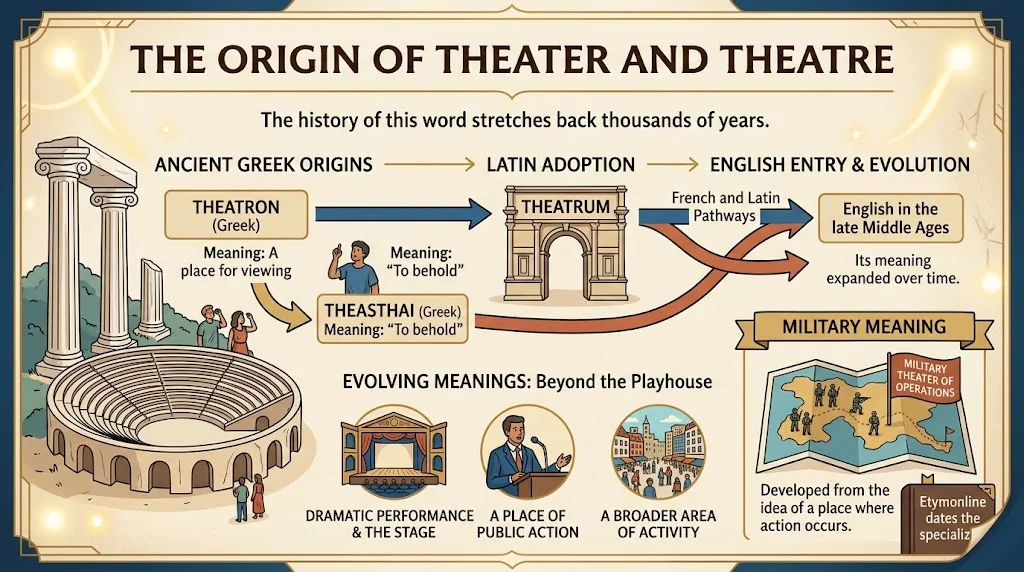
English ultimately inherited the word from the Greek theatron, which meant a place for viewing. The Greek word relates to theasthai, meaning “to behold.” It passed into Latin as theatrum and then entered English through French and Latin pathways.
The word appeared in English in the late Middle Ages. Its meaning expanded over time.
It could refer not only to a physical playhouse but also to:
- dramatic performance
- the stage
- a place of public action
- a broader area of activity
The military meaning developed from this broader idea of a place where action occurs. Etymonline dates the specialized sense of a region where war is fought to the 20th century.
How Did the “-re” Spelling Develop?
The modern -re spelling became established in Britain after earlier English usage showed variation.
Historical sources connect the British form with French influence. American English ultimately retained or revived the -er form.
This is similar to other spelling differences between American and British English.
| American English | British English |
| theater | theatre |
| center | centre |
| meter | metre |
| fiber | fibre |
These patterns don’t apply mechanically to every word. Still, they show why theater/theatre belongs to a much larger history of English spelling variation.
Regional Usage
English isn’t a single, uniform system. Different regions have developed their own conventions.
American English
Theater is the normal spelling.
Examples include:
- movie theater
- community theater
- theater department
- theater production
- musical theater
American English also commonly uses theater in the broader sense of the performing arts.
British English
Theatre is the standard spelling.
Examples include:
- theatre company
- theatre production
- musical theatre
- theatre critic
- theatre director
British English commonly uses cinema for a movie venue, although theatre can still refer to theatrical performance more broadly.
Canadian English
Canadian spelling often combines features associated with both American and British English.
The Canadian government’s Language Portal specifically notes that Canadians generally spell theatre and centre with -re, contrasting them with the American forms theater and center.
That makes Canadian usage particularly useful as a reminder that English spelling isn’t always a clean two-column US-versus-UK system.
Australian English
Australian English generally follows theatre in this word.
However, regional English should always be treated as a living system rather than a rigid checklist. Institutional preferences and proper names can still override a general spelling convention.
Theater and Theatre in Different Contexts
The surrounding words can tell you a lot about which meaning is intended.
Performing Arts
Both forms can refer to dramatic performance.
American:
She studied musical theater.
British:
She studied musical theatre.
The meaning remains essentially the same.
Movies
American English strongly favors:
movie theater
British English more commonly uses:
cinema
For example:
We went to the movie theater after dinner.
versus:
We went to the cinema after dinner.
The spelling difference isn’t the only regional difference here. The vocabulary surrounding the word changes too.
Education
Schools and universities may offer:
- theater studies
- theatre studies
- drama
- performing arts
- musical theater
- musical theatre
Use the terminology preferred by the institution.
If a university officially calls its program Theatre Studies, don’t rewrite the title as Theater Studies merely because you’re using American English elsewhere.
Professional Communication
Consistency matters in:
- resumes
- cover letters
- academic papers
- company websites
- press releases
- publications
- marketing materials
1. If your document follows American English, use theater in ordinary usage.
2. If it follows British English, use theatre.
3. If you’re quoting or naming an organization, preserve its original spelling.
Special Expressions You Should Know
The word becomes more interesting when it moves beyond the stage.
Theater of War
Theater of war is a formal military expression.
It refers to a geographical area where military operations occur.
For example:
The Pacific theater was a major focus of Allied military operations during World War II.
In this expression, theater doesn’t mean a playhouse.
The metaphor makes sense historically because theater developed a broader meaning involving a place where significant action unfolds. Oxford lists theatre/theater of war or operations as a formal use.
Operating Theatre
In British English, operating theatre refers to a hospital room where surgery takes place.
American English generally uses:
operating room
So these are regional equivalents:
| British English | American English |
| operating theatre | operating room |
| theatre nurse | operating-room nurse, depending on context |
| in theatre | in the operating room |
Oxford specifically identifies operating theatre as a British English medical term.
This is an important distinction because the word has moved far beyond its theatrical roots.
Theater Kid
Theater kid is an informal American expression for someone, often a student, who is deeply involved in theater activities.
A theater kid might spend much of their time:
- rehearsing plays
- performing musicals
- learning lines
- singing
- dancing
- working backstage
- discussing productions
- participating in drama clubs
The expression is informal and often playful.
For example:
She was a theater kid in high school and still performs today.
The British spelling would normally be theatre kid if the surrounding writing follows British conventions.
Examples of Theater in Sentences
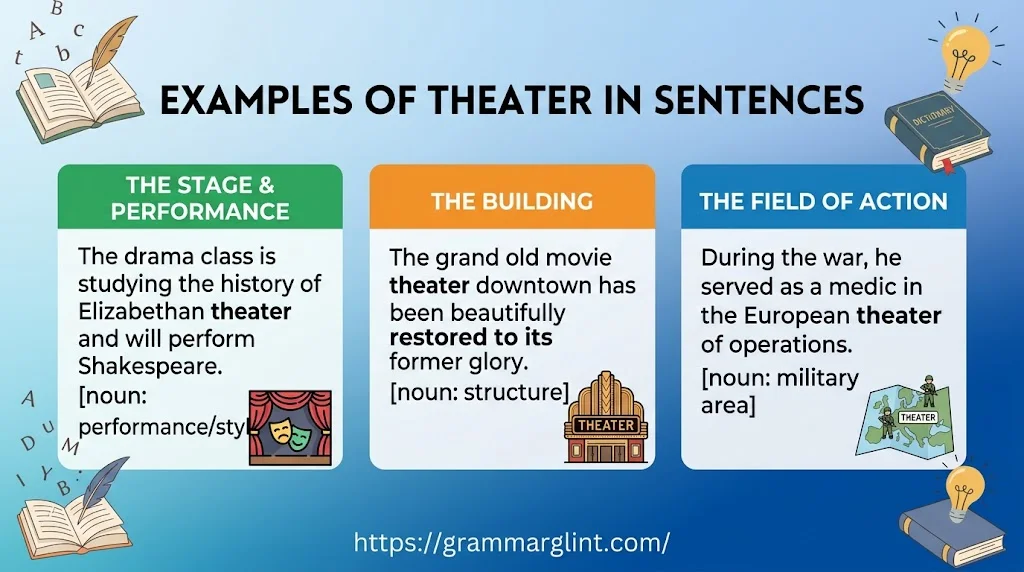
Here are natural examples using American English:
- The theater was nearly full on opening night.
- We bought tickets at the movie theater.
- She hopes to build a career in theater.
- The university has a strong theater program.
- The community theater is staging a new musical.
- He works backstage at a local theater.
- The film will arrive in theaters next Friday.
- Their theater company specializes in contemporary drama.
- She became interested in musical theater as a teenager.
- The military commander studied the Pacific theater of operations.
Examples of Theatre in Sentences
Here are comparable examples using British English:
- The theatre was packed for the evening performance.
- She works in theatre.
- The theatre company is touring the country.
- He studied musical theatre at university.
- The new theatre opened last autumn.
- She became a respected theatre critic.
- The play returns to the theatre next month.
- The theatre production received strong reviews.
- The patient was taken to the operating theatre.
- The conflict spread into another theatre of war.
Notice that the meanings don’t suddenly change when the spelling changes.
The regional convention changes. The basic concept usually doesn’t.
Common Mistakes
Assuming One Spelling Is Wrong
This is the biggest mistake.
Theater isn’t an incorrect version of theatre. Theatre isn’t an incorrect version of theater.
Each belongs to a recognized variety of English.
Mixing Both Spellings Randomly
Suppose an American article says:
The new theatre has a large theater program.
That combination might be correct if Theatre is part of a proper name. Otherwise, the inconsistent spelling looks accidental.
Choose one regional convention and stick with it.
Changing Official Names
If an organization uses Theatre in its official name, preserve it.
A proper name isn’t a spelling error just because it doesn’t match your preferred regional convention.
Confusing Theater With Cinema
In American English:
movie theater
In British English:
cinema
These terms overlap in meaning, but they don’t always carry the same regional flavor.
Confusing Performing Arts With Military Usage
Compare:
The theater presented a new play.
with:
The Pacific theater was a major area of military operations.
The same noun appears in both sentences, but the context changes its meaning.
Confusing Operating Theatre With a Performance Venue
An operating theatre is a medical room in British English.
It isn’t a place where actors perform.
The historical connection lies in the older sense of theatre as a designated place where people observe an activity.
Grammar Rules for Theater and Theatre
Part of Speech
Theater and theatre are primarily nouns.
They can refer to a physical place:
The theater is closed.
Or to an activity or field:
She works in theater.
The same distinction applies to theatre.
Singular and Plural Forms
The plural follows the regional spelling:
- theater → theaters
- theatre → theatres
Examples:
Three theaters opened downtown.
Three theatres opened downtown.
Countable and Uncountable Uses
When referring to a specific venue, the noun is countable:
The city built a new theater.
When referring to the art or profession, it can function as an uncountable noun:
She works in theater.
Oxford recognizes both the building and performing-arts uses.
Capitalization
Use lowercase when the word is a general noun:
We went to the theater.
Capitalize it when it forms part of a proper name:
The Royal Theatre announced its new season.
The capitalization depends on whether you’re naming something specific, not on whether you choose theater or theatre.
Should You Use Theater or Theatre in IELTS?
Yes, either spelling can be used.
IELTS states that it accepts both British and American spellings. The test also exposes candidates to English varieties from different regions, including the UK, North America, and Australasia.
The important point is consistency.
For example, don’t casually switch between:
- theater
- theatre
- center
- centre
- color
- colour
without a reason.
If you naturally write American English, theater is perfectly acceptable.
If you naturally write British English, theatre is perfectly acceptable.
A spelling mistake is different from choosing a legitimate regional variant.
Does AP Style Recommend Theater or Theatre?
For American journalism, AP Style is a major reference point. The current AP Stylebook is the 58th edition for 2026–2028, and AP identifies Merriam-Webster as its primary dictionary reference for spelling, style, usage, and related matters.
For an American-English article, theater is therefore the natural general spelling.
However, style rules don’t give writers permission to alter official names.
If a venue or organization officially uses Theatre, retain that spelling when referring to its name.
The practical newsroom rule is straightforward:
Use the standard spelling for ordinary words. Preserve the established spelling of proper names.
Can You Use Both Theater and Theatre in the Same Article?
Yes, but you need a reason.
Good Example
The theater opened in 1920. Its official name is the Grand Theatre.
This works because the second spelling is part of a proper name.
Poor Example
The new theater offers several theatre programs and has three theaters.
If the article follows American English and none of the forms belong to official names, this looks inconsistent.
Best Practice
Choose a style at the beginning:
American English: theater, theaters, theatergoer
British English: theatre, theatres, theatregoer
Then maintain that choice throughout the article.
A Simple Decision Guide
Use this quick decision tree when you’re unsure.
Theater or Theatre?
|
Is it an official name?
/ \
Yes No
| |
Keep the official Identify your
spelling English variety
|
———————
| |
American English British English
| |
THEATER THEATRE
This simple approach prevents most spelling mistakes.
Related Words and Commonly Confused Terms
Theater and Theatre
These are regional spelling variants in most ordinary contexts.
Theater and Cinema
Theater commonly means a movie venue in American English.
Cinema is more common in British English for that specific meaning.
Theater and Auditorium
An auditorium is a room or hall designed for an audience.
A theater can contain an auditorium, but the terms aren’t always interchangeable.
Theater and Playhouse
A playhouse usually refers specifically to a building or venue associated with theatrical performances.
It has a more literary or traditional feel than the everyday word theater.
Theater and Drama
Drama refers to plays, dramatic works, or a genre.
Theater/theatre can refer to the broader art, industry, venue, or practice of performance.
So:
Drama is a form of literature.
isn’t exactly the same as:
Theater is a performing art.
The terms overlap, but they aren’t synonyms in every context.
Real-Life Usage: Three Practical Cases
Case Study: An American School
Imagine a US high school announcing:
The spring theater production begins Friday.
Theater is the natural choice because the school is using American English.
If the drama department’s official name is Lincoln High School Theatre Department, however, the proper name should remain unchanged.
Case Study: A British Newspaper
A British publication might write:
The theatre’s new production opens this week.
Here, theatre fits the publication’s regional English.
Changing it to theater simply because both forms appear in American websites would be unnecessary.
Case Study: An International IELTS Candidate
An IELTS candidate may write:
The new theatre opened near my university.
Another candidate may write:
The new theater opened near my university.
Both can be acceptable because IELTS accepts British and American spelling conventions.
The candidate should focus on accurate spelling and consistent usage rather than worrying that one legitimate variant will automatically lose marks.
Expert Language Insight: Why Context Beats Spelling
The deeper lesson behind theater vs. theatre is that English doesn’t operate as one universal spelling system.
A word can be correct in one variety and less common in another without becoming “wrong.”
That distinction matters for learners because dictionaries often label entries by region:
- US
- UK
- Canadian
- Australian
Cambridge explicitly labels theater as the US spelling of theatre.
The better question isn’t:
Which spelling is correct everywhere?
It’s:
Which spelling is standard for the English variety I’m using?
That question leads to a much more accurate answer.
Read More: Combatting or Combating: Which Spelling Is Correct? Explained
FAQs
1. Is “theater” or “theatre” correct?
Both theater and theatre are correct spellings. Theater is standard in American English, while theatre is more common in British English and several other English varieties.
2. Is it “movie theater” or “movie theatre”?
Both are correct, depending on regional spelling. Movie theater is preferred in American English, while movie theatre is commonly used in British English.
3. Does “theater” mean the same as “theatre”?
Yes. Both words can refer to a place where performances take place or to the art of dramatic performance. The main difference is usually regional spelling and, sometimes, context.
4. Which spelling should I use in American English?
Use theater when writing in American English. For example, “We went to the movie theater last night.”
5. Which spelling is preferred in British English?
Theatre is generally preferred in British English. For example, “She performed at a local theatre.”
6. Why do “theater” and “theatre” have different spellings?
The difference comes from regional spelling conventions. American English commonly uses the -er ending, while British English often retains the -re form.
7. Can “theatre” refer to live performances?
Yes. Theatre often refers to live dramatic performances, including plays, musicals, and other stage productions. However, theater can also have this meaning in American English.
8. Can “theater” refer to a movie venue?
Yes. In American English, theater commonly refers to a place where people watch movies. Movie theater is therefore the standard American spelling.
9. Is “theatre” more formal than “theater”?
Not necessarily. Theatre can sometimes feel more traditional or classical because of its association with British usage and live stage performances. However, the spelling itself doesn’t automatically make the word more formal.
10. How do I choose between “theater” and “theatre”?
Consider your audience and the variety of English you’re using. Choose theater for American English and theatre for British English or when following a style that uses the British spelling.
Conclusion
Theater and theatre have the same basic meaning, but their spelling usually depends on regional English conventions. American English favors theater, while British English generally uses theatre. The same pattern applies to expressions such as movie theater and movie theatre.
The easiest way to remember the difference is to match your spelling with your audience. If you’re writing for American readers, choose theater. If you’re following British English, theatre is usually the better choice. Neither spelling is inherently wrong, so consistency matters most.

Aria Jane is a senior language writer and grammar specialist at Grammar Glint. She focuses on English grammar, spelling variations, vocabulary, and writing clarity. Through detailed research and practical examples, Aria helps readers understand language rules and avoid common mistakes. Her articles are designed to make English learning accessible for students, professionals, and everyday writers seeking reliable language guidance.