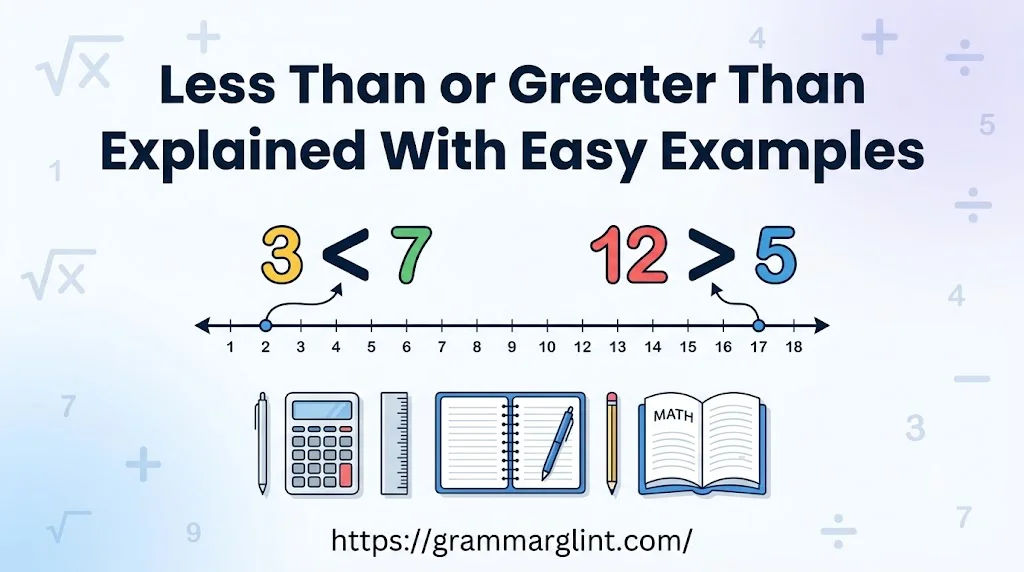
Less Than or Greater Than helps you compare numbers using less than and greater than symbols with simple math rules every day.
In mathematics, maths, and math, the less than sign (<) and greater than sign (>) are also called the less than symbol and greater than symbol. These signs, mathematical symbols, comparison symbols, and every symbol support comparison, mathematical comparison, and numerical comparison. They help you compare two numbers, whether it is the first number, second number, another number, or just a number with different numerical values. You can quickly identify which value is greater, less, bigger, or smaller.
Rather than showing equality, they represent an inequality, and many inequalities explain that equal values are not equal while still helping show relationship and relation between numbers. When I began learning, the sideways carat symbols looked similar, so they felt difficult to handle, but steady practice made them easy to recognize.
The formulas, rules, and notation used with these symbols appear across many fields because their usage is universally accepted. They save time and space, allowing an individual to communicate information through symbolism. You will find them in equations, math problems, classroom examples, and the definition of each sign explains how to solve questions instead of looking for a clear answer immediately. By comparing values, solving exercises, and building confidence, you discover why these symbols are so useful in everyday mathematics.
What Do Less Than and Greater Than Mean?
The less than and greater than symbols compare two numbers or values. They tell you whether one value is smaller or larger than another.
- Less than (<) means the value on the left is smaller than the value on the right.
- Greater than (>) means the value on the left is larger than the value on the right.
For example:
- 4 < 9 means 4 is less than 9.
- 15 > 8 means 15 is greater than 8.
These comparison symbols help us understand relationships between numbers rather than simply identifying their values.
In mathematics, this process is called comparison. Instead of finding an answer through addition or subtraction, you’re deciding which quantity is larger or smaller.
You use these symbols whenever you:
- Compare prices
- Measure distances
- Analyze scores
- Interpret scientific data
- Solve algebra problems
- Write computer code
- Read charts and graphs
Simply put, they help describe how one value relates to another.
Quick Answer
If you only need the short answer, here’s everything you should remember.
- < means less than
- > means greater than
Examples:
- 3 < 10 → Three is less than ten.
- 20 > 7 → Twenty is greater than seven.
- 55 < 100 → Fifty-five is less than one hundred.
- 200 > 50 → Two hundred is greater than fifty.
A simple trick makes these symbols easy to remember.
The open side always faces the larger number, while the pointed end always points toward the smaller number.
Think of the symbol as an open mouth that always wants the bigger value.
Comparison Table
| Feature | Less Than (<) | Greater Than (>) |
| Meaning | Smaller than | Larger than |
| Symbol | < | > |
| Read As | Is less than | Is greater than |
| Larger Number Faces | Open side | Open side |
| Smaller Number Faces | Pointed side | Pointed side |
| Example | 6 < 9 | 12 > 4 |
| Opposite Symbol | > | < |
| Common Uses | Comparing values, measurements, prices | Comparing values, scores, quantities |
This table summarizes the essential differences between the two symbols and serves as a quick reference whenever you’re unsure.
Understanding the Less Than Symbol (<)
The less than symbol (<) indicates that the number before the symbol has a lower value than the number after it.
For instance:
- 2 < 8
- 17 < 35
- 120 < 500
Each statement tells you the first number is smaller.
Instead of thinking about the symbol itself, focus on the relationship between the numbers.
Imagine comparing two stacks of books. If one stack contains five books and another contains twelve books, you would write:
5 < 12
The first stack simply has fewer books.
Definition
The less than symbol means:
The value on the left is smaller than the value on the right.
That’s all it means. Every example follows this same rule.
How the Symbol Works
The pointed end always points toward the smaller value.
Example:
8 < 15
The pointed tip faces 8, while the wider opening faces 15 because fifteen is larger.
You don’t need to memorize complicated rules. Instead, identify the larger number first, and the symbol naturally falls into place.
Reading Less Than Correctly
Read each comparison exactly as it appears.
Examples:
- 7 < 20
- Seven is less than twenty.
- 45 < 90
- Forty-five is less than ninety.
- 0 < 3
- Zero is less than three.
Reading expressions aloud strengthens your understanding and helps prevent mistakes.
Simple Examples
| Comparison | Meaning |
| 1 < 5 | One is less than five |
| 12 < 18 | Twelve is less than eighteen |
| 25 < 30 | Twenty-five is less than thirty |
| 99 < 100 | Ninety-nine is less than one hundred |
| 350 < 500 | Three hundred fifty is less than five hundred |
Notice how every statement follows the same pattern.
Understanding the Greater Than Symbol (>)
The greater than symbol (>) means the value on the left is larger than the value on the right.
Examples include:
- 9 > 2
- 100 > 75
- 500 > 450
Each comparison tells you the first number has the greater value.
Definition
The greater than symbol means:
The value on the left is larger than the value on the right.
Whether you’re comparing whole numbers, decimals, fractions, or variables, this definition never changes.
How the Symbol Works
The open side always faces the larger value.
For example:
50 > 10
The wider opening faces 50 because fifty is larger.
Meanwhile, the pointed tip directs toward the smaller number.
Reading Greater Than Correctly
Read comparisons naturally from left to right.
Examples:
- 18 > 9
- Eighteen is greater than nine.
- 400 > 200
- Four hundred is greater than two hundred.
- 7 > 3
- Seven is greater than three.
Practicing aloud helps build confidence and reduces confusion during exams.
Simple Examples
| Comparison | Meaning |
| 6 > 2 | Six is greater than two |
| 25 > 18 | Twenty-five is greater than eighteen |
| 100 > 99 | One hundred is greater than ninety-nine |
| 750 > 500 | Seven hundred fifty is greater than five hundred |
| 1000 > 999 | One thousand is greater than nine hundred ninety-nine |
Once you understand that the wider side always faces the larger value, these examples become easy to recognize.
Less Than vs Greater Than: The Main Difference
Although the symbols look alike, they express opposite relationships.
| Less Than | Greater Than |
| Shows a smaller value | Shows a larger value |
| Uses the < symbol | Uses the > symbol |
| Reads as “is less than” | Reads as “is greater than” |
| Point faces smaller number | Point faces smaller number |
| Open side faces larger number | Open side faces larger number |
Here are a few comparisons:
| Correct Statement | Explanation |
| 8 < 15 | Eight is smaller than fifteen. |
| 15 > 8 | Fifteen is larger than eight. |
| 40 < 100 | Forty is smaller than one hundred. |
| 100 > 40 | One hundred is larger than forty. |
Notice that both statements can describe the same two numbers. Only the order changes.
For example:
- 12 < 20
- 20 > 12
Both are equally correct because they express the same relationship from opposite directions.
Which Symbol Is Correct?
Choosing the correct symbol starts with identifying the larger number.
Ask yourself one question:
Which value is bigger?
If the number on the left is smaller, use <.
If the number on the left is larger, use >.
Examples:
| Numbers | Correct Symbol |
| 4 and 10 | 4 < 10 |
| 90 and 15 | 90 > 15 |
| 500 and 800 | 500 < 800 |
| 45 and 21 | 45 > 21 |
| 100 and 1,000 | 100 < 1,000 |
A quick mental comparison usually solves the problem within seconds.
When to Use Less Than (<)
Use the less than symbol whenever the first value is smaller.
Examples:
- A child is 8 years old, and the age requirement is 12.
8 < 12
- Your wallet contains $15, but the item costs $25.
15 < 25
- Today’s temperature is 18°C, while yesterday’s was 24°C.
18 < 24
When to Use Greater Than (>)
Use the greater than symbol whenever the first value is larger.
Examples:
- You scored 95 on the test, while your friend scored 82.
95 > 82
- A marathon is 42 kilometers, while a 10K race is 10 kilometers.
42 > 10
- One company earned $8 million, while another earned $5 million.
8 > 5
How to Read Less Than and Greater Than Correctly
Many students understand the symbols but struggle to read them aloud. Reading them correctly reinforces their meaning.
For example:
| Expression | Read As |
| 4 < 9 | Four is less than nine |
| 30 > 12 | Thirty is greater than twelve |
| 75 < 100 | Seventy-five is less than one hundred |
| 500 > 300 | Five hundred is greater than three hundred |
Always read from left to right.
Don’t try to interpret the symbol first. Instead, read the first number, say the comparison, and then read the second number.
For example:
- 16 < 20
- Sixteen is less than twenty.
- 90 > 45
- Ninety is greater than forty-five.
This habit improves reading speed and helps eliminate one of the most common beginner mistakes.
Visual Guide: How the Symbols Work
One of the easiest ways to master less than and greater than is to think visually instead of trying to memorize symbols.
The symbols never change their meaning. Once you understand what each side represents, you’ll rarely mix them up.
The Open Side Faces the Larger Number
The wide opening always points toward the larger value.
Examples:
- 3 < 8
- 25 < 100
- 450 < 900
In each example, the open side faces the larger number.
Here’s another way to picture it.
3 < 8
^ ^
Small Large
The opening naturally stretches toward the larger value.
The Pointed Side Faces the Smaller Number
The pointed tip always points to the smaller number.
25 > 10
^ ^
Large Small
This rule works every single time, regardless of whether you’re comparing whole numbers, decimals, fractions, or variables.
Number Line Visualization
A number line makes comparisons much easier.
0—-1—-2—-3—-4—-5—-6—-7—-8—-9—-10
Numbers farther to the right are always greater.
Numbers farther to the left are always smaller.
Examples:
- 2 < 7
- 5 < 10
- 9 > 4
- 10 > 6
Whenever you’re unsure, imagine where each number sits on the number line.
Read More: Policys or Policies: What Is the Plural of “Policy”? Explained
The Hungry Alligator Trick (and Its Limitations)
Many teachers introduce the symbols using the Hungry Alligator idea.
Imagine the symbol is an alligator’s mouth.
The alligator always wants to eat the bigger number.
4 < 9
The mouth opens toward 9 because nine is larger.
Likewise,
15 > 6
The mouth opens toward 15 because fifteen is larger.
While this trick helps younger learners, don’t rely on it forever. Understanding that the open side always faces the larger value works better for advanced math and algebra.
Less Than and Greater Than on a Number Line
A number line isn’t just for beginners. Even mathematicians use number lines to visualize inequalities.
Every number has a fixed position.
As you move right, values increase.
As you move left, values decrease.
For example,
1—-2—-3—-4—-5—-6—-7—-8
Since 2 appears before 6,
2 < 6
Since 8 appears after 5,
8 > 5
Comparing Positive Numbers
Positive numbers are the easiest to compare.
| Comparison | Result |
| 2 and 9 | 2 < 9 |
| 15 and 20 | 15 < 20 |
| 48 and 36 | 48 > 36 |
| 100 and 75 | 100 > 75 |
| 500 and 800 | 500 < 800 |
A larger positive number always lies farther right on the number line.
Comparing Negative Numbers
Negative numbers often confuse students because the larger-looking number isn’t always greater.
Consider this number line.
-10 -9 -8 -7 -6 -5 -4 -3 -2 -1 0
Notice that −2 sits to the right of −7.
That means:
−2 > −7
Even though seven is a larger digit than two, −7 represents a smaller value.
Another example:
- −12 < −4
- −20 < −5
- −1 > −8
Always compare where the numbers appear on the number line, not just their digits.
With Negative Numbers
Negative numbers become much easier once you remember one important rule.
The farther right a negative number appears, the greater its value.
This surprises many learners because it feels backward at first.
Think of temperatures.
A temperature of −3°F is warmer than −10°F.
Therefore,
−3 > −10
Which Negative Number Is Larger?
Here are several examples.
| Comparison | Correct Statement |
| −2 and −9 | −2 > −9 |
| −15 and −6 | −15 < −6 |
| −100 and −50 | −100 < −50 |
| −8 and −3 | −8 < −3 |
| −1 and −12 | −1 > −12 |
The closer a negative number is to zero, the greater it becomes.
Examples That Often Confuse Students
Consider these comparisons.
Example 1
-4 __ -9
Correct answer:
−4 > −9
Example 2
-18 __ -7
Correct answer:
−18 < −7
Example 3
-1 __ 2
Correct answer:
−1 < 2
Any positive number is always greater than any negative number.
Easy Rule to Remember
Keep these simple rules in mind.
- Positive numbers are always greater than negative numbers.
- Zero is greater than every negative number.
- The negative number closest to zero has the greater value.
These three rules solve most comparison questions involving negative numbers.
Comparing Decimals
Decimals follow the same comparison rules as whole numbers.
However, you must compare digits from left to right.
Start with the whole number.
If they’re equal, compare the tenths.
If those match, compare the hundredths, and so on.
Less Than Examples
| Comparison | Meaning |
| 2.5 < 2.8 | Two point five is less than two point eight |
| 4.25 < 4.8 | Four point two five is less than four point eight |
| 12.09 < 12.5 | Twelve point zero nine is less than twelve point five |
| 8.71 < 8.9 | Eight point seven one is less than eight point nine |
Greater Than Examples
| Comparison | Meaning |
| 9.8 > 9.2 | Nine point eight is greater than nine point two |
| 15.67 > 15.12 | Fifteen point six seven is greater than fifteen point one two |
| 100.4 > 99.9 | One hundred point four is greater than ninety-nine point nine |
| 5.09 > 5.01 | Five point zero nine is greater than five point zero one |
Common Decimal Mistakes
Many students compare only the last digit.
For example,
Some believe:
3.12 > 3.8
This is incorrect.
Compare from left to right.
- Whole numbers are both 3
- Tenths are 1 and 8
Since 1 < 8, the correct comparison is:
3.12 < 3.8
Always compare place values instead of counting digits.
Comparing Fractions
Fractions can also be compared using less than and greater than symbols.
The strategy depends on whether the denominators are the same.
Same Denominator
If both fractions share the same denominator, compare the numerators.
Examples:
- 2/8 < 5/8
- 3/10 < 9/10
- 7/12 > 4/12
Since the denominator stays the same, the larger numerator creates the larger fraction.
Different Denominators
Different denominators require another method.
You can:
- Find a common denominator.
- Convert each fraction to decimals.
- Cross multiply.
Example:
Compare:
2/3 and 3/5
Convert them.
- 2/3 ≈ 0.667
- 3/5 = 0.6
Therefore,
2/3 > 3/5
Mixed Numbers
Mixed numbers contain a whole number and a fraction.
Examples:
- 3½ > 3¼
- 4¾ < 5¼
- 6⅛ < 6⅜
Compare the whole numbers first.
If they’re equal, compare the fractional parts.
Quick Fraction Comparison Tips
- Compare whole numbers before fractions.
- Use common denominators whenever possible.
- Convert to decimals if needed.
- Draw fraction bars for visual comparisons.
- Simplify fractions before comparing them when appropriate.
Comparing Percentages
Percentages represent parts of one hundred, which makes them easy to compare using less than (<) and greater than (>) symbols.
The larger the percentage, the greater the value.
For example:
- 25% < 40%
- 65% > 50%
- 100% > 99%
- 12% < 18%
When percentages include decimals, compare them just as you would decimal numbers.
Examples:
- 12.5% < 12.75%
- 99.9% > 99.1%
Real-Life Percentage Comparisons
You probably compare percentages more often than you realize.
| Situation | Comparison |
| Test score | 92% > 85% |
| Battery level | 18% < 75% |
| Discount | 40% > 25% |
| Completion progress | 80% > 60% |
| Interest rate | 3.5% < 5% |
Understanding percentage comparisons helps you make better decisions when shopping, investing, analyzing reports, or tracking personal goals.
Comparing Variables and Algebraic Expressions
Comparison symbols don’t only work with numbers. They also compare variables, expressions, and equations in algebra.
Instead of comparing known values, you compare quantities that may change.
Variables
A variable represents an unknown value.
For example:
- x < 10
- y > 5
- a < b
These statements describe relationships rather than exact answers.
If x < 10, then x could be:
- 1
- 4
- 8
- 9.99
It cannot be 10 or any number larger than 10.
Inequalities
An inequality compares two expressions using comparison symbols.
Some common inequality symbols include:
| Symbol | Meaning |
| < | Less than |
| > | Greater than |
| ≤ | Less than or equal to |
| ≥ | Greater than or equal to |
| ≠ | Not equal to |
Unlike equations, inequalities often have many possible solutions.
For example:
x > 6
Possible answers include:
- 7
- 10
- 25
- 100
- 6.5
Every value greater than six satisfies the inequality.
Simple Algebra Examples
Example 1
If x = 8, determine whether:
x > 5
Replace x with 8.
8 > 5
This statement is true.
Example 2
If y = 4, determine whether:
y < 3
Replace y with 4.
4 < 3
This statement is false.
Example 3
If a = 15 and b = 20, compare them.
15 < 20
Therefore,
a < b
Learning to compare variables prepares you for algebra, geometry, calculus, and computer programming.
Less Than, Greater Than, and Equal To
Students often confuse less than, greater than, and equal to because all three compare values.
However, each symbol has a unique meaning.
Less Than (<)
The less than symbol means the value on the left is smaller.
Examples:
- 4 < 8
- 20 < 100
- 3.2 < 3.5
Greater Than (>)
The greater than symbol means the value on the left is larger.
Examples:
- 15 > 5
- 90 > 45
- 8.9 > 8.1
Equal To (=)
The equal to symbol shows that two values are exactly the same.
Examples:
- 8 = 8
- 25 = 25
- 10 ÷ 2 = 5
Unlike comparison symbols, the equal sign does not indicate one value is larger or smaller.
Less Than or Equal To (≤)
This symbol means a value can be smaller than or exactly equal to another value.
Examples:
- x ≤ 20
- Age ≤ 18
- Temperature ≤ 32°F
Possible values include the limit itself.
Greater Than or Equal To (≥)
This symbol means a value can be greater than or equal to another value.
Examples:
- x ≥ 5
- Score ≥ 70
- Speed ≥ 60 mph
Again, equality is allowed.
Not Equal To (≠)
The not equal to symbol means two values are different.
Examples:
- 8 ≠ 5
- 12 ≠ 13
- x ≠ 0
This symbol appears frequently in algebra, logic, and programming.
Common Examples
Practice helps reinforce every comparison rule you’ve learned.
Whole Numbers
| Comparison | Correct Statement |
| 5 and 12 | 5 < 12 |
| 70 and 20 | 70 > 20 |
| 150 and 250 | 150 < 250 |
| 900 and 450 | 900 > 450 |
| 1,000 and 2,000 | 1,000 < 2,000 |
Decimals
| Comparison | Correct Statement |
| 4.5 and 4.8 | 4.5 < 4.8 |
| 12.6 and 12.1 | 12.6 > 12.1 |
| 0.75 and 0.8 | 0.75 < 0.8 |
| 9.99 and 10 | 9.99 < 10 |
| 7.02 and 7.01 | 7.02 > 7.01 |
Fractions
| Comparison | Correct Statement |
| 1/4 and 3/4 | 1/4 < 3/4 |
| 7/8 and 5/8 | 7/8 > 5/8 |
| 2/5 and 3/5 | 2/5 < 3/5 |
| 5/6 and 1/2 | 5/6 > 1/2 |
| 9/10 and 1 | 9/10 < 1 |
Percentages
| Comparison | Correct Statement |
| 25% and 40% | 25% < 40% |
| 90% and 82% | 90% > 82% |
| 5% and 15% | 5% < 15% |
| 100% and 95% | 100% > 95% |
| 67% and 67% | 67% = 67% |
Variables
| Comparison | Meaning |
| x < 15 | x is smaller than 15 |
| y > 100 | y is greater than 100 |
| a ≤ 20 | a is less than or equal to 20 |
| b ≥ 9 | b is greater than or equal to 9 |
| c ≠ 0 | c is not zero |
Everyday Situations
Comparison symbols simplify many daily decisions.
| Situation | Example |
| Shopping | $15 < $25 |
| Test scores | 98 > 87 |
| Temperature | 18°F < 32°F |
| Distance | 12 miles > 8 miles |
| Height | 5 ft < 6 ft |
| Age | 14 years < 18 years |
| Savings | $800 > $500 |
| Rainfall | 3 inches > 1 inch |
Less Than vs Greater Than in Real Life
Many people associate these symbols only with school math, but they appear in countless real-world situations.
Shopping and Discounts
Imagine you’re choosing between two stores.
- Store A offers a 20% discount.
- Store B offers a 35% discount.
Since:
20% < 35%
Store B provides the larger discount.
Similarly, if one product costs $45 and another costs $60, then:
$45 < $60
The first item is less expensive.
Money and Budgeting
Budgeting relies on comparisons every day.
Suppose your monthly income is $4,500, and your expenses total $3,900.
You can compare them as:
$4,500 > $3,900
This means your income exceeds your spending.
Financial advisors regularly compare:
- Income versus expenses
- Savings versus debt
- Investment returns
- Interest rates
- Loan balances
Clear comparisons make better financial decisions possible.
Cooking and Measurements
Recipes require accurate measurements.
For example:
- 1/2 cup < 3/4 cup
- 250 ml < 500 ml
- 2 teaspoons < 1 tablespoon
Even small measurement differences can change the final result.
Temperature
Weather forecasts constantly compare temperatures.
Examples:
- 15°F < 32°F
- 95°F > 80°F
- −5°F < 10°F
Meteorologists use comparison symbols when analyzing climate data and historical records.
Time and Scheduling
Time comparisons help organize daily activities.
Examples:
- 20 minutes < 45 minutes
- 9:00 AM < 11:00 AM
- 2 hours > 90 minutes
These comparisons simplify scheduling, planning, and productivity.
Sports Scores
Sports are full of comparisons.
Examples:
- 28 > 17
- 5 goals > 2 goals
- 112 points > 104 points
The higher score determines the winner.
Science
Scientists compare measurements continuously.
Examples include:
- Temperatures
- Chemical concentrations
- Population growth
- Air pressure
- Rainfall
- Mass
- Speed
Accurate comparisons help researchers identify trends and draw reliable conclusions.
Business and Finance
Businesses compare performance every day.
Common comparisons include:
- Monthly sales
- Revenue growth
- Profit margins
- Customer satisfaction
- Conversion rates
- Market share
- Production costs
For example:
- $2.5 million > $2.1 million
- 18% > 12%
These comparisons guide strategic decisions.
Data Analysis
Analysts compare large amounts of information using inequalities.
Examples include:
- Website traffic
- Survey results
- Stock prices
- Population statistics
- Healthcare data
- Election results
- Academic performance
Without comparison symbols, interpreting complex datasets would be far more difficult.
Most Common Mistakes and How to Avoid Them
Many students understand the meaning of less than (<) and greater than (>), yet they still make simple mistakes during tests or while solving problems. Most of these errors happen because they rush through comparisons or rely on memory tricks instead of understanding the symbols.
Learning these common mistakes will help you avoid them.
Reversing the Symbols
This is the mistake learners make most often.
For example, someone wants to write:
8 is less than 12
Instead, they write:
8 > 12
This statement is incorrect because 8 is smaller than 12.
The correct comparison is:
8 < 12
How to avoid it:
Identify the larger number first. Then place the symbol so its open side faces that larger number.
Looking at the Wrong Side of the Symbol
Some learners pay attention only to the pointed end and forget about the open side.
For example:
15 < 8
At first glance, the symbol may seem correct, but the opening faces 8, even though 15 is larger.
The correct statement is:
15 > 8
Always check where the wide opening points before moving on.
Confusing Greater Than With Less Than
Because both symbols look similar, it’s easy to swap them accidentally.
| Incorrect | Correct |
| 20 < 10 | 20 > 10 |
| 75 > 100 | 75 < 100 |
| 9 > 12 | 9 < 12 |
Reading the comparison aloud often helps you catch these errors.
Comparing Negative Numbers Incorrectly
Negative numbers can feel counterintuitive.
Many students believe:
−8 > −3
This is incorrect.
Since −3 is closer to zero, it has the greater value.
The correct comparison is:
−8 < −3
Think of a thermometer. A temperature of −3°F is warmer than −8°F, so −3 is greater.
Mixing Up Decimals
Decimals should always be compared by place value, not by the number of digits.
Incorrect thinking:
3.12 > 3.8
Correct comparison:
- Whole numbers are equal (3)
- Compare tenths (1 and 8)
Since 1 < 8,
3.12 < 3.8
Compare digits from left to right until you find the first difference.
Misreading Inequalities
Expressions containing variables can also cause confusion.
For example:
x > 12
Some students think this means x equals 12.
It actually means x can be any value greater than 12, such as:
- 13
- 18
- 100
- 1,000
Understanding this difference is essential in algebra.
Confusing Equal To With Greater Than or Less Than
The equal sign has a completely different purpose.
Compare these statements:
| Expression | Meaning |
| 5 = 5 | Same value |
| 5 < 8 | Smaller value |
| 8 > 5 | Larger value |
Never replace one symbol with another unless the relationship actually changes.
Easy Tricks to Remember the Symbols
Understanding the symbols is more reliable than memorizing them, but a few simple tricks can make learning easier.
Open Mouth Faces the Bigger Number
This is one of the easiest memory aids.
Imagine the symbol is an open mouth.
The mouth always opens toward the larger value.
Examples:
5 < 9
The mouth opens toward 9.
20 > 8
The mouth opens toward 20.
This trick works for whole numbers, decimals, fractions, and percentages.
Number Line Trick
Visualize both numbers on a number line.
The number farther to the right is always greater.
Example:
2 ———- 9
Since 9 lies farther right,
2 < 9
This method becomes especially helpful when working with negative numbers.
Arrow Direction Method
Some learners picture the pointed end as an arrow.
The arrow always points toward the smaller value.
Example:
18 > 6
The point faces 6, the smaller number.
Practice Pattern Method
Recognition improves with repetition.
Practice comparing different kinds of values.
- Whole numbers
- Decimals
- Fractions
- Percentages
- Negative numbers
- Variables
After enough practice, you’ll recognize the correct symbol almost instantly.
Practice Questions
Try solving these comparisons before checking the answers.
Beginner Questions
Choose the correct symbol.
- 7 __ 15
- 30 __ 18
- 50 __ 50
- 2 __ 9
- 100 __ 75
Intermediate Questions
- 4.8 __ 4.3
- −6 __ −2
- 3/4 __ 2/4
- 45% __ 62%
- 12.05 __ 12.5
Challenge Questions
- −15 __ −22
- 5/6 __ 0.75
- 99.99 __ 100
- 8.125 __ 8.12
- If x = 18, determine whether x > 12.
Answer Key With Explanations
| Question | Answer | Explanation |
| 7 __ 15 | < | Seven is smaller. |
| 30 __ 18 | > | Thirty is larger. |
| 50 __ 50 | = | Both values are equal. |
| 2 __ 9 | < | Two is smaller. |
| 100 __ 75 | > | One hundred is greater. |
| 4.8 __ 4.3 | > | Eight tenths is greater than three tenths. |
| −6 __ −2 | < | Negative six is farther left on the number line. |
| 3/4 __ 2/4 | > | Three fourths is larger. |
| 45% __ 62% | < | Forty-five percent is smaller. |
| 12.05 __ 12.5 | < | Compare tenths first. |
| −15 __ −22 | > | Negative fifteen is closer to zero. |
| 5/6 __ 0.75 | > | Five sixths is approximately 0.833. |
| 99.99 __ 100 | < | Ninety-nine point ninety-nine is smaller. |
| 8.125 __ 8.12 | > | Compare thousandths place. |
| x > 12 | True | Because x equals 18. |
Related Mathematical Symbols
Less than and greater than belong to a larger family of mathematical comparison symbols.
Understanding these symbols makes algebra, geometry, statistics, and programming much easier.
| Symbol | Meaning | Example |
| < | Less than | 5 < 8 |
| > | Greater than | 12 > 7 |
| = | Equal to | 9 = 9 |
| ≠ | Not equal to | 8 ≠ 5 |
| ≤ | Less than or equal to | x ≤ 20 |
| ≥ | Greater than or equal to | y ≥ 12 |
| ≈ | Approximately equal to | π ≈ 3.14 |
Each symbol expresses a different relationship between values.
Learning them together helps build a stronger mathematical foundation.
Where You’ll Use These Symbols
Many people stop thinking about comparison symbols after school. In reality, they appear in countless professions and everyday activities.
Elementary School Math
Children first learn comparison symbols while comparing:
- Numbers
- Objects
- Shapes
- Measurements
These lessons build number sense and logical reasoning.
Algebra
Algebra introduces inequalities such as:
- x > 10
- y ≤ 8
- a < b
These expressions describe ranges of possible values instead of one exact answer.
Geometry
Geometry uses comparisons to describe:
- Side lengths
- Angle measures
- Areas
- Volumes
For example:
- 90° > 45°
- 12 cm < 18 cm
Statistics
Statisticians compare:
- Mean values
- Percentages
- Probabilities
- Survey responses
- Population data
Comparison symbols make large datasets easier to interpret.
Computer Programming
Programming languages use comparison operators constantly.
Examples include:
- >
- <
- >=
- <=
Programmers use these operators to create conditions, loops, and decision-making logic.
For example:
if score > 90
The program performs an action only if the score exceeds ninety.
Spreadsheets and Formulas
Spreadsheet applications like Microsoft Excel and Google Sheets use comparison operators in formulas.
Examples include:
- Highlight values greater than 100
- Count numbers less than 50
- Filter data based on comparisons
These comparisons automate calculations and data analysis.
Everyday Decision-Making
Whether you’re shopping, budgeting, tracking fitness goals, comparing travel times, or reviewing monthly expenses, you’re constantly deciding whether one value is greater than, less than, or equal to another.
Understanding these symbols helps you interpret information quickly and make informed decisions.
Read More: Has Been vs Have Been: Which One Is Correct?
FAQs
1. What is the difference between less than and greater than?
The less than (<) sign shows that one number is smaller than another, while the greater than (>) sign shows that one number is larger than another.
2. How can I remember which symbol to use?
A simple trick is to think of the symbol as a hungry mouth. The open side always faces the larger number because it “wants” the bigger value.
3. What do the symbols < and > mean?
The < symbol means less than, and the > symbol means greater than. They are used to compare two numbers or values.
4. Are less than and greater than symbols only used in math?
No. While they are most common in mathematics, these symbols also appear in programming, spreadsheets, computer science, and data analysis.
5. What is an inequality?
An inequality is a mathematical statement that shows two values are not equal. It uses symbols such as <, >, ≤, or ≥ to compare values.
6. Can I use these symbols with negative numbers?
Yes. Less than and greater than symbols work with positive numbers, negative numbers, fractions, decimals, and even algebraic expressions.
7. Which number comes first in a comparison?
The first number is placed on the left side of the symbol. The symbol then shows whether it is greater than or less than the number on the right.
8. Why are these symbols important?
They help compare values quickly, solve math problems, write equations and inequalities, and explain relationships between numbers clearly.
9. What mistakes do students commonly make?
The most common mistake is reversing the symbols. Practicing with simple examples and remembering that the open side faces the larger number can help avoid errors.
10. How can I get better at using less than and greater than?
Practice comparing different types of numbers every day. Start with whole numbers, then move to decimals, fractions, and negative numbers until reading the symbols becomes natural.
Conclusion
Understanding Less Than or Greater Than is one of the first steps toward building strong math skills. These simple symbols make it easy to compare numbers, recognize relationships, and solve inequalities with confidence. Once you understand how each sign works and practice using them in everyday examples, you’ll find it much easier to read mathematical expressions and avoid common mistakes. Whether you’re a student, parent, or teacher, mastering these symbols creates a solid foundation for more advanced mathematics.

Aria Jane is a senior language writer and grammar specialist at Grammar Glint. She focuses on English grammar, spelling variations, vocabulary, and writing clarity. Through detailed research and practical examples, Aria helps readers understand language rules and avoid common mistakes. Her articles are designed to make English learning accessible for students, professionals, and everyday writers seeking reliable language guidance.