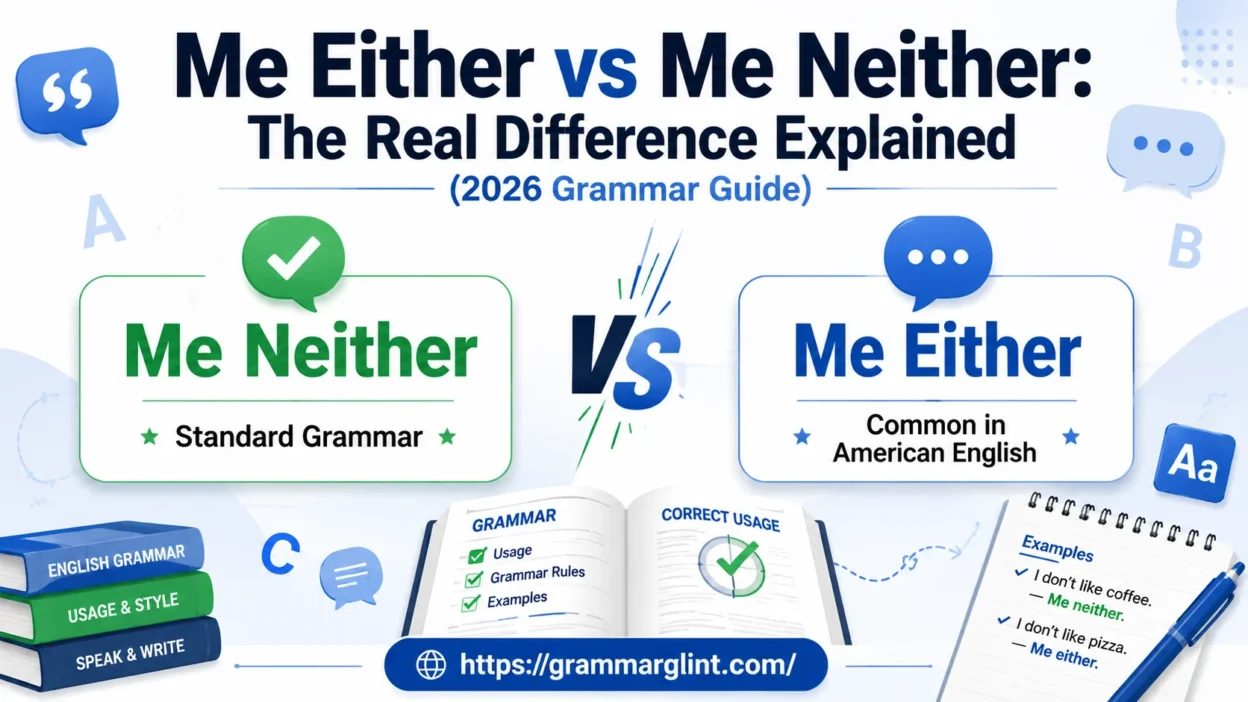
When you are unsure how to apply me either or me neither, the difference becomes clearer once you understand how each phrase works. Me Either vs Me Neither can seem confusing, but the basic rule is simple: after a negative statement, me neither is the correct variation under traditional grammar rules. For example, if someone says, “I don’t like spicy food,” you can respond with me neither.
This form is grammatically correct and helps you communicate clearly. In everyday English, however, me either is widely used in casual conversation, especially in spoken American English. As an English writer and editor, I have seen this confusion come up often in grammar questions because native speakers and English learners may follow different patterns.
The difference is easier to navigate when you focus on the meaning instead of treating both forms as completely interchangeable. The correct usage can also depend on the situation, level of formality, and style of English you choose. Positive statements usually take me too, while negative statements traditionally take me neither.
Still, me either sounds natural to many native speakers in casual conversations, which explains the ongoing debate. Choosing the right expression can sometimes feel like moving through pseudo-awkward waters, but plain English makes the rule easier to remember. Use me neither when you want the traditional form, while recognizing that me either has a place in informal speech. Knowing this distinction can help you avoid common mistakes, understand modern spoken English, and remember the pattern through real examples instead of relying only on isolated grammar rules.
Quick Answer
Here’s the short answer.
“Me neither” is the traditional and grammatically accepted response to a negative statement.
Example
“I don’t enjoy horror movies.”
“Me neither.”
However, “me either” is extremely common in informal American English. Although some teachers consider it less formal, native speakers use it naturally in casual conversations.
Example
“I can’t swim.”
“Me either.”
If you’re writing an academic paper, taking an English exam, or communicating professionally, choose “me neither.” If you’re chatting with friends in the United States, you’ll probably hear “me either” just as often.
The safest rule is simple:
- Formal English: Me neither
- Informal American English: Me either or Me neither
- British English: Me neither is strongly preferred
Comparison Table
| Feature | Me Neither | Me Either |
| Traditional grammar | Correct | Considered informal |
| Meaning | I don’t either | I don’t either |
| Formal writing | Recommended | Avoid |
| Casual conversation | Very common | Very common in the US |
| Academic writing | Preferred | Not recommended |
| Business communication | Appropriate | Better avoided |
| British English | Standard | Rare |
| American English | Common | Extremely common |
| Tone | Slightly formal | Relaxed and conversational |
| Best for English learners | Yes | Only in informal speech |
The table shows an important point. These expressions usually communicate the same idea. The biggest difference lies in grammar expectations and the level of formality.
What Does “Me Neither” Mean?
The phrase “me neither” means “I don’t either” or “the same is true for me.” It expresses agreement with someone who has just made a negative statement.
Unlike many English expressions, me neither doesn’t form a complete sentence by itself. It acts as a shortened conversational response that omits words the listener already understands.
For example:
“I haven’t seen that movie.”
Instead of saying:
“Neither have I seen that movie.”
Most people simply say:
“Me neither.”
The omitted words are understood through context, making the conversation faster and more natural.
When You Should Use Me Neither
Use me neither whenever someone says something negative that also applies to you.
Examples include:
- I don’t eat seafood.
- I can’t drive a truck.
- I haven’t finished my homework.
- I won’t attend the meeting.
- I never drink soda.
Appropriate responses:
- Me neither.
- Neither do I.
- Neither can I.
- Neither have I.
- Neither will I.
Although these responses have slightly different grammar structures, they communicate the same idea.
Why Me Neither Is Grammatically Correct
The word neither already carries a negative meaning.
It means:
- Not this one.
- Not that one.
- Not either.
Because the negative meaning already exists inside the word itself, me neither logically agrees with another negative statement.
Consider this example.
I don’t enjoy spicy food.
Your agreement is also negative.
Me neither.
There’s no contradiction between the original statement and the reply.
This is why grammar books have traditionally accepted me neither as the standard conversational response.
Read More: More Than vs More Then: Which One Is Correct?
Common Conversation Examples
Example One
Emma: I don’t watch reality TV.
Liam: Me neither.
Example Two
Sophia: I haven’t been to New York.
Olivia: Me neither.
Example Three
James: I can’t stay late tonight.
Noah: Me neither.
Example Four
Lucas: I never skip breakfast.
Mason: Me neither.
Notice that the reply stays short because everyone understands the missing words.
What Does “Me Either” Mean?
At first glance, me either seems strange.
After all, either usually appears in negative sentences like these:
- I don’t like tea either.
- She doesn’t work on weekends either.
- We didn’t buy one either.
So why do millions of native speakers respond with “me either”?
The answer lies in spoken English rather than textbook grammar.
Over time, many speakers began shortening longer replies such as:
“I don’t either.”
Eventually, the first two words disappeared.
That left:
Me either.
Even though this shortened version doesn’t perfectly follow traditional grammar rules, it became extremely common in everyday speech, especially across the United States.
Language evolves through usage, and me either is an excellent example of that process.
Why Native Speakers Say Me Either
There are several reasons why this expression became popular.
It feels natural.
People often simplify conversations.
Instead of saying:
I don’t either.
They shorten it to:
Me either.
It matches positive responses.
Most people already say:
Me too.
When responding negatively, many naturally switch to:
Me either.
The rhythm feels similar, making conversations quick and effortless.
People imitate others.
Children hear adults using expressions long before learning grammar rules. As a result, many Americans grow up saying me either without ever questioning it.
Language spreads through communities, television, movies, music, podcasts, and everyday conversations.
Is Me Either Grammatically Correct?
This question creates endless debate.
The honest answer is that it depends on the context.
From a traditional grammar perspective, me neither remains the preferred response.
From a modern linguistic perspective, me either has become an accepted feature of informal American speech because millions of native speakers use it naturally every day.
Many modern dictionaries acknowledge this widespread usage while noting that it is less appropriate in formal writing.
Think of it this way.
Grammar describes how language should work.
Real conversations reveal how language actually works.
Sometimes those two ideas don’t perfectly match.
When Me Either Sounds Natural
You’ll often hear me either in situations such as:
- Conversations with friends
- Family discussions
- Casual texting
- Social media comments
- Podcasts
- TV sitcoms
- Reality television
- Movies
- Everyday workplace conversations
Examples include:
“I don’t like Mondays.”
“Me either.”
“I can’t believe how expensive everything is.”
“Me either.”
“I haven’t finished the project.”
“Me either.”
These exchanges sound perfectly natural in casual American English, even though formal grammar guides may recommend another option.
The Grammar Behind Both Expressions
Understanding the grammar makes everything easier.
Both expressions respond to negative statements, but they arrive there through different grammatical paths.
Imagine someone says:
I don’t enjoy cold weather.
Your reply needs to express agreement with that negative idea.
English offers several ways to do this.
- Me neither.
- Neither do I.
- I don’t either.
- Me either (informal American English).
Although these responses differ slightly in grammar, they all communicate the same meaning.
The real confusion comes from the words either and neither themselves. They look similar, yet they serve different grammatical purposes.
Understanding those roles eliminates most mistakes people make with these expressions.
Responding to Negative Statements
English has a simple pattern for showing agreement.
When someone makes a positive statement, you usually respond with another positive expression.
Examples
“I love Italian food.”
“Me too.”
“I’ve visited Chicago.”
“So have I.”
Negative statements work differently. Instead of repeating the negative word, English typically uses neither or a negative construction with either.
Consider these examples.
| Original Statement | Natural Response |
| I don’t like coffee. | Me neither. |
| I don’t like coffee. | Neither do I. |
| I can’t swim. | Neither can I. |
| I haven’t seen it. | Neither have I. |
| I won’t be there. | Neither will I. |
Notice something important. The helping verb changes depending on the original sentence.
- don’t → Neither do I.
- can’t → Neither can I.
- haven’t → Neither have I.
- won’t → Neither will I.
This pattern follows standard English grammar and appears in textbooks, exams, and professional writing.
How “Neither” Functions in English Grammar
The word neither carries a negative meaning all by itself.
It means “not one and not the other.” Because it is already negative, you don’t usually add another negative word to the same clause.
For example:
- Neither answer is correct.
- Neither student arrived on time.
- Neither option seems practical.
When you reply to someone’s negative statement with me neither, you’re essentially saying:
“The same negative statement applies to me.”
That’s why grammar experts have traditionally preferred this response.
Here are a few more examples.
Conversation
Sarah: I don’t enjoy winter.
Emma: Me neither.
Conversation
Daniel: I haven’t eaten lunch yet.
Noah: Me neither.
Conversation
Olivia: I can’t stay after work.
Sophia: Me neither.
Each response agrees with the negative idea without repeating the entire sentence.
The Role of “Either” in Negative Sentences
Unlike neither, the word either is not negative by itself.
Instead, it works alongside another negative word.
Look at these examples.
- I don’t like broccoli either.
- She isn’t coming either.
- We didn’t buy tickets either.
- They haven’t called either.
Notice that every sentence already contains a negative verb.
Without that negative verb, the sentence would be incorrect.
For example:
❌ I like broccoli either.
✔ I don’t like broccoli either.
This explains why some grammar teachers argue that me either isn’t technically complete. The negative verb has disappeared.
However, spoken English often leaves out words that listeners can easily understand.
Native speakers mentally hear:
I don’t either.
Even though they only say:
Me either.
That’s one reason why the phrase became so common.
Why Grammar Rules and Spoken English Don’t Always Match
Many learners believe grammar rules never change.
In reality, languages evolve every generation.
Words gain new meanings.
Pronunciations shift.
Expressions become shorter.
Grammar adapts.
English is full of examples.
People often say:
- Wanna
- Gonna
- Gotta
- Kinda
- Sorta
These expressions rarely appear in formal writing, yet native speakers use them every day.
The same idea applies to me either.
Traditional grammar favors me neither.
Modern conversation accepts me either in many informal situations.
Neither approach is surprising once you recognize the difference between prescriptive grammar and descriptive grammar.
Prescriptive Grammar
Prescriptive grammar focuses on rules.
It answers questions like:
- What is considered correct?
- What should students write?
- What belongs in formal English?
This approach recommends me neither.
Descriptive Grammar
Descriptive grammar observes how people actually speak.
It asks:
- What do native speakers naturally say?
- Which expressions are common today?
- How has the language changed?
From this perspective, me either is a normal feature of informal American English because millions of people use it every day.
Neither perspective is completely wrong. They simply answer different questions.
The Key Differences
Although these expressions often communicate the same idea, several differences matter depending on where and how you use them.
Grammar Difference
The biggest difference is grammatical tradition.
Me neither follows the standard rule for agreeing with negative statements.
Me either developed through everyday speech and conversational shortcuts.
For formal writing, grammar experts almost always recommend me neither.
Meaning Difference
Interestingly, there is almost no difference in meaning.
Both expressions usually mean:
- I don’t either.
- The same applies to me.
- I agree with your negative statement.
The listener almost never misunderstands either phrase.
Tone Difference
Tone changes more than meaning.
Me neither sounds slightly more polished and careful.
Me either feels relaxed, friendly, and conversational.
That’s one reason younger speakers often choose me either in casual settings.
Formality Difference
Here’s where the distinction matters most.
| Situation | Best Choice |
| Academic essay | Me neither |
| School exam | Me neither |
| Business email | Me neither |
| Job interview | Me neither |
| Casual conversation | Either expression |
| Text messages | Either expression |
| Social media | Either expression |
| Family discussion | Either expression |
When you’re unsure, choosing me neither is always the safer option.
Usage Difference
Frequency also varies by region.
In the United States, you’ll regularly hear both expressions.
In the United Kingdom, me neither remains much more common.
Canadian English generally follows the British preference in formal contexts while still exposing speakers to American media.
Australian English also leans toward me neither, especially in writing.
Because American television, movies, YouTube videos, and podcasts reach audiences worldwide, many English learners encounter me either long before they learn the traditional grammar rule.
Which Expression Is Actually Correct?
This is the question almost everyone asks.
The answer depends on what you mean by correct.
If you’re asking about traditional grammar, the answer is clear.
Me neither is the preferred response after a negative statement.
Grammar guides, style manuals, English teachers, and standardized exams generally recommend this form.
Examples include:
“I don’t understand calculus.”
“Me neither.”
“I haven’t seen that documentary.”
“Me neither.”
These examples fit established grammar conventions and sound appropriate in every setting.
However, language isn’t limited to textbooks.
If you’re asking what native speakers actually say, the picture changes.
Across the United States, you’ll hear me either constantly in conversations. Friends, coworkers, actors, musicians, and television hosts use it naturally without confusing anyone.
That widespread usage doesn’t erase the traditional rule, but it does explain why both expressions continue to exist side by side.
A practical way to think about it is this:
- Want to sound grammatically safe everywhere? Use me neither.
- Want to sound natural in casual American conversations? You’ll hear both, and me either won’t sound unusual.
Understanding the context matters more than memorizing a single rule. Great communicators choose the expression that best fits the situation rather than assuming one phrase works equally well in every setting.
Why Do Americans Commonly Say “Me Either”?
If “me neither” is the traditional grammatical response, why do so many Americans say “me either” instead?
The answer lies in how spoken language naturally evolves. People rarely stop to analyze grammar during everyday conversations. Instead, they choose expressions that are quick, familiar, and easy to say.
Over time, “me either” became part of informal American English through repeated use. Today, you’ll hear it everywhere, from family dinners to office conversations, podcasts, and television shows.
Historical Development
English has never been a fixed language. Words, phrases, and grammar patterns have changed for centuries.
Many expressions that were once considered incorrect eventually became accepted because native speakers used them consistently. Language changes from the ground up, not from grammar books.
The phrase “me either” likely developed as a shortened version of:
“I don’t either.”
As conversations became faster and more informal, speakers dropped the first part of the sentence.
Instead of saying:
“I don’t either.”
They simply replied:
“Me either.”
The listener already understood the missing words, so communication remained clear.
Spoken Language Simplification
People naturally shorten familiar phrases.
Think about how often you hear expressions like:
- Thanks.
- Sounds good.
- No problem.
- Works for me.
- Me too.
None of these are complete sentences, yet everyone understands them.
The same principle applies to me either.
Spoken English favors efficiency. If a shorter response communicates the same idea, speakers often choose it.
Influence of Everyday Conversation
Language spreads through imitation.
Children learn English by listening to parents, teachers, siblings, friends, and media. They don’t begin by studying grammar rules.
If a child hears family members say:
“Me either.”
That expression becomes part of their natural vocabulary.
Later, they may discover that grammar textbooks recommend “me neither.”
Neither version sounds strange to them because both exist in real life.
Is It Becoming Standard English?
Many modern dictionaries recognize “me either” as an informal expression.
That doesn’t mean it has replaced “me neither.” Instead, it reflects actual language use.
Modern linguists often distinguish between:
- Standard written English
- Everyday spoken English
An expression can be common in conversation while still being inappropriate in formal writing.
That’s exactly where “me either” fits today.
Regional Differences Around the English-Speaking World
English varies from country to country. Vocabulary, pronunciation, spelling, and even grammar can change depending on where you are.
The difference between me either and me neither is another example of regional variation.
American English
In the United States, both expressions are widely understood.
Many Americans use me either naturally in casual speech without giving it a second thought.
For example:
“I don’t like waiting in traffic.”
“Me either.”
At the same time, me neither remains common and is often preferred in schools, professional writing, and edited publications.
British English
British English generally favors me neither.
You’ll still hear neither do I, especially in formal or careful speech.
Examples include:
“I haven’t finished yet.”
“Me neither.”
or
“Neither have I.”
The expression me either is much less common in the UK than in the United States.
Canadian English
Canadian English combines influences from both British and American English.
Because of Canada’s close cultural connection with the United States, many Canadians understand and use me either in casual conversation.
However, schools and formal writing still tend to recommend me neither.
Australian English
Australian English usually follows traditional grammar.
Most speakers naturally choose:
“Me neither.”
or
“Neither do I.”
While Australians understand me either, it appears less frequently than in American English.
Which Version Appears Most Often Worldwide?
If you consider English learners, schools, grammar books, and professional writing across the world, me neither remains the more widely recommended expression.
However, if you focus only on casual American conversation, movies, TV shows, and social media, you’ll encounter me either almost everywhere.
This difference explains why learners often receive mixed messages.
One source teaches the traditional rule.
Another reflects real-life speech.
Both represent different aspects of modern English.
Me Neither vs Neither Do I
Another common question is whether you should say me neither or neither do I.
The answer depends on the level of formality and the sentence structure.
Both responses are grammatically correct.
The difference is that neither do I forms a complete grammatical construction, while me neither is a shortened conversational response.
Compare these examples.
| Original Statement | Short Response | Full Response |
| I don’t eat meat. | Me neither. | Neither do I. |
| I can’t drive. | Me neither. | Neither can I. |
| I haven’t finished. | Me neither. | Neither have I. |
| I won’t attend. | Me neither. | Neither will I. |
Notice how the helping verb changes in the complete response.
This pattern follows normal English grammar.
What’s the Difference?
The biggest difference is style.
Me neither sounds conversational.
Neither do I sounds slightly more formal and grammatically complete.
Neither expression changes the meaning.
Which Sounds More Natural?
In everyday conversations, most native speakers choose the shorter response.
Imagine this exchange.
Emma: I don’t drink coffee.
Olivia: Me neither.
It feels quick and effortless.
Using Neither do I isn’t wrong, but it sounds a little more deliberate.
Which Is Better for Formal Writing?
Formal writing rarely includes either expression because dialogue appears less often.
However, if you’re writing dialogue, educational materials, or professional documents, neither do I is generally the stronger choice.
It follows standard grammar without relying on conversational shortcuts.
Me Either vs Me Too
This mistake is extremely common among English learners.
Many people accidentally respond to a negative statement with me too.
For example:
“I don’t like spicy food.”
❌ Me too.
Although native speakers may still understand the intended meaning, the response doesn’t follow standard English usage.
The correct responses are:
- Me neither.
- Neither do I.
- Me either (informal American English).
Why They Are Not Interchangeable
The phrase me too agrees with positive statements.
Examples:
“I love pizza.”
“Me too.”
“I’ve been to California.”
“Me too.”
“I’m excited.”
“Me too.”
Negative statements require a different response.
Examples:
“I don’t like horror movies.”
“Me neither.”
“I haven’t seen that film.”
“Neither have I.”
“I can’t play chess.”
“Me neither.”
Understanding this simple distinction eliminates one of the most common grammar mistakes in spoken English.
Either vs Neither: Understanding the Grammar
To master me either vs me neither, you also need to understand the individual words.
Although they look similar, they serve different purposes.
Meaning of Either
The word either usually refers to one of two choices.
Examples:
- You can choose either option.
- Either answer is acceptable.
- I don’t like either movie.
Notice that either often appears in negative sentences when it means “also not.”
Meaning of Neither
The word neither means “not one and not the other.”
Examples:
- Neither restaurant is open.
- Neither explanation makes sense.
- Neither player scored.
Because neither already carries a negative meaning, it naturally agrees with another negative statement.
Common Sentence Patterns
Here are some useful structures.
| Sentence Pattern | Example |
| Positive + Me too | I like tea. → Me too. |
| Negative + Me neither | I don’t like tea. → Me neither. |
| Negative + Neither do I | I don’t like tea. → Neither do I. |
| Negative + Me either (informal) | I don’t like tea. → Me either. |
Learning these patterns makes conversations smoother and helps you respond confidently without stopping to think about grammar every time.
Sentence Patterns You Should Know
Once you understand a few common sentence patterns, choosing between me either and me neither becomes almost automatic. Instead of memorizing isolated phrases, learn the pattern behind them.
Negative Statement + Me Neither
This is the safest and most widely accepted pattern in English.
Examples
“I don’t enjoy crowded places.”
Me neither.
“I haven’t finished reading the report.”
Me neither.
“I can’t understand this math problem.”
Me neither.
“I won’t be able to attend tomorrow.”
Me neither.
This structure works well in everyday conversations, classrooms, and professional settings.
Negative Statement + Neither Do I
This pattern is grammatically complete because it includes the correct helping verb.
Examples
“I don’t like waking up early.”
Neither do I.
“I can’t drive a motorcycle.”
Neither can I.
“I haven’t watched that series.”
Neither have I.
“I won’t forget your birthday.”
Neither will I.
Notice that the auxiliary verb changes depending on the original sentence.
| Original Verb | Correct Response |
| do / don’t | Neither do I. |
| can / can’t | Neither can I. |
| have / haven’t | Neither have I. |
| will / won’t | Neither will I. |
| did / didn’t | Neither did I. |
| was / wasn’t | Neither was I. |
Learning this table is one of the fastest ways to improve your spoken English.
Positive Statement + Me Too
Don’t confuse negative agreement with positive agreement.
Use me too only after positive statements.
Examples
“I love traveling.”
Me too.
“I’m excited for the weekend.”
Me too.
“I’ve visited New York.”
Me too.
Using me too after a negative sentence is one of the most common mistakes English learners make.
Negative Statement + Me Either (Informal)
Although grammar books generally recommend me neither, you’ll frequently hear me either in informal American English.
Examples
“I don’t watch much TV.”
Me either.
“I can’t believe how expensive everything is.”
Me either.
“I haven’t eaten breakfast.”
Me either.
These responses sound completely natural in casual conversations, especially among American speakers.
Read More: Less Than or Greater Than Explained With Easy Examples
Real-Life Examples
Grammar rules become much easier to remember when you see them in everyday situations. The following examples show how native speakers naturally use these expressions.
Everyday Conversations
Friends and family usually choose the shortest, most natural response.
Example
Alex: I don’t feel like cooking tonight.
Jordan: Me neither.
Example
Emily: I haven’t called Mom yet.
Rachel: Me neither.
Example
Ben: I can’t believe it’s already Friday.
Chris: Me either.
Notice how quickly the conversation moves. No one repeats the entire sentence because the meaning is already clear.
Workplace Communication
Professional communication generally favors grammatically standard expressions.
Example
Manager: I don’t think this report is ready yet.
Employee: Neither do I.
Example
Supervisor: I haven’t reviewed the proposal.
Team Member: Neither have I.
These responses sound polished without feeling overly formal.
Classroom Discussions
Teachers often encourage students to use standard grammar.
Example
Teacher: I don’t think that’s the correct answer.
Student: Neither do I.
Example
Teacher: I haven’t covered that chapter yet.
Student: Me neither.
Both responses are understandable, but grammar-focused classrooms usually prefer neither do I or me neither.
Social Media
Social media reflects how people actually speak rather than how grammar books say they should speak.
You’ll often see comments such as:
- Me either 😂
- Same here.
- Me neither!
- I thought I was the only one.
- Literally me.
Because social platforms encourage casual conversation, me either appears frequently.
TV Shows and Movies
American television has played a major role in popularizing me either.
Characters often speak quickly and naturally.
Example
Character A: I don’t trust him.
Character B: Me either.
Screenwriters usually choose dialogue that sounds authentic rather than overly grammatical.
Books and Journalism
Books vary depending on the author’s style.
Dialogue often reflects natural speech, so both me neither and me either may appear.
Narrative writing, however, follows standard grammar conventions much more closely.
Journalists also distinguish between quoted speech and editorial writing.
- Quoted speech: Preserves the speaker’s exact words.
- Editorial content: Follows standard grammar and style guides.
Common Mistakes and How to Avoid Them
Even advanced English learners occasionally confuse these expressions. Fortunately, most mistakes follow predictable patterns.
Saying “Me Too” After a Negative Statement
This is by far the most common error.
❌
“I don’t like broccoli.”
Me too.
✔
“I don’t like broccoli.”
Me neither.
or
Neither do I.
Remember this simple rule:
- Positive statement → Me too
- Negative statement → Me neither
Thinking “Me Either” Is Always Wrong
Many learners assume me either is completely incorrect because a teacher once corrected them.
That isn’t entirely accurate.
Although me neither is the preferred grammatical choice, me either has become an established part of informal American English.
The better question isn’t whether it’s “wrong.”
Ask yourself:
Is this the right situation?
If you’re writing an essay or taking an English exam, choose me neither.
If you’re chatting with friends in New York or California, me either won’t sound unusual.
Confusing “Either” With “Neither”
These two words have different meanings.
| Word | Basic Meaning |
| Either | One of two |
| Neither | Not one or the other |
Keeping this distinction in mind helps you build correct sentences more naturally.
Mixing Formal and Informal English
Imagine sending this email to your manager.
I haven’t completed the presentation.
Me either.
Although understandable, it sounds too casual.
A better response would be:
Neither have I.
Choosing language that matches the situation is an important communication skill.
Ignoring the Original Speaker’s Sentence
Always listen carefully before responding.
If the original statement is positive, use a positive agreement.
If it’s negative, use a negative agreement.
Compare these examples.
| Original Statement | Correct Response |
| I love sushi. | Me too. |
| I don’t love sushi. | Me neither. |
| I’ve finished. | Me too. |
| I haven’t finished. | Me neither. |
| I can swim. | Me too. |
| I can’t swim. | Me neither. |
This simple habit prevents most grammar mistakes.
Formal vs Informal Usage
Choosing between me either and me neither isn’t only about grammar. It’s also about audience and context.
Different situations call for different levels of formality.
Academic Writing
Academic writing values precision and standard grammar.
If dialogue appears in an essay or language analysis, me neither or neither do I is the safer choice.
Most style guides recommend avoiding me either in formal academic work.
Business Emails
Professional communication should remain clear and polished.
Instead of writing:
Me either.
Consider writing:
Neither do I.
or
I don’t either.
These responses sound professional while remaining natural.
Professional Communication
Meetings, presentations, interviews, and client interactions generally benefit from standard grammar.
Using me neither demonstrates careful language use without sounding stiff.
Casual Conversations
This is where language becomes more flexible.
Among friends and family, both expressions are widely understood.
In the United States, many people naturally say:
Me either.
Others prefer:
Me neither.
Neither choice is likely to interrupt the conversation.
Text Messages and Social Media
Texting encourages speed and informality.
Common responses include:
- Me either.
- Me neither.
- Same.
- Same here.
- Literally.
The context is relaxed, so strict grammar rules matter less than clear communication.
By understanding when each expression fits best, you can adapt your English to different audiences with confidence instead of relying on a single phrase for every situation.
Pronunciation Guide
Although me either and me neither look simple on paper, their pronunciation often surprises English learners. Native speakers don’t always pronounce these words exactly the way they’re spelled. Regional accents also influence how they sound.
Learning the most common pronunciations will help you understand conversations more easily and make your own speech sound more natural.
How Native Speakers Pronounce “Me Neither”
The word neither has two accepted pronunciations in modern English.
- NEE-ther (/ˈniːðər/)
- NYE-ther (/ˈnaɪðər/)
Both are correct.
In the United States, you’ll hear both pronunciations, although NEE-ther is becoming increasingly common. In the United Kingdom, both forms also exist, with preferences varying by region and speaker.
Examples:
“I don’t like mushrooms.”
Me NEE-ther.
or
Me NYE-ther.
Choose one pronunciation and stay consistent during the conversation.
How Native Speakers Pronounce “Me Either”
The word either also has two accepted pronunciations.
- EE-ther (/ˈiːðər/)
- EYE-ther (/ˈaɪðər/)
Both are widely accepted across English-speaking countries.
Examples:
“I haven’t finished yet.”
Me EE-ther.
or
Me EYE-ther.
Again, consistency matters more than choosing one pronunciation over the other.
Common Pronunciation Variations
English pronunciation varies by region.
| Country | Common Preference |
| United States | EE-ther / NEE-ther are very common |
| United Kingdom | Both pronunciations are common |
| Canada | Similar to American pronunciation |
| Australia | Both forms are widely understood |
Because movies, podcasts, and online videos expose learners to many accents, you’ll probably hear every variation over time.
Tips for Sounding Natural
You don’t need a perfect accent to sound fluent.
Instead, focus on these habits.
- Speak clearly instead of speaking quickly.
- Stress the first syllable of either and neither.
- Listen to native speakers from different regions.
- Repeat short conversations aloud.
- Practice common responses until they become automatic.
Fluency comes from consistent practice rather than memorizing isolated words.
Memory Tricks to Never Mix Them Up Again
Grammar becomes much easier when you connect it to simple mental shortcuts.
These memory tricks can help you remember the correct response without stopping to think during a conversation.
The Negative Rule
Ask yourself one question.
Was the original sentence negative?
If the answer is yes, your response should also express negative agreement.
Examples:
“I don’t watch baseball.”
Me neither.
“I haven’t called him.”
Neither have I.
This single question prevents many common mistakes.
The “Too” Test
Look for the word not or another negative word.
If you see one, don’t reply with me too.
Instead, choose one of these:
- Me neither.
- Neither do I.
- Me either (informal American English).
If the original sentence is positive, me too works perfectly.
The Formal Writing Shortcut
Whenever you’re unsure, imagine you’re writing an English exam or a business email.
Choose me neither.
It’s the safest option because it follows traditional grammar and is accepted in every formal setting.
A Simple Conversation Formula
Here’s an easy formula to remember.
| Original Sentence | Best Response |
| Positive | Me too. |
| Negative | Me neither. |
| Formal Negative | Neither do I. |
| Casual American Negative | Me either. |
Many English learners memorize this chart and quickly become more confident in conversations.
FAQs
1. Is “me neither” grammatically correct?
Yes. Me neither is the traditional and grammatically standard way to agree with a negative statement. For example, “I don’t like coffee.” “Me neither.”
2. Is “me either” correct?
Me either is widely used in informal spoken English, especially in American English. Although some traditional grammar guides prefer me neither, “me either” is common in everyday conversation.
3. Should I use “me either” or “me neither”?
Use me neither if you want the safest choice according to traditional grammar. In casual conversation, me either is also commonly understood and accepted by many native speakers.
4. Can I use “me neither” after a positive statement?
No. Me neither normally agrees with a negative statement. After a positive statement, use me too. For example, “I love movies.” “Me too.”
5. Can “me either” be used after a negative statement?
Yes. In casual English, people often say me either after a negative statement. For example, “I don’t watch football.” “Me either.”
6. Is “me neither” more formal than “me either”?
Generally, me neither is considered more traditional and grammatically standard. Me either has a more casual, conversational feel.
7. Do Americans say “me either”?
Yes. Me either is frequently heard in spoken American English. It is especially common in relaxed conversations.
8. What is the difference between “me either” and “me neither”?
Both expressions can show agreement with a negative statement, but me neither follows the traditional grammar rule. Me either is a common informal alternative in everyday speech.
9. What should English learners remember?
A simple rule is enough: use me too for positive statements and me neither for negative statements. You will also hear me either in casual conversations, so recognizing it will help you understand native speakers.
10. Which one should I use in writing?
For formal or academic writing, it is better to avoid both short forms and write a complete response when possible. In informal writing, me neither is the safer traditional choice.
Conclusion
The difference between me either vs me neither becomes much easier when you remember the basic pattern. Me neither is the traditional grammatically correct response to a negative statement, while me either is widely used in casual spoken English. If you are writing something formal, choosing me neither can help you stay closer to standard grammar rules.
At the same time, understanding me either is important because you will likely hear it in everyday conversations, particularly in American English. Knowing why people use both expressions allows you to communicate naturally without getting stuck on a small grammar question. When in doubt, remember: positive statement → me too; negative statement → me neither.

Aria Jane is a senior language writer and grammar specialist at Grammar Glint. She focuses on English grammar, spelling variations, vocabulary, and writing clarity. Through detailed research and practical examples, Aria helps readers understand language rules and avoid common mistakes. Her articles are designed to make English learning accessible for students, professionals, and everyday writers seeking reliable language guidance.