
Laid or Layed can confuse English learners because laid and layed look similar, sound related, and create spelling confusion in everyday writing. In English grammar, this tiny verb has caused head-scratching, uncertainty, and a grammar crisis for students, professionals, and intelligent adults for years. The essential rules can seem difficult because regular verbs usually form the past tense by adding -ed as a standard ending.
This predictable pattern makes layed look like a natural verb form, but lay belongs to the irregular verbs group, so its past-tense forms must be memorized. In standard English and standard American English, laid is the correct form, while layed is usually a common misspelling and spelling error in ordinary writing.
A common mistake appears when writers use the forms interchangeably in everyday writing and then second-guess their choice. This linguistic puzzle becomes easier to untangle with a clear guide and practical explanation instead of relying on arbitrary rules. These perplexing pairs often create grammatical confusions, but mastering their nuances can improve writing accuracy, clarity, and precision.
This common point of confusion gradually disappears when you recognize that English does not always follow a regular -ed pattern. The same careful approach can help with other grammar rules, including Your vs. You’re. Good writing does not need to feel complicated. Knowing the right answer, avoiding errors, and choosing the correct form every time can strengthen your good understanding of English and prevent the confusion that has tripped up many writers.
Quick Answer
Laid is correct. Layed is generally incorrect in standard English.
The verb lay means to put, place, or set something somewhere. Its forms are:
| Verb form | Correct form | Example |
| Base form | lay | I lay the papers on the desk. |
| Past tense | laid | I laid the papers on the desk. |
| Past participle | laid | I have laid the papers on the desk. |
| Present participle | laying | I am laying the papers on the desk. |
Notice something important: lay does not become layed.
English has many regular verbs that take -ed in the past tense. Walk becomes walked. Call becomes called. Play becomes played. But lay uses the irregular-looking form laid.
That means these sentences follow standard English:
- She laid the baby in the crib.
- He laid the keys on the counter.
- They laid the foundation last year.
- We laid the documents on the table.
- The workers laid new cables underground.
The form layed doesn’t belong in those sentences.
Comparison Table
The quickest way to understand the difference is to compare the words with their actual grammatical functions.
| Word | Standard English? | Meaning or function | Example |
| lay | Yes | Put or place something | Lay the book here. |
| laid | Yes | Past tense/past participle of lay | She laid the book here. |
| laying | Yes | Present participle of lay | She is laying the book down. |
| layed | Generally no | Common misspelling of laid | She layed the book here. |
| lie | Yes | Be or rest in a position | I lie on the sofa. |
| lay | Yes | Past tense of lie | I lay on the sofa yesterday. |
| lain | Yes | Past participle of lie | I have lain there for hours. |
| lying | Yes | Present participle of lie | I am lying on the sofa. |
This table reveals why the problem isn’t simply a spelling mistake.
There are actually two different verbs involved:
lay → laid → laid
and
lie → lay → lain
That’s the heart of the confusion.
What Does Laid Mean?
Laid is the past tense and past participle of lay.
The basic meaning of lay is to put or place something somewhere. Cambridge defines it as putting something in a flat or horizontal position, usually carefully or for a particular purpose.
For example:
She laid the letter on the table.
The subject, she, placed the object, the letter, on the table.
That object matters. In its main placement sense, lay is a transitive verb, which means it normally takes a direct object.
Compare:
- She laid the book on the desk.
- He laid the blanket on the floor.
- They laid the tiles carefully.
- We laid the foundation last summer.
In each sentence, something receives the action.
The word laid also appears in many established expressions:
- laid off
- laid out
- laid down
- laid aside
- laid back
- laid claim
- laid the groundwork
- laid the foundation
- best laid plans
So laid isn’t merely a spelling correction for layed. It’s a well-established English form with a wide range of uses.
What Does Layed Mean?
Layed is generally not the standard past tense or past participle of lay.
A writer may produce layed because the regular spelling pattern seems obvious:
lay + ed = layed
That logic works for many verbs, but not here.
The standard form is:
lay → laid
not:
lay → layed
Cambridge’s grammar guidance explicitly identifies laid as the past simple and past participle of lay and notes the spelling laid, not layed.
The mistake usually appears when someone applies a regular verb rule to an irregular verb. English contains plenty of these exceptions. Consider:
- go → went
- buy → bought
- teach → taught
- take → took
- bring → brought
- lay → laid
You wouldn’t write buyed in standard English. You’d write bought.
Likewise, you shouldn’t write layed when the intended verb is laid.
Why Do People Write Layed?
The most obvious reason is regularization.
When speakers encounter an unfamiliar or irregular form, they may unconsciously apply a familiar pattern. Adding -ed feels natural because English uses that pattern so often.
The spelling layed therefore makes visual sense even though it isn’t the standard form.
There’s another reason for the confusion: lay and lie overlap in everyday speech.
Consider these sentences:
- I lay on the bed yesterday.
- I laid the blanket on the bed yesterday.
The first sentence uses lay as the past tense of lie.
The second uses laid as the past tense of lay.
Change one word and the grammar changes completely.
Merriam-Webster explains that lay means to place something and requires an object, while lie refers to being in a horizontal position without taking a direct object. It also gives the tense patterns lay → laid → laid and lie → lay → lain.
Laid vs. Lay vs. Lie vs. Lain
This is the grammar chart worth remembering.
| Verb | Present | Past | Past participle | Meaning |
| lay | lay | laid | laid | Put or place something |
| lie | lie | lay | lain | Rest or remain in a position |
| lie | lie | lied | lied | Tell an untruth |
That final row matters because English has two different verbs spelled lie.
Lay: You Put Something Somewhere
Use lay when someone places something.
- Lay the phone on the table.
- She laid the baby in the crib.
- He laid his jacket on the chair.
- They laid the papers beside the printer.
A useful test is to ask:
“What is being placed?”
If you can identify the object, lay may be the verb you need.
Lie: You Rest Somewhere
Use lie when the subject itself occupies a position.
- I lie on the couch.
- She lies in bed.
- The dog lies beside the door.
- He lay on the floor yesterday.
There is no direct object receiving the action.
Cambridge explains that lie means to be in a horizontal position or in a particular place and does not take an object in this sense.
Lain: The Past Participle of Lie
Lain is the past participle of lie.
Examples:
- She has lain in bed all morning.
- The book has lain untouched for months.
- He had lain awake for hours.
Cambridge lists lain as the past participle of lie.
The Easiest Way to Remember
Think of lay as an action that moves something into position.
You lay something down.
Then remember:
Yesterday, you laid it down.
For example:
Today:
I lay the keys on the table.
Yesterday:
I laid the keys on the table.
For several hours:
I have laid the keys on the table.
The object remains present in each sentence.
Now compare that with lie:
Today:
I lie on the sofa.
Yesterday:
I lay on the sofa.
For several hours:
I have lain on the sofa.
The subject itself occupies the position.
A simple memory trick is:
Lay = place. Lie = rest. Laid = placed. Lain = rested.
It isn’t a complete explanation of every grammatical use, but it’s an excellent starting point.
Read More: Dreamed or Dreamt? Which Is Correct? The Grammar Guide
In Bed
The phrase laid in bed can be correct, but its meaning depends on the sentence.
If someone places another person in bed, use laid:
She laid the baby in bed.
Here, the baby is the object being placed.
If you’re describing your own position, use lay for the simple past of lie:
I lay in bed all morning.
Not:
I layed in bed all morning.
And not, in careful standard usage:
I laid in bed all morning.
The distinction can feel awkward because everyday speech often blurs lay and lie. Cambridge specifically notes that using lay as the past tense of lie is common in speech but is considered nonstandard in that use.
Compare These Sentences
| Sentence | Correct? | Why |
| She laid the baby in bed. | Yes | She placed the baby there. |
| She lay in bed. | Yes | Lay is the past tense of lie. |
| She layed in bed. | No | Layed isn’t the standard form. |
| She laid in bed. | Generally no in careful standard usage | It uses laid where lay is needed for the past of lie. |
Laid or Layed Down
Laid down is correct when lay means to place something down.
He laid the book down.
She laid the baby down gently.
They laid the tools down beside the door.
However, when someone puts themselves into a reclining position, the standard forms involve lie:
I lay down after lunch.
She lay down for an hour.
He has lain down to rest.
In present-tense usage:
I lie down when I’m tired.
The distinction becomes easier once you identify the object.
Lay something down.
Lie down yourself.
Merriam-Webster makes the same grammatical distinction: lay requires an object in its placement sense, whereas lie doesn’t.
Laid or Layed Off
The correct expression is laid off.
The company laid off 200 employees.
She was laid off last month.
Several workers have been laid off because of the restructuring.
Layed off is incorrect in standard English.
The expression comes from the phrasal verb lay off. Its employment-related meaning developed from the idea of releasing or setting workers aside. Etymonline dates the sense of lay off meaning temporary release from employment to the late 19th century and notes later expansion in employment usage.
So the spelling remains:
lay off → laid off
Never:
layed off
Read More: Time Flies or Time Flys: Which Is Correct in 2026?
Laid or Layed Out
The correct form is laid out.
She laid out the documents on the table.
The designer laid out the page before printing it.
He laid out his argument clearly.
The phrase has several meanings. It can describe physically arranging objects, organizing information, explaining something, or spending money.
Cambridge lists lay something out among the established phrasal verbs of lay.
Again, the past form comes from lay → laid.
Therefore:
- laid out ✓
- layed out ✗
Past Tense
If you’re asking for the past tense of lay, the answer is laid.
The basic pattern is:
Present: lay
Past: laid
Past participle: laid
-ing form: laying
Examples:
- I lay the documents on the desk every morning.
- Yesterday, I laid the documents on the desk.
- I have laid the documents on the desk.
- I am laying the documents on the desk now.
Merriam-Webster lists laid as both the past tense and past participle of lay.
Meaning
If you searched “laid or layed meaning,” you’re probably trying to determine whether the two words carry different meanings.
In standard English, they don’t function as two normal competing forms of the same verb.
Laid is the established form.
Layed is generally a spelling error when intended as the past form of lay.
That means you shouldn’t write:
He layed the foundation.
Write:
He laid the foundation.
Likewise:
She layed the clothes on the bed.
should become:
She laid the clothes on the bed.
Examples
Here are practical examples across everyday and professional contexts.
Everyday Conversation
- I laid my phone on the counter.
- She laid the keys beside the door.
- He laid his jacket over the chair.
- We laid the towels on the beach.
- Mom laid the baby in the crib.
- They laid the plates on the table.
School and Academic Writing
- Researchers laid the groundwork for the study.
- The author laid out the main argument in the introduction.
- The report laid emphasis on long-term effects.
- The researchers laid the evidence before the review panel.
Professional Communication
- The manager laid out the revised schedule.
- The company laid off several employees.
- The project team laid the foundation for future expansion.
- The consultant laid out three possible strategies.
Formal and Figurative Uses
Lay isn’t limited to physically putting something down.
You can also:
- lay the groundwork
- lay the foundation
- lay blame
- lay charges
- lay claim
- lay emphasis
- lay a tax
- lay a bet
- lay plans
Their past forms use laid:
- The team laid the groundwork.
- The prosecutor laid charges.
- The company laid claim to the design.
- The government laid a tax on imports.
Cambridge and Merriam-Webster both document these broader uses of lay.
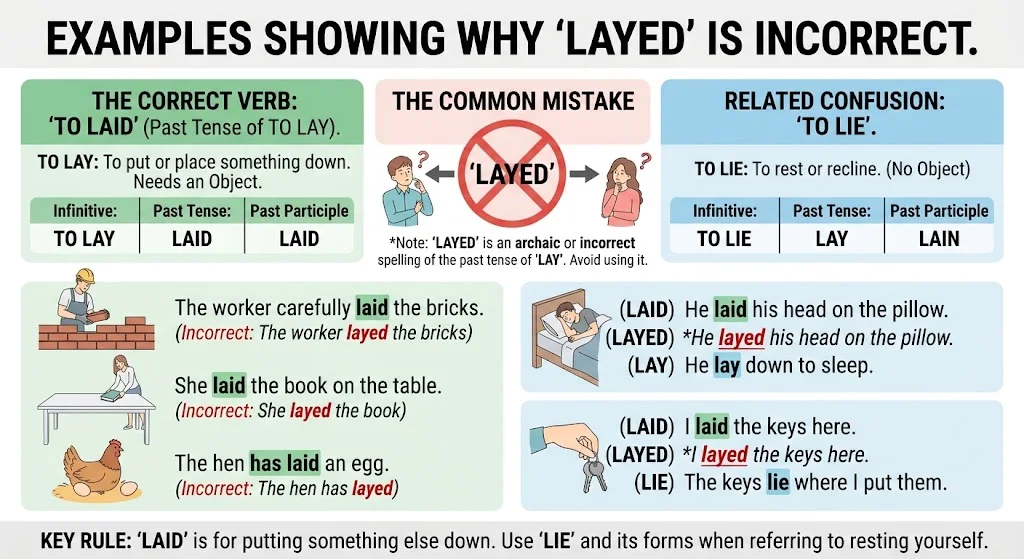
Examples Showing Why Layed Is Incorrect
The following examples show common mistakes and their corrections.
| Incorrect | Correct |
| She layed the book down. | She laid the book down. |
| He layed the baby in the crib. | He laid the baby in the crib. |
| They layed the foundation. | They laid the foundation. |
| The company layed off workers. | The company laid off workers. |
| She layed out the documents. | She laid out the documents. |
| He layed the cards on the table. | He laid the cards on the table. |
One caution matters here: sometimes the problem isn’t actually layed versus laid. The writer may have chosen lay when they needed lie.
For example:
I laid down because I was tired.
In careful standard English, if the speaker means that they reclined themselves, the expected form is:
I lay down because I was tired.
The mistake isn’t spelling. It’s verb selection.
Common Mistakes
Adding -ed to Every Verb
The most straightforward mistake is assuming every past-tense verb needs -ed.
That works with regular verbs:
- walk → walked
- jump → jumped
- clean → cleaned
But English also has irregular verbs:
- go → went
- take → took
- see → saw
- buy → bought
- lay → laid
So layed looks logical, but standard English uses laid.
Mixing Up Lay and Lie
This causes even more trouble.
Compare:
She laid the baby on the bed.
with:
She lay on the bed.
The first sentence describes someone placing another person somewhere.
The second describes someone resting in a position.
Trusting Internet Examples
Search results can contain misspellings. Social media, comments, informal posts, user-generated websites, and poorly edited pages don’t necessarily follow standard grammar.
Seeing layed online doesn’t make it the standard form.
For grammar questions, reputable dictionaries and established style resources provide stronger evidence than an isolated online example.
Forgetting Irregular Verb Patterns
The safest approach is to learn the complete verb pattern rather than memorizing one isolated word.
Remember:
lay → laid → laid
and:
lie → lay → lain
Once those patterns become familiar, the spelling becomes much easier.
Grammar Rules for Laid, Lay, and Lie
Lay Is Normally Transitive
When lay means “put or place,” it takes an object.
She laid the book on the table.
The book receives the action.
That gives you a useful structural pattern:
Subject + lay/laid + object
Examples:
- He laid the phone on the desk.
- They laid the bricks carefully.
- She laid the papers on the counter.
Cambridge describes lay in this sense as a transitive verb and says it must be followed by an object.
Lie Is Usually Intransitive
When lie means to rest or remain in a position, it doesn’t take a direct object.
I lay on the sofa.
There isn’t an object receiving the action.
The tense pattern is:
lie → lay → lain
Examples:
- I lie down every afternoon.
- Yesterday, I lay down after lunch.
- I have lain here for an hour.
That pattern is different from:
lay → laid → laid
Learning both together prevents a great deal of confusion.
A Simple Decision Test
When you’re unsure whether to use lay, laid, or lie, ask one question:
Is someone putting something somewhere?
If yes, use lay or laid.
She laid the blanket on the bed.
If the person or animal is simply resting, use lie or its appropriate tense.
She lay on the bed.
Now ask whether the action happened in the past.
- Present placement: lay
- Past placement: laid
- Present resting: lie
- Past resting: lay
- Past participle of resting: lain
This method works far better than trying to remember isolated sentences.
Real-Life Usage: Why the Confusion Persists
The distinction looks tidy on paper. Real conversation is messier.
Many English speakers use lay where traditional standard grammar expects lie. Cambridge explicitly recognizes this pattern as common in speech while labeling the use nonstandard.
Merriam-Webster takes a broader usage perspective and notes that lay has long been used in place of lie in expressions such as “lay down.” It also explains that the distinction has been taught and debated for centuries.
That history helps explain why people encounter conflicting examples.
However, there’s still a clear rule for formal writing:
If you mean the past tense of the placement verb lay, use laid, not layed.
And if you’re describing someone resting in a position, carefully choose among lie, lay, lain, and lying.
Etymology
The story behind lay reaches much further back than modern English.
Merriam-Webster traces the verb to Middle English leyen and Old English lecgan. The word is related to the older Germanic vocabulary associated with placing something down.
Etymonline traces lay to Old English lecgan, meaning to place something on the ground or another surface. It connects the word to the Proto-Indo-European root reconstructed as *legh-, associated with lying down or laying something down.
The relationship between lay and lie therefore isn’t an accidental similarity.
The two verbs are historically connected.
That connection is one reason their modern forms can feel like pieces of the same puzzle.
The past form laid developed as the past tense and past participle associated with lay. Etymonline also records laid as an adjective formed from the past tense and past participle of lay.
Is Layed Ever Correct?
For ordinary modern English, don’t use layed as the past tense or past participle of lay.
In standard writing, use laid.
That applies across common contexts:
- laid down
- laid out
- laid off
- laid aside
- laid claim
- laid the foundation
- laid the groundwork
- laid the book on the table
The important qualifier is that language can contain historical, dialectal, specialized, or nonstandard forms. A word appearing somewhere doesn’t automatically make it the preferred standard form.
For contemporary standard English, however, the practical answer is straightforward:
Use laid.
Does American English Use Layed?
No. American English does not use layed as the standard past tense or past participle of lay.
American dictionaries identify laid as the correct form. Cambridge’s American Dictionary gives laid as the past tense and past participle of lay, while Merriam-Webster lists the same forms.
The same standard spelling applies in formal English regardless of whether the audience is in the United States, the United Kingdom, Canada, or Australia.
There may be differences in vocabulary, pronunciation, punctuation, or preferred style across English varieties. Laid vs. layed isn’t one of those standard regional spelling differences.
British, Australian, and Canadian English
The standard form remains laid in these varieties as well.
You may encounter layed in informal writing, online comments, learner writing, or speech-based transcription. That doesn’t establish it as a standard regional spelling.
So the practical rule remains:
| Variety | Standard form |
| American English | laid |
| British English | laid |
| Canadian English | laid |
| Australian English | laid |
The issue is therefore grammatical rather than a US-versus-UK spelling difference.
Laid in Professional and Academic Writing
In professional writing, small grammar errors can affect credibility.
Consider a workplace report:
The company layed off several employees.
The intended meaning is understandable. Yet the spelling immediately looks incorrect to many readers.
The polished version is:
The company laid off several employees.
The same principle applies to academic writing:
The study laid the groundwork for later research.
not:
The study layed the groundwork for later research.
And in everyday professional communication:
I laid out the proposed schedule below.
not:
I layed out the proposed schedule below.
When the correct form is only one letter away, there’s little reason to leave the mistake in a finished document.
Common Phrases With Laid
These expressions are especially useful because they appear frequently in everyday and professional English.
Laid down
Used when something was placed down or when someone established a rule or principle.
The manager laid down the new guidelines.
Laid out
Used for arranging, explaining, or presenting information.
She laid out the plan clearly.
Laid off
Used when an employer dismisses workers, often because of business conditions.
Hundreds of employees were laid off.
Laid aside
Means put away or temporarily set aside.
He laid aside the report until Monday.
Laid claim
Usually appears in the phrase laid claim to.
The company laid claim to the invention.
Laid the groundwork
Means established the basis for something that will happen later.
The early research laid the groundwork for the discovery.
Laid the foundation
Means created the underlying basis for something.
Their first project laid the foundation for the business.
Case Study: Three Sentences That Look Almost Identical
Consider these three examples:
1. She laid the baby on the bed.
Here, she places the baby on the bed. Laid is correct.
2. She lay on the bed.
Here, she rests on the bed. Lay is the past tense of lie.
3. She has lain on the bed for an hour.
Here, lain is the past participle of lie.
The difference can be summarized like this:
Someone lays something. Someone lies down. Yesterday, someone lay down. Someone has lain down.
That four-part pattern solves much of the confusion.
Read More: Puddy or Putty: Which Spelling Is Correct in 2026?
FAQs
1. Is “laid” or “layed” correct?
Laid is the correct form in standard English. Layed is generally considered a misspelling when you mean the past tense or past participle of the verb lay.
2. Why do people write “layed”?
People often write layed because many English verbs form their past tense by adding -ed. Since lay looks like a regular verb, it can be easy to assume that layed follows the same pattern.
3. What is the past tense of “lay”?
The past tense of lay is laid. For example: “She laid the book on the table.”
4. Is “layed” ever a word?
In ordinary modern English, layed is not the standard past form of lay. In almost all everyday writing, use laid instead.
5. What is the difference between “lay” and “laid”?
Lay is the base form, while laid is its past tense and past participle. For example, “I lay the keys here every morning” uses the base form, while “I laid the keys here yesterday” uses the past tense.
6. Why is “laid” considered an irregular form?
The verb lay does not form its past tense by simply adding -ed. Instead, it changes to laid, making it different from regular verbs such as “walk” → “walked.”
7. Is “laid” correct in American English?
Yes. Laid is the standard form in American English as well as other major varieties of English.
8. How can I remember “laid” instead of “layed”?
A simple trick is to remember that lay → laid → laid. Once you connect lay with laid, you’ll be less likely to add -ed and create the incorrect form layed.
9. Is “laid” pronounced differently from “layed”?
In standard English, laid is pronounced like “layd.” The spelling layed may look different, but that does not make it the correct form of the verb lay.
10. What is the easiest way to avoid this mistake?
Remember that laid is the standard past form of lay. When you’re unsure, check whether the sentence describes an action involving placing something somewhere. If it does, laid may be the form you need.
Conclusion
The choice between laid or layed becomes much easier once you understand how the verb lay works. Laid is the correct standard form, while layed is generally a spelling mistake in ordinary English. The confusion usually comes from applying the regular -ed pattern to an irregular verb.
Keep one simple pattern in mind: lay → laid → laid. With that small rule, you can avoid a common spelling error and write with greater confidence and accuracy.

Aria Jane is a senior language writer and grammar specialist at Grammar Glint. She focuses on English grammar, spelling variations, vocabulary, and writing clarity. Through detailed research and practical examples, Aria helps readers understand language rules and avoid common mistakes. Her articles are designed to make English learning accessible for students, professionals, and everyday writers seeking reliable language guidance.