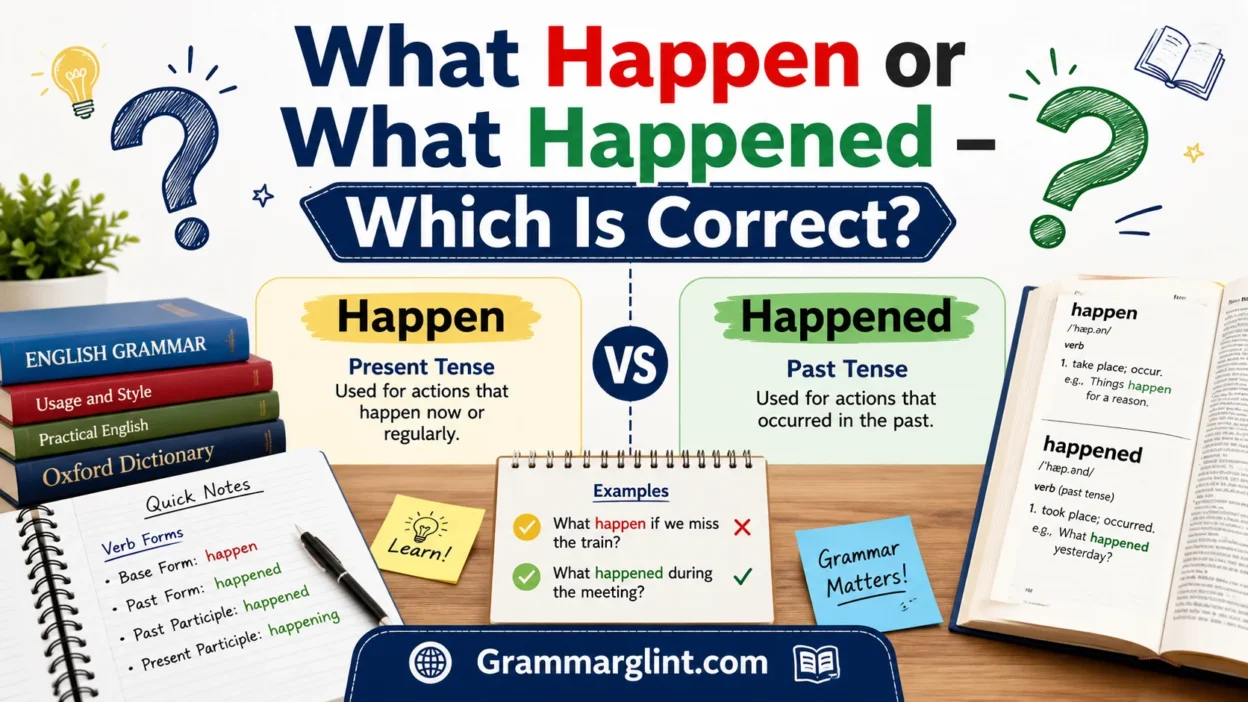
“What Happen” or “What Happened” Which Is Correct? is a common question among English learners and even native speakers. Since both phrases sound similar in fast conversation, it’s easy to assume they mean the same thing.
However, only “what happened” is grammatically correct when asking about a past event, while “what happen” is generally incorrect unless it appears as part of a larger grammatical structure. Understanding this difference is essential for clear writing, natural speech, and confident communication.
This guide explains the difference between what happen and what happened using simple explanations, real-life examples, and everyday conversations. Whether you’re writing an email, preparing for an exam, telling a story, or speaking with a friend, you’ll learn why one phrase is correct and the other is not.
We’ll also explore common mistakes, professional usage, casual speech, storytelling, and situations where learners often become confused.
By the end of this article, you’ll know exactly when to use what happened, why what happen is usually incorrect, and how to avoid one of the most common grammar mistakes in English. With practical examples, expert tips, and clear explanations, you’ll be able to write and speak more naturally and confidently in both formal and informal contexts.
Which One Is Correct?
The answer is straightforward:
“What happened” is correct when you ask about something in the past.
The word happened is the past tense form of the verb happen.
The phrase follows this structure:
What + happened + question mark
Examples:
- What happened yesterday?
- What happened at the party?
- What happened to your phone?
- What happened after the meeting?
Each question asks about something that already occurred.
On the other hand:
“What happen?” is generally incorrect in standard English.
It leaves the verb in its base form without a reason.
Incorrect:
What happen after the accident?
Correct:
What happened after the accident?
The difference is only one letter combination, but that small change affects the grammar.
Understanding the Verb “Happen”
Before choosing between what happen or what happened, it helps to understand the verb itself.
The verb happen means:
- To occur
- To take place
- To become true
- To come about unexpectedly
When something happens, it means an event occurs.
Examples:
- “Mistakes happen.”
- “Good things happen when you practice.”
- “An accident happened on the road.”
The verb changes depending on the time of the action.
Different Forms of “Happen”
| Verb Form | Usage | Example |
| Happen | Base form | Things happen for a reason. |
| Happens | Present tense | This happens every year. |
| Happened | Past tense | It happened last night. |
| Happening | Continuous form | What is happening now? |
The form you choose depends on when the action happens.
That is the key.
Why “What Happened” Is Correct
The phrase “what happened” uses the past tense because it asks about a completed event.
When someone asks:
What happened?
They usually want an explanation about something that has already occurred.
Maybe a person looks upset. Maybe something broke. Maybe a situation changed.
The question points backward in time.
“What Happened” in Real Conversations
Imagine you walk into a room and notice everyone looks surprised.
You might ask:
What happened?
You are not asking about the future. You are asking about the event that caused the reaction.
Another example:
Your friend arrives late.
You ask:
What happened?
You want to know the reason behind the delay.
The word happened connects the question to a completed moment.
The Grammar Behind “What Happened?”
English questions often use auxiliary verbs, but some questions work differently.
For simple past questions, we usually use did:
Example:
- Did you go home?
- Did she call you?
- Did they finish the project?
However, questions with what can sometimes place the verb directly after the question word.
Example:
- What happened?
- Who called you?
- Who broke the window?
Here, happened already carries the past tense.
The structure looks like this:
Question word + past verb
Examples:
| Question | Meaning |
| What happened? | What event occurred? |
| Who arrived? | Which person came? |
| What changed? | What became different? |
What Happens vs What Happened vs What Is Happening
Many people confuse these three phrases because they look similar.
However, each one describes a different time.
What Happens
Use “what happens” for general situations, habits, or repeated events.
Examples:
- What happens when you mix these ingredients?
- What happens if you press this button?
- What happens every winter?
This phrase talks about something that normally occurs.
Example:
What happens when plants don’t get enough water?
The question asks about a general result.
It does not focus on one specific past event.
What Happened
Use “what happened” for the past.
Examples:
- What happened last night?
- What happened during the game?
- What happened to your old laptop?
The event already took place.
What Is Happening
Use “what is happening” for something occurring right now.
Examples:
- What is happening outside?
- What is happening in the classroom?
- What is happening with the website?
This asks about the present moment.
Quick Comparison Table
| Phrase | Time | Example |
| What happens? | Present/general | What happens after you click this? |
| What happened? | Past | What happened yesterday? |
| What is happening? | Right now | What is happening here? |
| What will happen? | Future | What will happen tomorrow? |
A simple way to remember:
Past = happened
Present = happens
Future = will happen
When “What Happen” Can Be Correct
Although “what happen” is usually wrong by itself, the phrase can appear in correct sentences.
The reason?
Another word may already show the tense.
For example:
With “Will”
Correct:
What will happen next?
Here, will shows the future.
The verb stays in its base form:
- will happen ✅
- will happened ❌
With “Did”
Correct:
What did happen yesterday?
Many people make this mistake:
Incorrect:
What did happened yesterday?
Why is it wrong?
Because did already shows past tense.
After “did,” the main verb returns to the base form.
Examples:
Correct:
- What did you see?
- What did she say?
- What did they do?
Incorrect:
- What did you saw?
- What did she said?
- What did they did?
The same rule applies to happen.
Correct:
What did happen?
Incorrect:
What did happened?
Common Mistakes With “What Happen”
Small grammar mistakes can change how natural your English sounds.
Let’s look at the most common errors.
Mistake One: Forgetting Past Tense
Incorrect:
What happen yesterday?
The word “yesterday” tells us the event happened in the past.
The verb needs the past form.
Correct:
What happened yesterday?
Read More: Hours Worth or Hours’ Worth? Apostrophe or Not?
Mistake Two: Using “Did” With “Happened”
Incorrect:
What did happened?
Correct:
What did happen?
Remember:
Did + base verb
Not:
Did + past verb
More examples:
❌ Did you went there?
✅ Did you go there?
❌ Did she finished her work?
✅ Did she finish her work?
❌ What did happened?
✅ What did happen?
Mistake Three: Mixing Present and Past
Incorrect:
What happens yesterday?
The word “yesterday” refers to the past.
The verb “happens” refers to the present.
They do not match.
Correct:
What happened yesterday?
A sentence should keep the time consistent.
Real-Life Examples of “What Happened” in Everyday English
Grammar becomes easier when you see how people actually use it. The phrase “what happened” appears constantly in daily conversations because people often need explanations about past events.
It can show surprise, concern, curiosity, or confusion.
A single question can carry different emotions depending on the situation.
For example:
“What happened?”
A worried parent might ask it after hearing a loud noise.
A friend might ask it after noticing someone looks upset.
A coworker might ask it after a project suddenly changes.
The words stay the same, but the meaning changes with the context.
At Home
Imagine you walk into your kitchen and notice a broken glass on the floor.
You might ask:
What happened?
You are asking about the event that caused the situation.
Other examples:
- “The TV stopped working. What happened?”
- “The door is open. What happened?”
- “The lights went out. What happened?”
These questions all refer to something that already occurred.
At Work or School
The phrase “what happened” is common in professional and educational settings too.
Examples:
- “The presentation was canceled. What happened?”
- “The meeting ended early. What happened?”
- “The assignment disappeared from the system. What happened?”
You use this phrase when you need details about a previous event.
It helps start a conversation without making assumptions.
Instead of saying:
You made a mistake.
You can ask:
What happened?
That sounds more open and invites an explanation.
“What Happened to You?” Meaning Explained
One of the most common versions is:
What happened to you?
This question does not always mean something bad happened.
The meaning depends on the situation.
It can mean:
- Why are you late?
- Why do you look different?
- Why did you disappear?
- What experience did you have?
Examples:
A friend arrives two hours late:
What happened to you?
Meaning:
Why were you late?
Someone returns after a long absence:
What happened to you?
Meaning:
Where have you been?
However, the tone matters.
A caring tone sounds friendly.
An angry tone can sound like a complaint.
Simple Trick to Remember “What Happen” vs “What Happened”
English becomes easier when you connect grammar with time.
Ask yourself one question:
When did the action happen?
If it already happened:
Use:
Happened
Example:
- What happened yesterday?
- What happened last year?
- What happened during the trip?
If it happens regularly:
Use:
Happens
Example:
- What happens every morning?
- What happens when you click this button?
If it is happening now:
Use:
Is happening
Example:
- What is happening right now?
If it will happen later:
Use:
Will happen
Example:
- What will happen tomorrow?
The Timeline Method
Think about the verb as a timeline:
Past ——– Now ——– Future
happened happening will happen
happens
Each form points to a different moment.
This small trick helps you choose the right word quickly.
Practice Examples: Choose the Correct Phrase
Test yourself with these sentences.
Example One
The computer suddenly turned off.
Question:
❌ What happen?
✅ What happened?
Reason:
The computer already turned off.
Example Two
You are explaining a science experiment.
Question:
What ______ when water reaches boiling point?
Correct answer:
✅ happens
Reason:
This describes a general result.
Example Three
A strange sound is coming from outside.
Question:
What ______ outside?
Correct answer:
✅ is happening
Reason:
The event is occurring now.
Example Four
You are talking about tomorrow’s event.
Question:
What will ______ next?
Correct answer:
✅ happen
Reason:
“Will” already shows future tense.
Mini Quiz: Test Your Understanding
Choose the correct option.
1. ______ after the accident?
A) What happen
B) What happened
Answer:
✅ What happened
The accident occurred in the past.
2. What will ______ after the storm?
A) happen
B) happened
Answer:
✅ happen
“Will” requires the base verb.
3. What ______ every summer?
A) happens
B) happened
Answer:
✅ happens
This describes a repeated event.
4. What is ______ right now?
A) happen
B) happening
Answer:
✅ happening
The action is occurring at this moment.
5. What did ______ yesterday?
A) happen
B) happened
Answer:
✅ happen
“Did” already shows past tense.
FAQs
1. What Is Correct: “What Happen” or “What Happened”?
“What happened” is the correct phrase when asking about a past event. “What happen” is generally incorrect unless it is part of a different grammatical structure.
2. Why Is “What Happen” Incorrect?
“What happen” does not follow standard English grammar because questions about past events require the past tense verb happened.
3. When Should You Use “What Happened”?
Use “what happened” whenever you are asking about something that has already occurred, whether in conversation, writing, or storytelling.
4. Can “What Happen” Ever Be Correct?
Yes, but only in uncommon grammatical structures, such as after modal verbs or in embedded clauses. It is not correct as a standalone question about a past event.
5. Why Do English Learners Confuse “What Happen” and “What Happened”?
The two phrases sound similar in fast or casual speech, so many learners mistakenly use the base verb happen instead of the past tense happened.
6. Is “What Happened” Common in Spoken English?
Yes. “What happened?” is a natural and frequently used expression in everyday spoken and written English.
7. What Is the Most Common Mistake Students Make?
The most common mistake is using “what happen” instead of “what happened” when asking about something that occurred in the past.
8. Does Using the Wrong Form Affect the Meaning?
Yes. Using the wrong form makes the sentence grammatically incorrect and can make your writing or speech sound unnatural or unclear.
9. How Can You Avoid This Grammar Mistake?
Practice using “what happened” in daily conversations, writing exercises, and reading English materials. Regular practice helps reinforce the correct form.
10. Is Knowing the Difference Important for Exams?
Yes. Grammar exams, English proficiency tests, and academic writing assessments often check whether you can correctly use past tense questions like “what happened?”
Conclusion
In English grammar, only “what happened” is the correct form for asking about past events. It clearly follows standard rules and is used in both formal and informal situations. On the other hand, “what happen” is generally incorrect in normal usage and can make sentences sound wrong or incomplete.
To improve your English, focus on understanding tense rules and practicing real examples in speaking and writing. With regular use, choosing the correct form becomes natural and helps you communicate more confidently.
Mia Brooke is a content strategist and English language writer at Grammar Glint. She specializes in spelling comparisons, word meanings, idioms, and usage guides. Mia combines careful research with straightforward explanations to help readers navigate the nuances of modern English. Her goal is to provide accurate, trustworthy content that supports learners at every stage of their language journey.