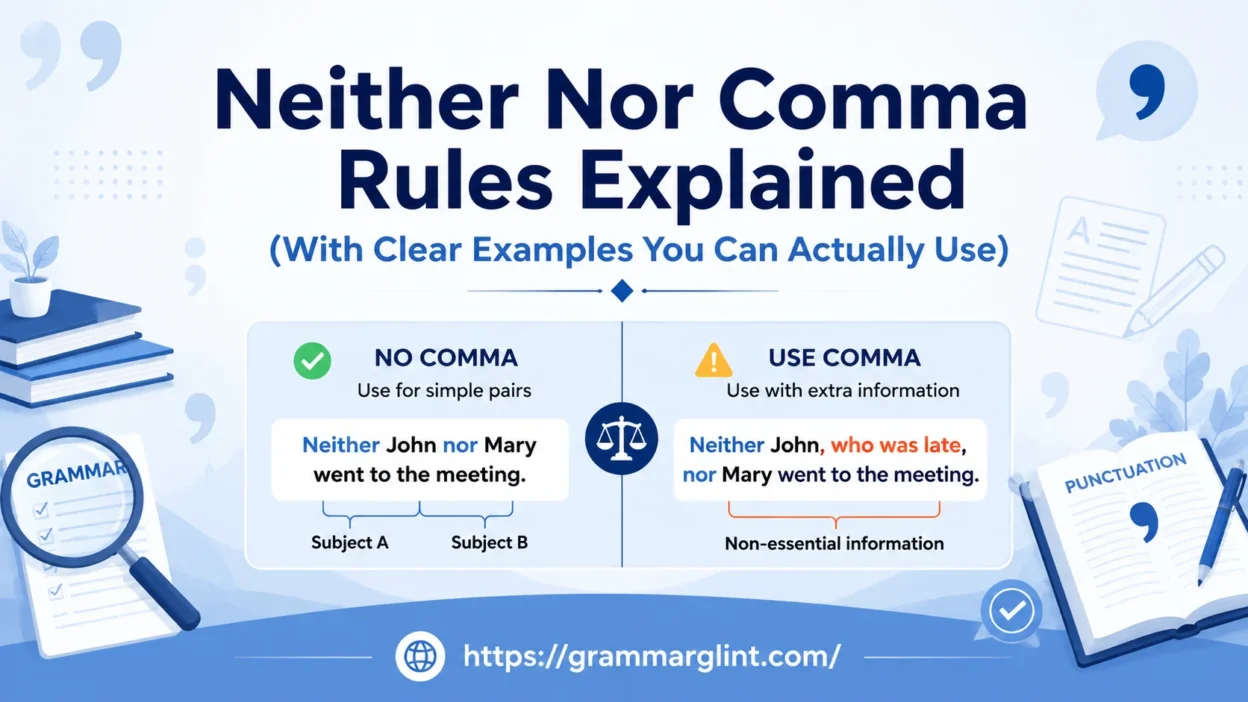
Learn Neither Nor Comma Rules with English grammar; punctuation helps explain how the neither nor construction connects different ideas in a clear way. Understanding this structure makes writing easier because the right comma placement can improve the meaning of a sentence. Many learners find this topic confusing at first, but the correct rules and usage can make the process simple. The phrase works as a useful link when expressing two negative options, showing not this and not that in a natural sentence pattern.
Getting a message across in the English language sometimes feels like a tightrope walk, where a small slip can change the whole meaning. This is especially true when using the neither nor construction, a handy tool for writers who want sharp writing. The structure connects choices and items while creating a relationship between two parts of an idea. The simple rule is that a comma is usually not needed when talking about two items directly, such as the examples “neither apples nor oranges.”
The main goal of this article is to show how English grammar, grammar usage, and context affect punctuation decisions. A comma is only used in special situations, such as when a nonrestrictive clause appears between the linked parts. By understanding these patterns, writers can create better sentences with proper linking, clearer expression, and stronger control over punctuation rules.
What It Really Means in Writing
Before we even talk commas, you need to understand what neither…nor does.
It works as a paired negative conjunction. That just means it connects two negative options in a single idea.
Think of it like a balance scale:
- Neither side wins
- Nor does the other
Simple structure:
Neither + option A + nor + option B
Example:
- Neither the manager nor the assistant was available.
Notice something important:
There’s no pause. No break. The sentence flows as one complete thought.
That’s the foundation of comma rules.
The Straight Answer
In most cases, you do NOT use a comma with neither…nor.
Why?
Because neither…nor already acts as a tight grammatical unit. Adding a comma usually interrupts the natural flow instead of helping it.
Correct:
- Neither Ali nor Sara went to the meeting.
Incorrect:
- Neither Ali, nor Sara went to the meeting.
That comma after “Ali” breaks the pairing. It creates a pause where none should exist.
Why the Comma Feels Tempting (And Why It’s Wrong Most of the Time)
People often insert commas because they expect a pause in spoken English. You might naturally pause after “neither” when speaking casually.
But grammar doesn’t always follow speech rhythm.
Here’s the key idea:
Grammar prioritizes structure, not breath pauses.
If you start adding commas based on how you speak, neither…nor becomes messy fast.
When You CAN Use a Comma (Rare But Real Cases)
Now here’s where things get interesting.
Yes, commas can appear with neither…nor, but only in specific situations.
1. When You Insert Extra Information
If you interrupt the sentence with non-essential details, commas may appear.
Example:
- Neither the CEO, who arrived late, nor the manager addressed the issue.
The phrase “who arrived late” is extra information. It’s not part of the core structure.
2. When the Sentence Becomes Long and Complex
Sometimes readability matters more than strict structure.
Example:
- Neither the students from the morning batch, exhausted after exams, nor the evening group, still preparing for tests, attended the seminar.
Here, commas help the reader breathe.
3. When You Use Parenthetical Emphasis
Occasionally, writers add commas for stylistic rhythm.
Example:
- Neither the plan, surprisingly, nor the backup strategy worked.
This is less about grammar and more about tone.
Common Mistakes
Let’s look at real mistakes writers make every day.
Mistake 1: Adding a comma automatically after “neither”
- ❌ Neither, John nor Mary came.
- ✔ Neither John nor Mary came.
Mistake 2: Breaking the pairing
- ❌ Neither John, nor Mary came.
- ✔ Neither John nor Mary came.
Mistake 3: Using “and” logic instead of “nor”
- ❌ Neither John nor Mary didn’t come.
- ✔ Neither John nor Mary came.
That double negative confusion is more common than you think.
Sentence Structure Breakdown (So You Actually Understand It)
Let’s slow it down.
Basic structure:
- Neither + subject A + nor + subject B + verb
Example:
- Neither Tom nor Jerry is responsible.
Now here’s the interesting part: verb agreement.
Verb Agreement Rule
The verb usually agrees with the closest subject.
| Sentence | Correct Verb | Why |
| Neither John nor Mary is here | is | Mary is closer |
| Neither the teacher nor the students are ready | are | students is closer |
This rule trips people up more than commas do.
Special Cases That Confuse Writers
Let’s go deeper into real-world writing problems.
Long Subjects Between Neither and Nor
Example:
- Neither the marketing team responsible for digital campaigns nor the sales department in charge of outreach attended.
This is where people want a comma, but structure still rules.
No comma needed unless clarity breaks.
Multiple Items (Extended Structure)
Sometimes neither…nor expands into longer chains.
Example:
- Neither the CEO nor the CFO nor the board members agreed.
This is grammatically correct, but readability can suffer if overused.
Read More: Postfix vs Suffix: Difference Explained (With Examples)
Mixing With Other Conjunctions
Be careful when combining structures.
Bad example:
- Neither John nor Mary and Sara came.
Better:
- Neither John nor Mary nor Sara came.
Neither Nor vs Either Or (Important Difference)
These two are often confused.
| Structure | Meaning | Example |
| Neither…nor | Negative | Neither tea nor coffee is available |
| Either…or | Choice | Either tea or coffee is available |
Key idea:
- Neither removes options
- Either offers options
Real-Life Usage Examples
Let’s make this practical.
Everyday Speech
- Neither I nor my friend wanted to leave early.
Workplace Writing
- Neither the finance report nor the audit summary was approved.
Academic Writing
- Neither hypothesis A nor hypothesis B was supported by the data.
Social Media Style
- Neither today nor tomorrow feels right.
Short. Clean. Emotional.
Case Study: Why Misusing Commas Changes Meaning
Let’s look at a real editing scenario.
Original sentence:
- Neither the manager nor the assistant was available.
Incorrect version:
- Neither the manager, nor the assistant was available.
What happens?
- The second version feels broken
- Readers pause too early
- The structure loses balance
Editing takeaway:
One small comma shifts flow and weakens clarity.
Quick Memory Rules for Writers
If you forget everything else, remember this:
- No comma in normal neither…nor sentences
- Use commas only when adding extra non-essential information
- Keep structure tight and balanced
- Match verb with the closest subject
- Don’t treat it like spoken pauses
Mini Practice Section
Try fixing these:
1
❌ Neither, Ali nor Sara came.
✔ Correct version:
- Neither Ali nor Sara came.
2
❌ Neither the teacher, nor the students are ready.
✔ Correct version:
- Neither the teacher nor the students are ready.
3
❌ Neither the CEO nor, the manager responded.
✔ Correct version:
- Neither the CEO nor the manager responded.
My Personal Experience as an English Language Specialist
Over the years, I’ve worked with English learners, writers, and content creators from different backgrounds, and I’ve noticed that many grammar mistakes come from confusion rather than a lack of ability. Small differences between similar words or phrases often create the biggest challenges. That’s why I focus on explaining grammar in plain, everyday English instead of relying on complicated rules or technical terms.
As an English language specialist, I believe the best way to learn grammar is through real examples and practical usage. Every article I write is based on common questions that learners actually ask, along with mistakes I’ve seen repeatedly in writing and conversation. My goal is to help you understand not only which form is correct but also why it’s correct and when to use it naturally. If you can apply these lessons with confidence in your own speaking and writing, then I’ve achieved exactly what I set out to do.
FAQs
1. What are Neither Nor Comma Rules?
Neither Nor Comma Rules explain how commas work with the neither nor construction. In most cases, no comma is needed when neither and nor directly connect two choices, ideas, or items.
2. Are neither and nor always used together?
Yes, neither and nor are usually used together as correlative conjunctions. They create a connection between two negative options and work as a pair in a sentence structure.
3. Do I need a comma between neither and nor?
No, a comma is generally not placed between neither and nor when they are directly linking two things. For example, “I like neither tea nor coffee.”
4. When should I use a comma with neither nor?
A comma can be used when a longer sentence needs a pause or when extra information, such as a nonrestrictive clause, is added for clarity.
5. What type of conjunction is neither nor?
Neither nor is a type of correlative conjunction. These conjunctions connect words, phrases, or ideas that have a balanced relationship.
6. Why do writers get confused about neither nor construction?
Many writers experience confusion because punctuation rules can change depending on context, sentence length, and the relationship between ideas.
7. Can neither nor connect more than two items?
The basic use of neither nor connects two items or two choices. For multiple elements, writers should focus on keeping the structure clear and readable.
8. How does punctuation affect the meaning of a sentence?
A small slip in punctuation can change the meaning of a sentence. Correct punctuation helps get the message across clearly.
9. What is the simple rule for using commas with neither nor?
The simple rule is that no comma is needed when neither and nor directly connect two ideas. Add punctuation only when it improves clarity.
10. How can I master neither nor usage?
You can master this grammar point by breaking down the rules, studying examples, and practicing English grammar in different situations.
Conclusion
Understanding Neither Nor Comma Rules becomes easier when you see how neither and nor function as correlative conjunctions. These words create a balanced connection between negative options and help organize ideas in a clear way. The correct use of a comma depends on the structure of the sentence, the need for a pause, and the overall context.
With practice, learners can improve their writing skills, avoid common punctuation mistakes, and use the neither nor construction confidently. Following simple rules and paying attention to sentence structure allows writers to create smoother, clearer, and more effective communication.

Aria Jane is a senior language writer and grammar specialist at Grammar Glint. She focuses on English grammar, spelling variations, vocabulary, and writing clarity. Through detailed research and practical examples, Aria helps readers understand language rules and avoid common mistakes. Her articles are designed to make English learning accessible for students, professionals, and everyday writers seeking reliable language guidance.