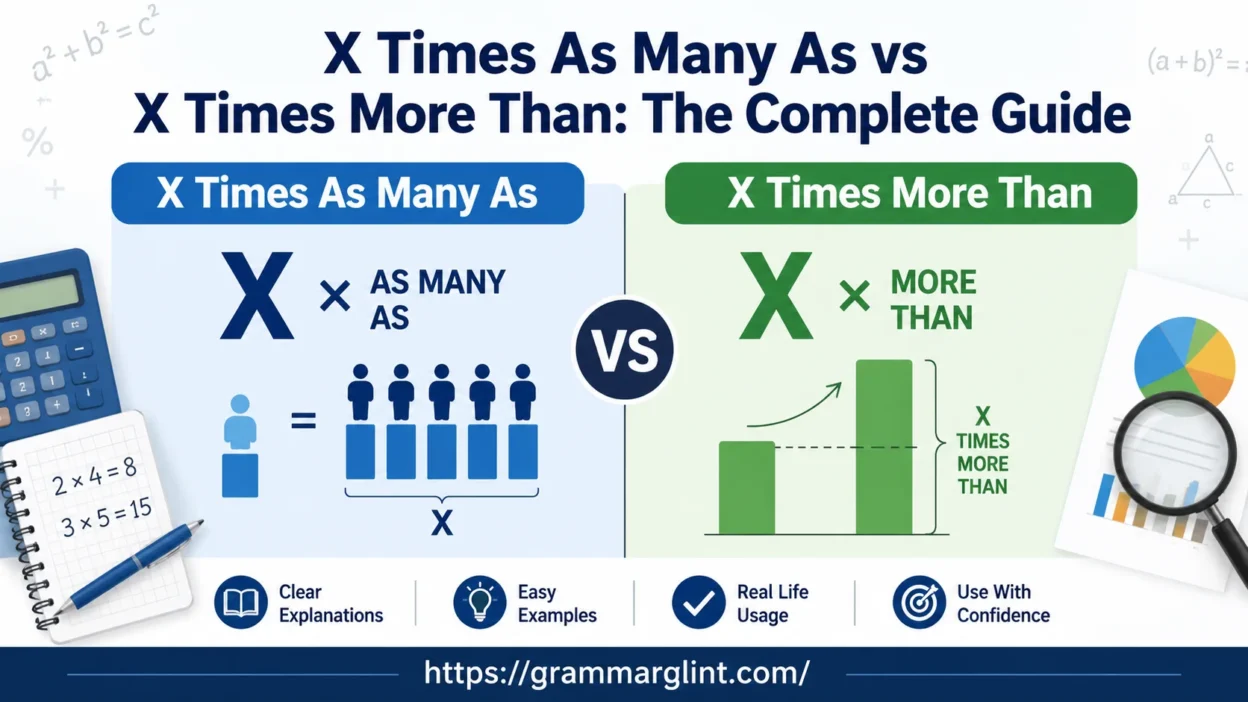
When learning Math through English, mathematical phrases can sometimes create confusing meanings because the words used in different situations may imply different ideas. The phrase “X Times As Many As” vs. “X Times More Than” is a common example where learners may mix up the intended meaning. Many people hear saying x as many times as and assume it carries the same meaning as x times more than, but the two expressions have different purposes.
The phrase X times as many as mainly describes a numerical relationship where as many focuses on multiplying the base by x. This approach uses mathematical concepts to show how one quantity relates to another through a specific expression. The focus is on the resulting amount or value after applying the multiplication idea.
On the other hand, X times More Than often suggests a difference because the phrase can indicate adding something to the original amount. The latter phrase highlights how people may understand increases in everyday communication. These ideas connect comparison, calculation, multiplication, and addition while showing why times, many, more, than, and as must be read carefully in a sentence.
Understanding “X Times As Many As” Meaning
The phrase “X times as many as” is one of the clearest ways to compare quantities.
It shows a direct relationship between two amounts.
The basic formula is:
New amount = X × original amount
For example:
“The new factory produces 4 times as many products as the old factory.”
If the old factory makes:
- 100 products per day
Then the new factory makes:
- 100 × 4 = 400 products per day
The phrase tells you the final amount immediately.
Examples of “times as many as”
| Sentence | Original Amount | Final Amount |
| The store sold 2 times as many items | 100 items | 200 items |
| The website received 5 times as many visitors | 1,000 visitors | 5,000 visitors |
| The company hired 3 times as many employees | 50 employees | 150 employees |
This structure works because it focuses on the comparison itself.
It answers the question:
“How large is the new amount compared with the old amount?”
Why “Times As Many As” Creates Less Confusion
Numbers already require careful thinking. Adding unclear wording makes the situation harder.
The phrase “times as many as” avoids confusion because it describes the ratio.
For example:
“The new model has 3 times as much storage as the old model.”
If the old model has:
- 128 GB storage
The new model has:
- 384 GB storage
There’s no debate.
The reader knows the exact relationship.
This is why many technical fields prefer this structure.
Industries that often use “times as much/as many”
- Scientific research
- Engineering
- Finance
- Data analysis
- Education
- Healthcare reporting
When accuracy matters, clarity wins.
Understanding “X Times More Than” Meaning
The phrase “X times more than” causes much more debate.
Why?
Because people interpret it in two different ways.
Some people understand:
“3 times more than”
as:
The original amount plus three additional amounts
Others understand it as:
Three times the original amount
Both interpretations appear in everyday language.
That creates a communication problem.
Read More: Send You or Send to You? The Clear Grammar Rule Explained
The Two Common Interpretations of “Times More Than”
Interpretation One: Increase-Based Meaning
Some speakers use “times more than” to describe an increase.
Example:
“The company made 3 times more profit than last year.”
Under this interpretation:
- Last year profit: $100,000
- Increase: $300,000
- Total profit: $400,000
The phrase means:
100% + 300% = 400% of the original amount
Interpretation Two: Multiplication Meaning
Other speakers use the phrase to mean the final amount is multiplied.
Example:
“The company made 3 times more profit than last year.”
They may mean:
- Last year profit: $100,000
- New profit: $300,000
The phrase means:
3 × the original amount
Why “Times More Than” Causes Arguments
The issue comes from mixing two different ideas:
- A comparison
- An increase
These are not always identical.
Consider this:
“The price increased by 50%.”
This means:
- Original price: $100
- Increase: $50
- New price: $150
Now compare:
“The price is 1.5 times as high.”
This also means:
- $150 total
The math matches.
But:
“The price is 50% more”
and:
“The price is 1.5 times more”
can be interpreted differently by different readers.
Difference
The easiest way to understand the difference is to compare them directly.
| Phrase | Meaning | Example With 100 |
| 2 times as many as | Two times the original | 200 |
| 3 times as many as | Three times the original | 300 |
| 100% more than | Original + same amount | 200 |
| 200% more than | Original + double amount | 300 |
| 3 times more than | Often debated | 300 or 400 |
The safest option?
Use:
- “times as many as”
- “times as much as”
- “increased by X%”
These phrases leave less room for confusion.
Real-World Examples of Confusing “Times More Than”
Numbers appear everywhere. A small wording mistake can create a major misunderstanding.
Business and Marketing Examples
Imagine an advertisement says:
“Our product lasts 5 times longer than competitors.”
What does that mean?
Possible meanings:
- The product lasts five times as long.
- The product lasts five additional times longer.
A customer might expect one result while the company intended another.
A clearer statement would be:
“Our product lasts five times as long as the leading competitor.”
That tells the reader exactly what happens.
Scientific Research Examples
Researchers need precise language.
A scientific paper might compare:
- test results
- chemical concentrations
- biological measurements
A scientist would usually avoid:
“The reaction was 4 times more active.”
Instead, they might write:
“The reaction rate was four times the control rate.”
This removes uncertainty.
Everyday Conversation Examples
In casual speech, people often say:
“My new phone is twice faster.”
Most listeners understand the meaning.
However, technically:
- “Twice as fast” is clearer.
- “Takes half the time” may be even clearer.
Example:
Instead of:
“This laptop is 3 times faster.”
Say:
“This laptop completes the task in one-third of the time.”
The second sentence gives measurable information.
“Times As Many” vs. “Times As Much”
Another common confusion involves many and much.
The rule is simple:
- Use many with things you can count.
2. Use much with things you measure.
Use “times as many” for countable items
Examples:
- people
- cars
- books
- products
- employees
Correct:
“The company has twice as many customers.”
Incorrect:
“The company has twice as much customers.”
Use “times as much” for amounts
Examples:
- money
- energy
- water
- time
- fuel
Correct:
“The machine uses three times as much energy.”
Incorrect:
“The machine uses three times as many energy.”
Percentage vs. Multiplication: A Common Math Mistake
Many people confuse percentages and times.
Here’s the simple breakdown:
| Increase | Final Amount Compared to Original |
| 50% more | 1.5 times as much |
| 100% more | 2 times as much |
| 200% more | 3 times as much |
| 300% more | 4 times as much |
A quick example:
Original number:
100
A 200% increase means:
- Add 200
- Final amount = 300
So:
200% more = 3 times as much
Not 2 times.
This mistake appears frequently in headlines and social media posts.
Better Ways to Rewrite “Times More Than”
If you want your writing to be crystal clear, replace vague phrases.
Instead of:
“The company has 4 times more users.”
Write:
“The company has 4 times as many users.”
Or:
“The company’s user base increased by 300%.”
Or:
“The company grew from 100,000 users to 400,000 users.”
The third option is often the strongest because it gives exact numbers.
How Writers Should Use These Phrases
Good writing depends on removing unnecessary confusion.
When writing about numbers:
Use “times as many/as much as” when:
- comparing quantities
- explaining statistics
- writing reports
- describing research
Example:
“The updated system processes twice as many requests as the previous version.”
Use percentages when:
- discussing growth
- describing increases
- reporting changes
Example:
“Sales increased by 75%.”
Use exact figures when possible
Instead of:
“Traffic increased 10 times.”
Try:
“Traffic increased from 10,000 monthly visitors to 100,000.”
Readers trust specific numbers.
Common Mistakes With “Times More Than”
Mistake: Assuming everyone understands it the same way
They don’t.
Different readers may calculate different results.
Mistake: Using “times” with percentages incorrectly
Example:
Wrong:
“The price increased 100% times.”
Better:
“The price increased by 100%.”
Mistake: Using unclear comparisons
Weak:
“The new product is much better.”
Strong:
“The new product lasts twice as long and uses 30% less energy.”
Specific details create stronger communication.
The Best Rule for Clear Communication
When you compare numbers, choose language that leaves no doubt.
The safest choices are:
- “X times as many as”
- “X times as much as”
- “increased by X%”
- “grew from A to B”
Avoid relying on:
- “X times more than”
unless the context makes the meaning obvious.
Numbers should inform people, not make them stop and calculate what you meant.
My Personal Experience as an English Language Specialist
From my experience as an English language specialist, I have noticed that learners often struggle with mathematical expressions when they are presented in English rather than in numbers alone. Even students who understand basic math can become confused by phrases like “X times as many as” and “X times more than” because these expressions seem similar but can communicate different ideas depending on the context. Over the years, I have seen this confusion appear in classrooms, academic writing, and everyday conversations. That is why I believe it is important to explain not only the grammar behind these expressions but also the logic that shapes their meaning. When learners understand how these phrases work, they become more confident in interpreting numerical comparisons accurately and expressing their own ideas with greater clarity.
FAQs
1. What is the difference between X Times As Many As and X Times More Than?
X Times As Many As usually describes a ratio or multiplication relationship, while X Times More Than often describes an increase or additional difference from the original amount.
2. Does x as many times as mean the same as x times more than?
No, they do not always have the same meaning. The context of the sentence determines whether the phrase shows multiplication or an added difference.
3. What does X times as many as mean in mathematics?
It means one quantity is multiplied by x compared to another quantity. It focuses on a direct numerical relationship between values.
4. Why do people confuse these two phrases?
People often confuse them because both phrases involve comparison, quantity, and numbers, but their mathematical interpretation can be different.
5. Is X Times More Than grammatically correct?
Yes, X Times More Than is commonly used in everyday English, but its exact meaning can depend on how the speaker intends the comparison.
6. How does grammar affect the meaning of these phrases?
Grammar and sentence structure help show whether the phrase refers to multiplying a base amount or adding a difference to the original amount.
7. What role does context play in understanding these expressions?
Context helps readers decide the intended meaning and implication because the same words can create different interpretations.
8. Can these phrases be used in mathematical calculations?
Yes, but careful usage is important. Mathematical calculation requires clear understanding of whether the expression means multiplication or addition.
9. Why is X Times As Many As connected to a ratio?
It is connected to a ratio because it compares two quantities by showing how many times one value is related to another.
10. How can learners avoid mistakes with these phrases?
Learners can avoid mistakes by studying examples, checking the language, and identifying whether the phrase shows a comparison, multiplication, or increase.
Conclusion
Understanding the difference between “X times as many as” and “X times more than” helps you avoid one of the most common misunderstandings in mathematical English. Although the phrases look similar, they can lead readers to different interpretations if they are used without enough context. Choosing the right expression makes explanations clearer and reduces confusion.
Whenever you describe quantities, think about whether you want to express a direct multiple or an increase over an original amount. In many educational and technical settings, “X times as many as” is the clearer choice because it states the multiplication relationship directly. By paying attention to these small language differences, you can communicate mathematical ideas more accurately and understand them with greater confidence.

Emma Brooke is an editor and language researcher at Grammar Glint. Her work centers on grammar rules, punctuation, word usage, and style consistency. Emma is passionate about transforming complex language concepts into clear, reader-friendly explanations. She contributes in-depth articles that help readers communicate more effectively and confidently in both academic and professional settings.