People Who vs People That explains grammar precision when referring to individuals and choosing the correct language for clear communication. Many writers and learners often question which option sounds more natural and accurate in different situations. This small choice in sentence formation can affect the overall meaning, flow, and professionalism of written work.
Many people face misconceptions and confusing parts in the English language because they sometimes fail to notice small details. The difference between People Who and People That is connected with English grammar and the way we create references. Although both forms may appear in daily language and writing, understanding the proper context helps readers identify the intended meaning.
The distinction between People Who and People That shows how grammar rules work when describing humans, things, or objects. The word who is generally preferred when referring to people because it connects directly with human references, while that can be correct in particular contexts where the meaning allows a broader reference. This grammatical principle improves accuracy and avoids confusion.
From my experience with writing and language learning, I have noticed that careful use of these words and phrases helps improve readability. The correct choice between People Who and People That supports better communication by making references clearer and helping readers follow the message without unnecessary confusion. This approach strengthens both everyday language skills and formal writing quality.
The Core Meaning You Need First
Before diving into grammar rules, you need to understand the basic idea.
- “Who” refers to people
- “That” usually refers to things
- In real-world usage, “that” sometimes slips into informal speech when talking about people
So when you compare people who vs people that, you’re really comparing:
- Formal, standard English (who)
- Informal, flexible English (that in some cases)
Here’s the clean version:
If you’re writing anything important, “who” is your safest and strongest choice.
The Simple Rule for People Who vs People That
Let’s cut through the confusion.
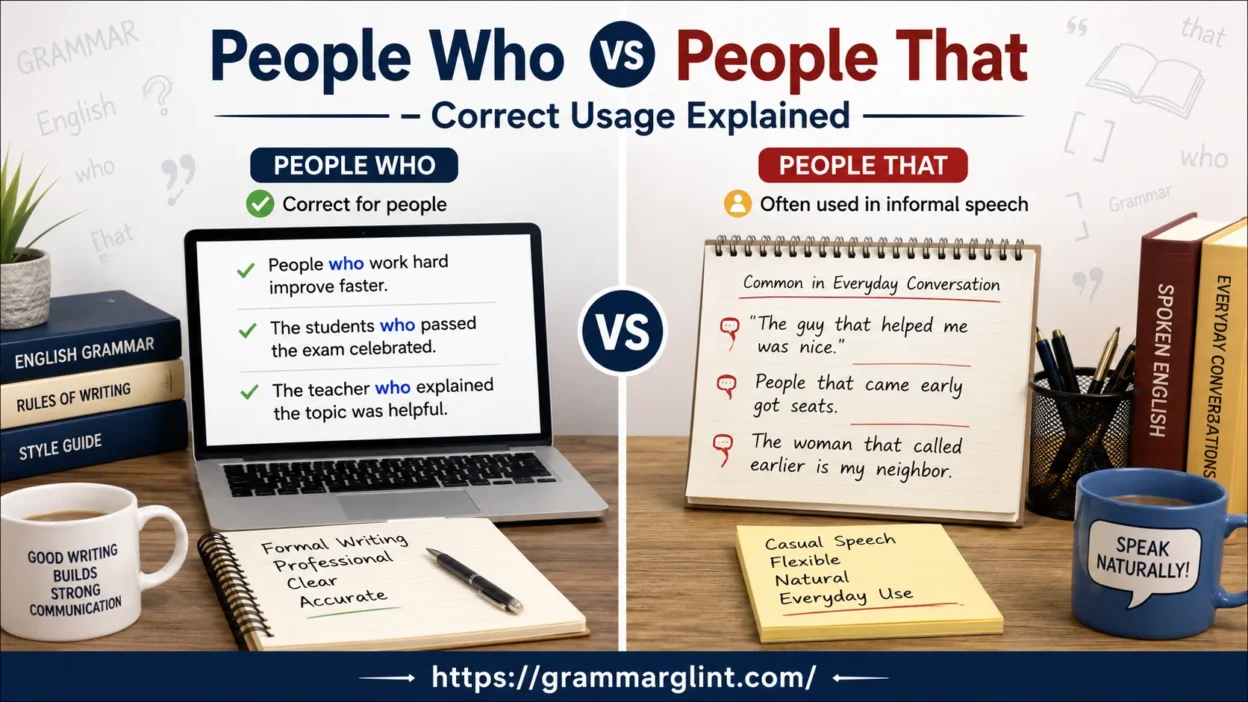
Use “who” when talking about people
This is the standard rule in grammar and professional writing.
Examples:
- People who work hard improve faster.
- The students who passed the exam celebrated.
- The teacher who explained the topic was helpful.
Use “that” mainly for things
This is the default rule in formal English.
Examples:
- The book that I read was helpful.
- The phone that you bought is expensive.
Where confusion starts
In spoken English, people often say:
- “The guy that helped me was nice.”
- “People that came early got seats.”
It sounds natural in conversation. But in writing, it weakens tone slightly.
Why “Who vs That” Matters More Than You Think
You might think this is a tiny grammar detail. It’s not.
Using “who” instead of “that” when talking about people changes how your writing feels:
- It sounds more professional
- It sounds more natural in formal English
- It improves clarity and precision
- It matches modern grammar expectations
Think of it like clothing.
- “Who” is a clean, fitted shirt
- “That” in people-context is like casual wear at a formal meeting
Both work. But one fits the situation better.
The Grammar Behind It: Restrictive vs Nonrestrictive Clauses
Now let’s understand the real structure behind people who vs people that.
This is where most guides overcomplicate things. We won’t.
Restrictive Clauses (Essential Information)
A restrictive clause gives information you need to identify the person.
No commas.
Example:
- People who work hard succeed.
If you remove “who work hard,” the sentence loses meaning.
👉 You don’t mean all people succeed. You mean a specific group.
More examples:
- Employees who arrive early get priority.
- Students who study daily improve faster.
Read More: Onward or Onwards: Difference Explained With Clear Examples
Nonrestrictive Clauses (Extra Information)
A nonrestrictive clause adds extra detail. You can remove it without breaking the sentence.
It uses commas.
Example:
- My brother, who lives in Dubai, is visiting.
If you remove the clause:
- My brother is visiting.
The meaning still works.
More examples:
- The manager, who joined last year, is very strict.
- The team, who trained for months, finally won.
Key takeaway
- Restrictive = no commas = essential info
- Nonrestrictive = commas = extra info
And in both cases:
👉 “who” stays the correct choice for people
People Who vs People That in Real Life Usage
Grammar books give clean rules. Real life doesn’t always follow them.
Let’s break down how people actually speak and write.
Formal Writing (Strict Rule Zone)
In professional writing, you should always prefer:
- People who
- Students who
- Employees who
Why?
Because formal English prioritizes precision and clarity.
Example:
- The candidates who meet the requirements will be interviewed.
This sounds clean and authoritative.
Informal Speech (Flexible Zone)
In everyday conversation, you’ll hear:
- People that
- The guy that helped me
- The woman that called earlier
It’s not “wrong” in speech. It just sounds casual.
Think of it like slang in grammar form.
Writing reality check
Here’s the honest truth:
- Blogs → prefer “who”
- Essays → always “who”
- Business emails → “who”
- Casual texting → “that” is fine
Style Guides and Grammar Experts Agree
Most major writing standards prefer “who” for people.
Here’s what different sources generally support:
- Chicago Manual of Style → prefers “who” for people
- APA Style → recommends “who”
- Modern English usage guides → support “who” as standard
Key takeaway from experts
“Use ‘who’ for people unless you have a strong stylistic reason not to.”
That’s the real-world rule professionals follow.
Common Mistakes in People Who vs People That Usage
Let’s fix the errors that show up most often.
Mixing “who” and “that” randomly
Incorrect:
- People who came late and that missed the test were punished.
Correct:
- People who came late and missed the test were punished.
Using “that” in formal writing about people
Weak:
- The employees that finished early were rewarded.
Better:
- The employees who finished early were rewarded.
Confusing sentence structure
Incorrect:
- The teacher that helped me who is very kind.
Correct:
- The teacher who helped me is very kind.
Or:
- My teacher, who helped me, is very kind.
Overthinking commas
Incorrect:
- People, who work hard succeed.
Correct:
- People who work hard succeed.
Comparison Table
| Situation | Correct Usage | Example |
| Formal writing about people | who | People who study daily succeed |
| Casual speech about people | that / who | The guy that helped me was nice |
| Extra information about people | who (with commas) | My friend, who is a doctor, arrived |
| Referring to objects | that | The car that I bought is fast |
| Essential identifying clause | who | Students who pass the test move forward |
| Non-essential clause | who | The coach, who trained us, is strict |
Real-Life Case Studies: How Usage Changes Tone
Let’s see how small grammar choices change perception.
Case Study 1: Job Application Email
Weak version:
- I worked with people that handled customer support.
Improved version:
- I worked with people who handled customer support.
👉 Result: The second version sounds more professional and credible.
Case Study 2: Blog Writing
Weak version:
- The writers that follow grammar rules improve faster.
Improved version:
- The writers who follow grammar rules improve faster.
👉 Result: More polished, more authoritative tone.
Case Study 3: Casual Conversation
Both sound fine:
- The guy that fixed my laptop was quick.
- The guy who fixed my laptop was quick.
👉 No real difference in spoken English.
Quick Memory Trick to Never Get Confused Again
Use this simple rule:
- Who = Human
- That = Thing (mostly)
Or even simpler:
If it breathes, use “who.”
That shortcut works 95% of the time.
Expert Quote on Relative Pronouns
“In formal English, ‘who’ remains the preferred relative pronoun for people, while ‘that’ serves as a general-purpose connector.”
— Modern English Usage Principle
This matches how editors and publishers treat writing today.
My Personal Experience as an English Language Specialist
As an English language specialist, I have worked with learners, writers, and professionals who often struggle with choosing between people who and people that. While the difference may seem minor at first, I have found that it has a noticeable impact on the clarity, tone, and professionalism of a piece of writing. In my experience, using who for people consistently produces sentences that sound more natural and align with standard English grammar, especially in academic, business, and formal contexts.
Over the years, I have seen that mastering small grammar rules like this gives writers greater confidence and improves the overall quality of their communication. Many of the documents I have reviewed became clearer and more polished after replacing people that with people who where appropriate. These small improvements not only enhance readability but also help writers present their ideas with greater precision, making their English more effective and professional.
FAQs
1. What is the difference between People Who and People That?
People Who is mainly used when referring to humans, while People That can be used in some contexts where the reference is broader or less personal.
2. Is People Who grammatically correct?
Yes, People Who is grammatically correct and is commonly preferred when talking about individuals or groups of people.
3. Can People That be used for humans?
Yes, People That can appear in English, and many speakers use it, but People Who is often considered more natural for human references.
4. Why do writers confuse People Who and People That?
Writers often confuse them because both forms appear in everyday language and communication, making the distinction less obvious.
5. Which one should I use in formal writing?
In formal writing, People Who is usually preferred because it creates clearer human references and improves reader comprehension.
6. Does using People That make a sentence wrong?
No, using People That does not always make a sentence wrong. The correct choice depends on context, usage, and meaning.
7. What role does grammar play in choosing between People Who and People That?
Grammar helps determine which word fits better by considering the type of reference, sentence structure, and intended meaning.
8. Are People Who and People That interchangeable?
They can sometimes be interchangeable, but they are not always equal in style, tone, or clarity.
9. How can I improve my understanding of this grammar rule?
Practice reading and writing different sentences while paying attention to context, rules, and how writers use these structures.
10. Why does this small difference matter in English?
This small distinction matters because it affects clarity, accuracy, and the overall quality of communication.
Conclusion
Choosing between People Who and People That may seem like a minor grammar decision, but it can significantly improve the clarity and professionalism of your writing. In most situations, people who is the preferred and more natural choice because who specifically refers to human beings. Although people that may appear in informal speech or certain defining clauses, it is generally less common in formal English and should be used with care.
Understanding this distinction helps you write more accurately and communicate your ideas with confidence. Whether you are writing academic papers, business emails, or everyday messages, using the correct relative pronoun makes your sentences easier to read and more grammatically precise. When in doubt, choose people who to ensure your writing follows standard English conventions.

Aria Jane is a senior language writer and grammar specialist at Grammar Glint. She focuses on English grammar, spelling variations, vocabulary, and writing clarity. Through detailed research and practical examples, Aria helps readers understand language rules and avoid common mistakes. Her articles are designed to make English learning accessible for students, professionals, and everyday writers seeking reliable language guidance.