The English language contains many phrases that appear similar but can have different meaning depending on the specific contexts where they are used. Small specific nuances in these phrases help distinguish their actual purpose and message. The expressions “On my own” and “by myself” are common examples that often create confusion for learners because they can sometimes seem to mean the same thing.
The phrase “On my own” is generally used to show independence and personal ability. It usually has a connotation that implies doing something without help from anyone else. This expression focuses more on independent effort, self-reliance, and completing an action through personal ability. In everyday communication, it often highlights the idea of handling a task or situation without outside support or assistance.
On the other hand, “by myself” normally emphasizes being alone or having no other person involved in the situation. It suggests that no one else is present or accompanying the person during an activity. This type of comparison helps explain how small language choices can affect sentence structure and the way an idea is understood. Each expression carries its own meaning, making careful selection important for clear communication.
Quick Meaning Breakdown
Before diving deep, let’s lock in the basic meanings. Think of this as your foundation.
| Phrase | Core Meaning | Focus | What It Really Describes | Example |
| By myself | Alone physically | Presence | No one is with you | “I ate lunch by myself.” |
| On my own | Independent | Responsibility | Doing something without help | “I solved it on my own.” |
Here’s the key idea:
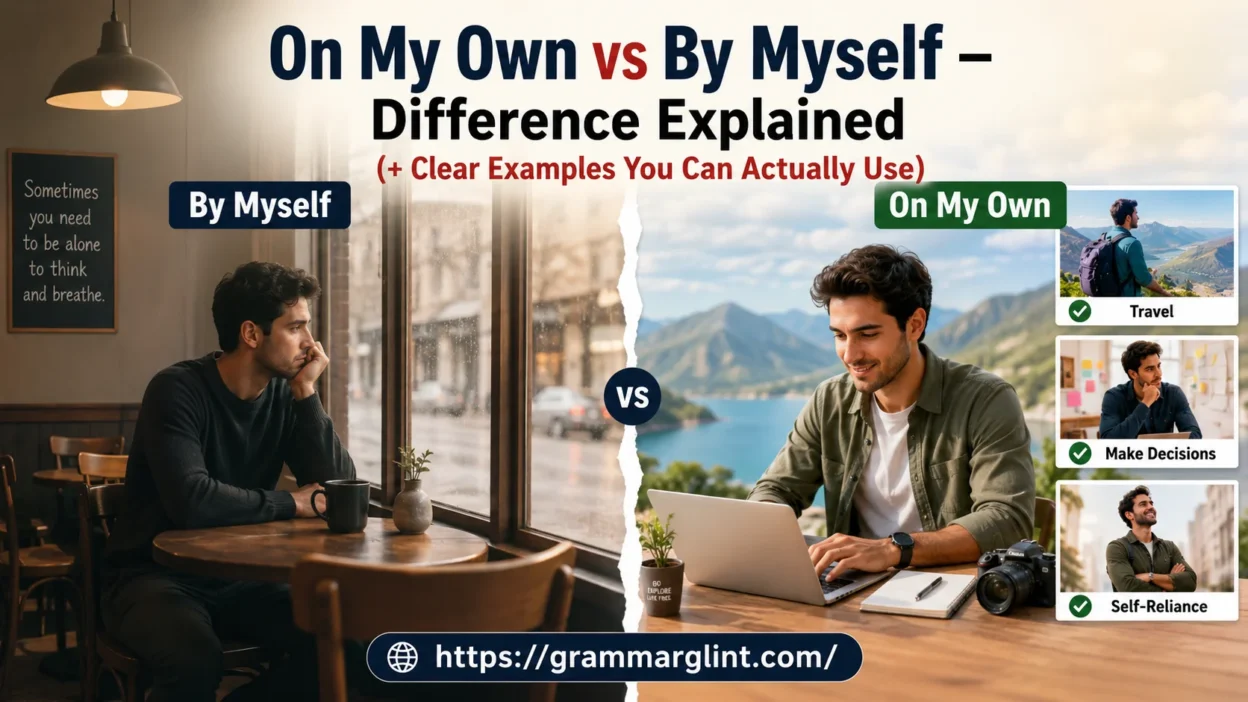
- By myself = solitude
- On my own = independence
Simple. But powerful.

By Myself Meaning: Being Alone in a Physical Sense
When you say “by myself,” you describe a situation where no one else is present with you. It’s about location and company, not skill or responsibility.
You can imagine it like this: you’re standing in an empty room. No one else is there. That’s “by myself.”
Core idea of “By Myself”
At its heart, “by myself” answers one question:
👉 “Who is physically here with me?”
And the answer is: nobody.
Everyday Uses of “By Myself”
People use “by myself” in simple, daily situations:
- Sitting alone in a café
- Walking alone in a park
- Staying home with no one else around
- Traveling without companions
It describes physical isolation, not emotional strength.
Real-Life Examples of “By Myself”
Let’s make it practical:
- “I watched the movie by myself last night.”
- “She sat by herself during lunch break.”
- “I lived in that apartment by myself for two years.”
- “He finished dinner by himself because everyone left early.”
Notice something important here:
None of these sentences talk about ability or independence. They only talk about presence.
Emotional Tone of “By Myself”
This phrase changes meaning depending on context:
- Neutral: “I studied by myself.” (just stating fact)
- Peaceful: “I like walking by myself.” (enjoying solitude)
- Lonely: “I spent the holiday by myself.” (emotional sadness)
Same phrase. Different feeling. Context decides everything.
Case Study: The Quiet Student
Imagine a student named Ali.
Ali eats lunch alone every day. He sits under a tree and scrolls his phone.
- He says: “I eat lunch by myself.”
This doesn’t mean Ali struggles in life. It only means he eats alone. If his friends join him tomorrow, the sentence changes.
That’s how flexible “by myself” really is.
Read More: All Of vs All: Proper Grammar Explained With Clear Rules
On My Own Meaning: Independence and Self-Reliance
Now let’s switch gears.
When you say “on my own,” you talk about independence. You’re not focusing on where people are. You’re focusing on whether you need help.
Think of it like this: you’re building something, solving something, or managing life without support.
That’s “on my own.”
Core idea of “On My Own”
This phrase answers a different question:
👉 “Do I need help?”
And the answer is: no.
Everyday Uses of “On My Own”
You’ll hear this phrase in situations like:
- Moving out and living independently
- Solving problems without help
- Starting a business alone
- Making life decisions independently
It describes self-reliance, not physical isolation.
Real-Life Examples of “On My Own”
Here are clear examples:
- “I moved to another city on my own.”
- “She started her business on her own.”
- “I fixed the computer on my own.”
- “He learned English on his own without a tutor.”
Notice how each sentence shows skill or independence.
Emotional Tone of “On My Own”
Unlike “by myself,” this phrase often carries emotional weight:
- Pride: “I built my career on my own.”
- Strength: “She raised her kids on her own.”
- Challenge: “He survived on his own after leaving home.”
It usually signals growth or resilience.
Case Study: The Self-Taught Designer
Meet Sara.
Sara wanted to become a graphic designer. She had no teacher. No classes. No mentorship.
She learned through YouTube, practice, and trial-and-error.
She says:
“I learned design on my own.”
Even if friends sat next to her while she worked, the phrase still applies. Why? Because she didn’t rely on help.
That’s the power of “on my own.”
The Real Difference Explained
Now let’s connect the dots.
This is where most learners finally “get it.”
The core distinction
- By myself = physical condition
- On my own = mental or practical independence
Let’s break it down even further:
| Situation | By Myself | On My Own |
| Sitting alone in a room | ✔ Yes | ❌ Not relevant |
| Solving a math problem without help | ✔ Yes | ✔ Yes |
| Living independently | ✔ Yes | ✔ Yes |
| Getting emotional support | Not related | Often implied lack of support |
Simple analogy
Think of it like this:
- “By myself” is like standing alone in a room.
- “On my own” is like building the house you’re standing in.
One shows where you are.
The other shows what you can do.
When Both Mean the Same Thing
Sometimes, both phrases overlap.
This confuses learners the most.
Let’s look at real cases.
Living alone scenario
- “I live by myself.” → You have no roommates
- “I live on my own.” → You manage your life independently
Both can be true at the same time.
Cooking scenario
- “I cooked dinner by myself.” → No help while cooking
- “I cook on my own every day.” → You manage cooking regularly without assistance
One focuses on the moment.
The other focuses on lifestyle.
Travel scenario
- “I traveled by myself.” → You had no travel companions
- “I traveled on my own.” → You handled planning and decisions independently
Again, different focus.
Common Mistakes
Many learners mix these phrases because they sound interchangeable.
Let’s fix that.
Mistake: Using “by myself” for independence
❌ “I learned English by myself for five years.”
✔ “I learned English on my own for five years.”
Why? Because learning shows independence, not just solitude.
Mistake: Using “on my own” for physical presence
❌ “I sat on my own in the room.”
✔ “I sat by myself in the room.”
Why? Because sitting alone describes location.
Mistake: Ignoring context
English doesn’t run on fixed rules here. It runs on meaning.
Ask yourself:
- Am I talking about being alone? → use by myself
- Am I talking about independence? → use on my own

Side-by-Side Real-Life Comparisons
Let’s make this crystal clear with everyday scenarios.
1. Scenario: Moving to a new city
- By myself: “I traveled by myself to Karachi.”
- On my own: “I moved to Karachi and started life on my own.”
2. Scenario: Solving a problem
- By myself: “I fixed the issue by myself in the office.”
- On my own: “I handle IT problems on my own at work.”
3. Scenario: Studying
- By myself: “I studied by myself in the library.”
- On my own: “I prepared for exams on my own without a tutor.”
Quick takeaway
Same action. Different meaning.
Memory Trick to Never Confuse Them Again
Here’s a simple trick that sticks fast.
Think of it like this:
- Myself = presence
- Own = ownership
Now lock it in:
- “By myself” → Who is physically with me?
- “On my own” → Who takes responsibility?
Funny way to remember it
Imagine:
- “By myself” = I’m sitting alone eating noodles.
- “On my own” = I cooked the noodles, bought them, and paid the bill.
Same person. Different meaning.
Quick Practice Section
Try choosing the correct phrase:
1. I fixed the laptop ___.
2. I stayed home ___ last night.
3. She built her career ___.
4. He walked through the park ___.
Answers
- on my own → independence
- by myself → physical presence
- on my own → self-made success
- by myself → alone physically
Why This Difference Actually Matters
You might wonder why this small grammar detail even matters.
Here’s the truth:
- It changes how people understand your experience
- It affects clarity in storytelling
- It improves your fluency in real conversations
In interviews, writing, and daily speech, precision builds confidence.
My Personal Experience as an English Language Specialist
As an English language specialist, I’ve found that “on my own” and “by myself” are among the most misunderstood expressions for English learners. Many of my students initially believe they are completely interchangeable because both can describe doing something alone. However, after working with learners from different backgrounds, I’ve seen that understanding the subtle difference between physical solitude and personal independence dramatically improves both their speaking and writing. I always encourage students to look beyond dictionary definitions and focus on the message they want to communicate. Once they understand the context behind each phrase, they begin using them naturally in everyday conversations.
In my teaching experience, I use practical, real-life examples instead of memorized grammar rules because they make these expressions much easier to understand. For instance, I ask students to imagine eating lunch alone in a café versus starting a business without anyone’s help. The first situation clearly calls for “by myself,” while the second naturally fits “on my own.” Watching learners recognize this distinction is always rewarding because it builds their confidence and helps them express themselves more accurately. Over the years, I’ve learned that mastering English isn’t just about knowing vocabulary or grammar rules, it’s about understanding the small differences that make communication clear, natural, and meaningful.
Read More: Freshman or Freshmen Explained: Quick Grammar Guide 2026
FAQs
1. What is the main difference between “On my own” and “by myself”?
“On my own” usually focuses on independence and doing something without help, while “by myself” mainly focuses on being alone without another person present.
2. Can “on my own” and “by myself” have the same meaning?
Yes, in some contexts both phrases can mean doing something alone, but their nuances and connotations can be different.
3. When should “on my own” be used?
“On my own” is used when the focus is on personal ability, individual effort, or completing something without support from others.
4. When should “by myself” be used?
“By myself” is used when the focus is on being alone or when no one else is present or involved.
5. Is “on my own” related to independence?
Yes, “on my own” often shows independence, self-reliance, and the ability to manage something without assistance.
6. Does “by myself” always mean without help?
Not always. It mainly means being alone, but the exact meaning depends on the context of the sentence.
7. Are these expressions common in English communication?
Yes, both expressions are widely used in everyday writing and speaking.
8. Why do learners confuse these two phrases?
Many learners confuse them because they look similar and sometimes appear to mean the same thing in different situations.
9. Do these phrases affect sentence structure?
Yes, choosing the correct phrase improves sentence structure, clarity, and overall interpretation.
10. Why is understanding this difference important?
Knowing the difference helps improve English grammar, usage, and the ability to express ideas more accurately.
Conclusion
Although “on my own” and “by myself” are closely related, they are not always interchangeable. “On my own” mainly highlights independence and the ability to do something without assistance, while “by myself” usually emphasizes being alone or without other people present. Paying attention to the context helps you choose the expression that best matches your intended meaning.
Mastering small distinctions like these makes your English more precise and natural. Whether you’re speaking, writing, or learning grammar, using the correct phrase improves clarity and prevents misunderstandings. With regular practice and exposure to real-life examples, you’ll become more confident in knowing when to use “on my own” and when “by myself” is the better choice.

Aria Jane is a senior language writer and grammar specialist at Grammar Glint. She focuses on English grammar, spelling variations, vocabulary, and writing clarity. Through detailed research and practical examples, Aria helps readers understand language rules and avoid common mistakes. Her articles are designed to make English learning accessible for students, professionals, and everyday writers seeking reliable language guidance.