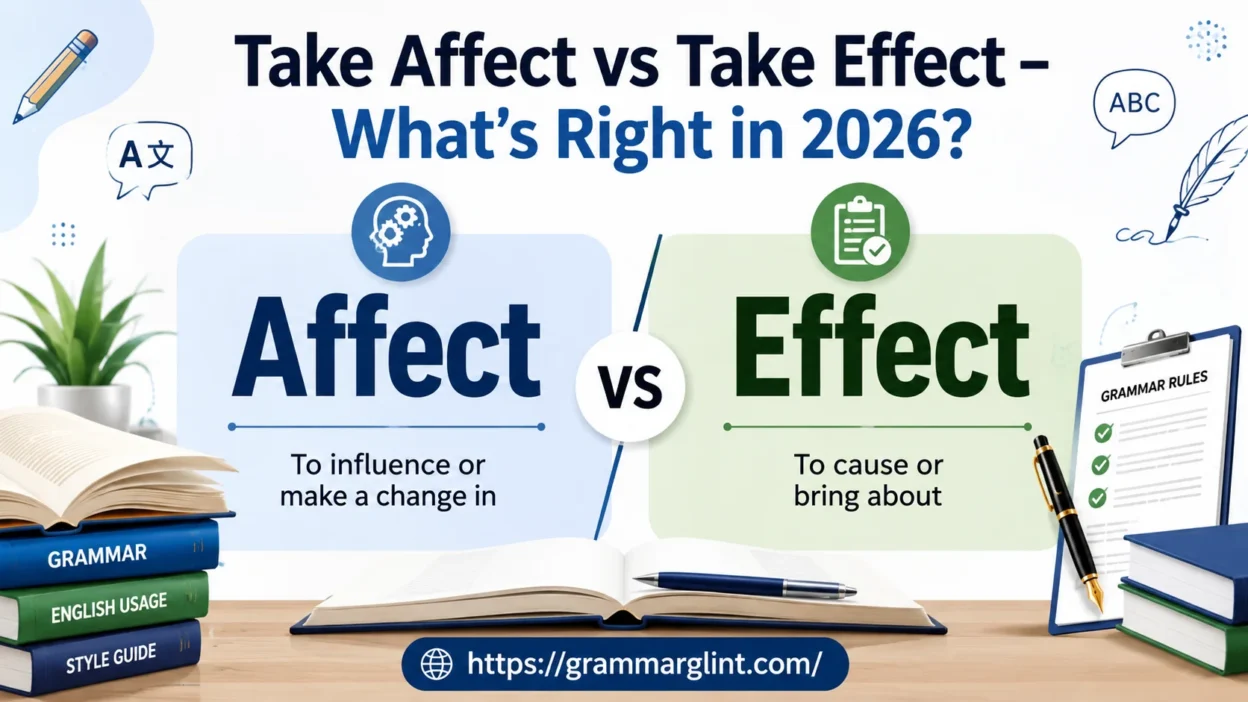
Take Affect vs Take Effect is a question many people ask when they begin improving their English grammar and writing skills every day.
If you have ever wondered which form to write, you are not alone. From my experience editing content in the English language, I have seen native English speakers, language learners, students, bloggers, writers, and professionals make the same mistake. The English language has its fair share of tricky, confusing words and phrases, and each phrase can change its meaning through word choice, grammar, spelling, pronunciation, usage, context, sentence, and sentence structure.
At first, it may seem impossible to tell apart or distinguish affect from effect because they sound similar. That confusion often causes common mistakes, the wrong phrase, or an incorrect choice in a polished email, report, or other work. A quick comparison makes the difference and distinction clear, and the correct phrase is always take effect, not take affect.
This guide will help you learn the correct usage by explaining the function of each word with affect vs effect, affect vs effect examples, real-world examples, and practical examples in a simple way. I have found that the easiest trick, easy trick, and simplest method are to remember that effect usually means a result, while affect often means influence.
That clue helps speakers avoid mistakes forever, keeps every blooper reel out of your writing, and stops these sneaky pranksters from tripping even the smartest people. Once you stop letting them confuse your vocabulary, telling the two apart becomes natural.
Which Is Correct?
The correct expression is:
Take effect
It means something starts to operate, become valid, or produce a result.
You will see this phrase often with:
- Laws
- Rules
- Contracts
- Policies
- Agreements
- Medical treatments
- Technology updates
- Business decisions
Examples:
- “The new traffic law will take effect on Monday.”
- “The updated terms take effect immediately.”
- “The medicine usually takes effect within thirty minutes.”
The phrase “take affect” does not work in standard English for this meaning.
Although affect is a real English word, it usually functions differently. It commonly means “to influence” something.
Example:
- “The weather can affect your travel plans.”
Here, weather influences travel. It does not “take affect.”
What Does Take Effect Mean?
The phrase “take effect” means that something begins to happen or becomes active.
Think of it as a switch being turned on. Before something takes effect, it may exist as an idea, plan, or announcement. After it takes effect, it becomes active in real life.
For example:
A company announces a new workplace rule in June.
Before the starting date:
The rule exists, but employees do not follow it yet.
After the starting date:
The rule takes effect, and employees must follow it.
The phrase connects an action or decision with the moment it begins creating a real impact.
Common meanings
| Meaning | Example |
| Become active | “The new schedule takes effect tomorrow.” |
| Become official | “The agreement takes effect after signing.” |
| Start working | “The treatment takes effect quickly.” |
| Begin producing results | “The changes took effect over several weeks.” |
The phrase appears everywhere because many things have a starting point. Laws, plans, and decisions rarely become active instantly. They usually have a date or condition attached.
Why Do People Write Take Affect Instead of Take Effect?
The mistake comes from the similarity between the two words.
When people hear:
“take effect”
the sound can feel like:
“take affect”
English pronunciation creates many spelling challenges because several words sound alike but have different meanings.
This happens with words such as:
- Their / there / they’re
- Your / you’re
- Affect / effect
The brain often focuses on sound first and meaning second. That is why even careful writers sometimes choose the wrong spelling.
Another reason is that affect appears frequently in daily writing.
People see:
- “This affects me.”
- “It affects the result.”
- “The change affects everyone.”
Because “affect” feels familiar, some writers accidentally place it into the phrase “take effect.”
However, the correct pattern is:
Something affects something else.
Something takes effect.
These structures are different.
The Main Difference Explained
Understanding affect vs effect makes “take effect” much easier to remember.
Affect: Usually a verb
Affect usually means “to influence or change.”
It describes an action.
Examples:
- “Lack of sleep affects your focus.”
- “The storm affected road conditions.”
- “The decision affected the entire team.”
In these sentences, something creates an influence.
A simple memory trick:
Affect = Action
The word starts with “A,” just like “Action.”
Read More: In the Park vs At the Park: Easy Preposition Guide
Effect: Usually a noun
Effect usually means a result or outcome.
Examples:
- “The new rule had a positive effect.”
- “The medicine showed a strong effect.”
- “The decision created unexpected effects.”
A simple memory trick:
Effect = End result
Something happens, and the effect is what comes afterward.
Examples Table
| Sentence | Correct Word | Reason |
| “The noise affected my concentration.” | Affect | Noise influenced concentration |
| “The noise had an effect on my concentration.” | Effect | The result is concentration change |
| “The rule takes effect tomorrow.” | Effect | The rule becomes active |
| “The rule affects employees.” | Affect | The rule influences people |
The key is not memorizing random rules. Instead, look at the job the word performs.
Is it causing a change?
Use affect.
Is it the result of a change?
Use effect.
Is Take Affect Ever Correct?
In normal English, “take affect” is not the correct phrase when you mean “become active.”
However, affect can appear after the word “take” in rare situations if the sentence structure is completely different.
For example, “take affect” might appear as two separate words in specialized contexts involving the noun “affect” meaning emotional expression in psychology.
Example:
- “The patient’s affect was carefully observed.”
Here, affect means emotional appearance or mood expression. This is a different meaning and unrelated to the phrase “take effect.”
For everyday writing, business communication, and general English:
Use:
✅ take effect
Avoid:
❌ take affect
Take Effect in Legal and Official Writing
One of the most common places you will find “take effect” is legal writing.
Governments, organizations, and companies use the phrase because they need to describe exactly when something becomes valid.
Examples:
- “The law takes effect on January 1.”
- “The agreement takes effect after both parties sign.”
- “The regulation takes effect immediately.”
Legal documents often include specific dates because timing matters.
A rule might be approved today but become active later. The phrase “take effect” clearly separates approval from implementation.
For example:
| Stage | Meaning |
| Proposal | Someone suggests a change |
| Approval | The change becomes accepted |
| Takes effect | The change becomes active |
This small distinction prevents confusion.
In Business Communication
Businesses use “take effect” when explaining changes that influence employees, customers, or operations.
Common examples include:
- New prices
- Updated policies
- Contract changes
- Employee benefits
- Service updates
Example:
“Starting July 1, the new pricing structure will take effect.”
This sentence tells readers:
- A change exists
- The change has a specific start time
- The old system ends or changes
Clear wording matters in business because unclear messages can create mistakes.
A customer who misunderstands a start date may expect a change too early. An employee who misunderstands a policy date may follow outdated instructions.
The phrase “take effect” removes that uncertainty.
In Everyday Conversations
Although “take effect” appears in formal writing, people also use it in normal conversations.
You might hear:
- “The new rules take effect tomorrow.”
- “The discount takes effect at midnight.”
- “The update takes effect after you restart the device.”
The phrase sounds natural because people constantly talk about changes.
Your phone updates. Prices change. Plans begin. New habits start. All of these things can “take effect.”
For example:
Imagine you download a new app update. The update installs at 10:00 a.m., but the new features only work after you reopen the app. The features officially take effect after that moment.
The phrase describes the point where something moves from being planned to actually working.
Take Effect vs Come Into Effect vs Go Into Effect
English has several expressions that mean almost the same thing.
Take effect
This is one of the most common and widely accepted options.
Example:
“The new safety rules take effect next week.”
Come into effect
This phrase also means something becomes active.
Example:
“The new agreement comes into effect after approval.”
It often sounds slightly more formal, especially in British English.
Go into effect
This phrase is also correct.
Example:
“The changes go into effect tomorrow.”
It is common in American English.
| Phrase | Meaning | Example |
| Take effect | Become active | “The law takes effect Friday.” |
| Come into effect | Become active | “The rule comes into effect soon.” |
| Go into effect | Become active | “The update goes into effect tonight.” |
All three work. The choice depends on style and region.
Common Mistakes With Take Effect
Small grammar mistakes often happen because writers remember the sound instead of the meaning.
Here are common errors:
| Incorrect | Correct |
| The new rule will take affect tomorrow. | The new rule will take effect tomorrow. |
| The changes took affect immediately. | The changes took effect immediately. |
| The policy takes affect next month. | The policy takes effect next month. |
| The law will take affect soon. | The law will take effect soon. |
A useful habit is to ask:
“Does this sentence mean something is becoming active?”
If yes, choose effect.
Easy Ways to Remember Take Effect
Remembering grammar rules becomes easier when you connect them to meaning.
Try these simple tricks:
Effect is the result
The word effect often refers to what happens after something.
Example:
A new rule starts.
The result?
The rule has an effect.
That is why:
“The rule takes effect.”
Affect is the action
The word affect usually shows influence.
Example:
“The rule affects workers.”
The rule influences workers.
Quick memory formula
Affect = Action
Effect = End result
This simple comparison solves many confusing situations.
Real-World Examples of Take Effect
The phrase appears in many areas of life.
Government Example
A government announces a new law.
The announcement does not always mean people must follow it immediately.
There may be a future date:
“The law takes effect on August 1.”
That date marks the official beginning.
Workplace Example
A company changes its vacation policy.
The company might announce the change in advance:
“The updated vacation policy will take effect next quarter.”
Employees know exactly when the new rule starts.
Technology Example
A software company releases a security update.
The update may require installation and activation:
“The security changes take effect after restarting the system.”
Health Example
A doctor explains a treatment:
“The medication may take effect within a few hours.”
The treatment exists before the result appears. The phrase describes when the benefit begins.
Case Study: Why Choosing the Right Word Matters
Imagine a company sends an announcement:
“The new payment policy will take affect on Monday.”
Most readers understand the meaning. The message is not impossible to understand.
However, the incorrect spelling can reduce trust.
Professional writing depends on small details. Customers, employees, and readers often judge credibility through language choices.
A corrected version:
“The new payment policy will take effect on Monday.”
The sentence looks cleaner and follows standard English.
This is why grammar accuracy matters even with small words.
How to Use Take Effect in a Sentence
The phrase can appear with different verb tenses.
Present tense
“The rule takes effect today.”
Use this when something becomes active now or regularly.
Future tense
“The rule will take effect tomorrow.”
Use this when something starts later.
Past tense
“The rule took effect last year.”
Use this when describing a previous change.
Present perfect
“The rule has taken effect.”
Use this when something has already become active.
| Tense | Example |
| Present | The policy takes effect now. |
| Future | The policy will take effect next month. |
| Past | The policy took effect yesterday. |
| Perfect | The policy has taken effect. |
Sentence Comparison
Looking at similar sentences makes the difference clearer.
Example 1
“The new rule affects employees.”
Meaning:
The rule influences employees.
“The new rule takes effect tomorrow.”
Meaning:
The rule becomes active tomorrow.
Example 2
“The medicine affects the body.”
Meaning:
The medicine influences the body.
“The medicine takes effect quickly.”
Meaning:
The medicine starts working quickly.
One word describes influence. The other describes activation.
Why Grammar Accuracy Matters in 2026
Modern writing happens everywhere:
- Emails
- Websites
- Social media
- AI-generated content
- Online learning
- Business documents
People read thousands of words every day. Clear writing helps your message stand out.
A phrase like “take effect” seems small, but it shows attention to detail.
Good grammar is not about making writing complicated. It is about making your meaning easy to understand.
A single correct word can prevent confusion.
Read More: Swifty or Swiftie: Which Spelling Is Correct? The Complete Guide
FAQs
1. Is take affect or take effect correct?
Take effect is the correct phrase. Take affect is almost always incorrect because effect is the noun used in this expression.
2. What does take effect mean?
Take effect means to begin working, become active, or start producing results. For example, a new law may take effect on January 1.
3. Why do people confuse affect and effect?
The words look and sound similar, which makes them easy to mix up. However, they have different meanings and grammatical roles.
4. Is affect a verb or a noun?
Most of the time, affect is a verb that means “to influence” or “to change.” Although it can be a noun in psychology, that use is uncommon.
5. Is effect a verb or a noun?
In everyday English, effect is usually a noun that means a result or outcome. It can also be a verb meaning “to bring about,” but that use is much less common.
6. Can I ever use take affect in a sentence?
No. In standard English, take affect is considered incorrect. The correct expression is always take effect.
7. How can I remember the difference between affect and effect?
A simple trick is to remember that affect usually means influence, while effect usually means result. If something begins producing a result, it takes effect.
8. What is an example of take effect in a sentence?
“The company’s new policy will take effect next Monday.”
9. Is take effect used in formal and informal writing?
Yes. Take effect is appropriate in formal documents, business emails, legal writing, academic papers, and everyday conversations.
10. Why is learning the difference important?
Using the correct phrase improves your grammar, makes your writing more professional, and helps readers clearly understand your message.
Conclusion
Understanding the difference between take affect and take effect is easier than it first appears. While the two words look and sound alike, they serve different purposes in English. Whenever you want to say that something begins to work, become active, or start producing results, the correct phrase is always take effect. Remembering this small rule can help you avoid a common grammar mistake and make your writing more accurate.
The more you read, write, and practice, the more natural the distinction between affect and effect will become. Keep the simple memory trick in mind, pay attention to how these words are used in real-world writing, and you’ll gain confidence in choosing the right phrase every time. A little practice today can improve your grammar for years to come.

Aria Jane is a senior language writer and grammar specialist at Grammar Glint. She focuses on English grammar, spelling variations, vocabulary, and writing clarity. Through detailed research and practical examples, Aria helps readers understand language rules and avoid common mistakes. Her articles are designed to make English learning accessible for students, professionals, and everyday writers seeking reliable language guidance.