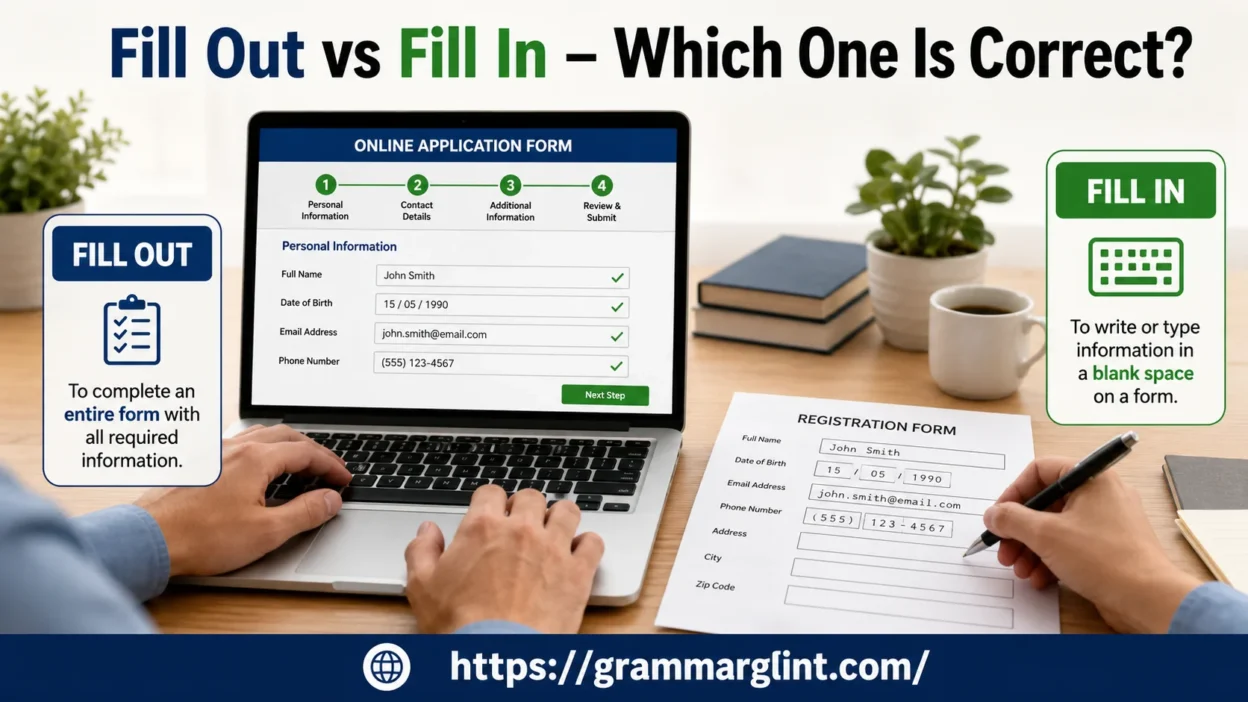
Fill Out vs Fill In: Which One Is Correct? Thinking yesterday about the question of phrasal verbs, I started wondering how fill in and fill out often create confusion even though both are used in relation to form filling and general English usage in everyday communication.
It becomes clearer when we notice that in daily speech we often use phrasal verbs like fill in, fill out, stay in, switch on, switch off, tune in, and tune out, and these expressions can confuse learners because opposites in English do not always behave in a simple or predictable way depending on context and meaning.
Another interesting point is that fill in in British English is commonly used as a form expression that refers to providing information input in a questionnaire or a given questionnaire, where users enter details or mark answers in structured spaces.
On the other hand, fill out is more commonly used in American English speakers as an equivalent phrase, and thus both are correct depending on where you say it, especially when completing forms, answering questions, selecting circles, or submitting job application details that require full completion.
Overall, both expressions are widely understood in English, and their usage depends mainly on regional preference and context, especially when dealing with forms and structured information input situations in everyday communication.
Quick Meaning
Before we go deep, here’s the clean, no-nonsense rule:
- Fill out → used when completing an entire form or document
- Fill in → used when completing specific blanks or missing details
That’s it. That’s the core difference.
Think of it like this:
- You fill out the whole paper.
- You fill in the empty spaces inside it.
Simple. But powerful.
Fill Out vs Fill In Meaning Explained in Real Life Context
Language becomes easier when you connect it to real situations. So let’s do exactly that.
When you go to a hospital, apply for a job, or register online, you interact with forms all the time.
Now ask yourself:
- Are you completing the entire document? → Fill out
- Are you adding missing details inside boxes? → Fill in
That mental shift alone solves most confusion.
What Does “Fill Out” Mean? (Complete the Whole Form)
The phrase fill out means you complete an entire form, application, or document from start to finish.
It focuses on the whole structure, not individual parts.
Common situations where you use “fill out”
You’ll often hear this in American English, especially in official or formal contexts:
- Fill out a job application
- Fill out a visa form
- Fill out a survey
- Fill out registration paperwork
- Fill out an online checkout form
Example sentences
- I filled out the job application last night.
- She filled out the university admission form carefully.
- They filled out a customer feedback survey after the meal.
Why “fill out” makes sense
Think of a form like a full page waiting to be completed. When you finish everything, you’ve “filled it out.”
You didn’t just touch a part of it—you completed the entire thing.
A helpful analogy:
Filling out a form is like coloring an entire drawing. You don’t just shade one corner—you complete the whole picture.
What Does “Fill In” Mean? (Complete the Gaps or Blanks)
Now let’s look at the second phrase: fill in.
This one is more specific. It means you add missing details inside a form or text.
You are not completing everything—just the empty parts.
Common situations where you use “fill in”
- Fill in your name
- Fill in your address
- Fill in the blanks
- Fill in missing details
- Fill in a password field
Example sentences
- Please fill in your email address.
- I forgot to fill in my phone number.
- Can you fill in the missing words in this sentence?
Why “fill in” makes sense
Imagine a form already mostly complete, but some spaces are empty.
You step in and complete those missing parts.
Think of it like this:
Filling in is like fixing a puzzle by placing the missing pieces, not building the whole puzzle from scratch.
Read More: In Stock or On Stock: Which Is Correct? Complete Usage Guide
Comparison Table (Clear Side-by-Side View)
Sometimes the fastest way to learn is to see everything side by side.
| Phrase | Meaning | Focus Area | Example |
| Fill out | Complete a full form | Entire document | Fill out the application form |
| Fill in | Add missing information | Specific blanks | Fill in your name and phone number |
This table shows the core idea in seconds.
Fill Out vs Fill In in Everyday English Usage
Let’s move beyond grammar books and into real life.
You’ll notice these phrases everywhere:
At work
- Fill out HR forms
- Fill in timesheets
- Fill out onboarding documents
At school
- Fill out admission forms
- Fill in answer sheets
- Fill in missing answers
Online
- Fill out registration pages
- Fill in login details
- Fill out checkout forms
Even apps like Google Forms or job portals quietly use both patterns depending on context.
British vs American English Difference
Here’s where things get a little interesting.
English changes depending on where you are.
American English
- Strong preference: fill out
- Very common in official paperwork and online systems
Example:
- Fill out this form before you leave.
British English
- More flexible usage
- Often uses fill in for both meanings
Example:
- Fill in this form before you leave.
Key takeaway
Both are correct. But:
- American English = more strict separation
- British English = more relaxed usage
So don’t panic if you see both. Context matters more than geography.
Common Mistakes People Make With Fill Out vs Fill In
Even advanced learners mix these up. Let’s fix the most common mistakes.
Mistake: Using “fill in” for full forms in American English
❌ Fill in the job application
✔ Fill out the job application
Mistake: Using “fill out” for single blanks
❌ Fill out your name here
✔ Fill in your name here
Mistake: Treating them as exact synonyms
They are not identical. They overlap, but context controls meaning.
Real-Life Case Study: Filling Forms in a Job Application
Let’s walk through a real scenario so it sticks.
Imagine you’re applying for a job online.
You open a form with:
- Name
- Address
- Experience
- Resume upload
Now here’s how both phrases appear:
Step 1: Fill out the entire application
You complete everything from top to bottom.
- You are filling out the job application.
Step 2: Fill in specific fields
Inside that application, you type:
- Your name
- Your phone number
- Your email
Each field you complete is a “fill in” action.
Final takeaway from this case
One form. Two types of actions.
- Overall process → fill out
- Individual inputs → fill in
Simple Memory Tricks
You don’t need complex grammar rules. Just remember these shortcuts.
Memory trick 1: Out = whole thing
- Fill out = complete everything
Memory trick 2: In = inside spaces
- Fill in = complete blanks
Memory trick 3: Visual idea
Imagine a house:
- You fill out the house by finishing construction
- You fill in cracks in the wall
Simple mental images stick better than rules.
Fill Out vs Fill In in Forms You See Every Day
Let’s connect it to familiar experiences.
Bank forms
- Fill out account opening form
- Fill in personal details
School exams
- Fill out answer sheet
- Fill in blanks in grammar section
Online shopping
- Fill out shipping form
- Fill in address and payment details
You already use both—you just didn’t notice it.
Expert Linguistic Insight (Simple Version)
Linguists explain this difference using “scope.”
- Fill out → broad action (entire structure)
- Fill in → narrow action (specific points)
This pattern appears in other English phrases too:
- Turn on (entire system) vs turn up (specific level change)
- Log in (system access) vs sign up (full registration)
English often splits actions like this to show precision.
Quick Practice Section (Test Yourself)
Try choosing the correct phrase:
- Please ___ your email address.
- I need to ___ this application form.
- Can you ___ the missing words?
- She ___ the registration form yesterday.
Answers
- fill in
- fill out
- fill in
- fill out
FAQs
1. What is the difference between fill in and fill out?
Fill in is often used in British English, while fill out is commonly used in American English, but both mean completing a form.
2. Are fill in and fill out interchangeable?
Yes, in most form-related contexts, both expressions are understood and considered correct.
3. When should I use fill in?
Use fill in when referring to entering information in a form, especially in British English contexts.
4. When should I use fill out?
Use fill out when referring to completing an entire form, mainly in American English usage.
5. Is fill in correct English?
Yes, fill in is correct and widely used, especially in the UK and other British English regions.
6. Is fill out correct English?
Yes, fill out is also correct and commonly used in American English.
7. Do both phrases mean the same thing?
In most cases related to forms and applications, fill in and fill out mean the same thing.
8. Can I use fill in for job applications?
Yes, you can use fill in for job applications, especially in British English contexts.
9. Can I use fill out for questionnaires?
Yes, fill out is commonly used when completing questionnaires, especially in American English.
10. Why do both expressions exist?
Both exist because English varies by region, and different phrasal verbs developed in British and American English usage.
Conclusion
Both fill in and fill out are correct English expressions used for completing forms, questionnaires, and applications. The difference mainly comes from regional usage, where British English prefers fill in and American English prefers fill out, but in real communication, both are widely understood and accepted without confusion.

Mia Brooke is a content strategist and English language writer at Grammar Glint. She specializes in spelling comparisons, word meanings, idioms, and usage guides. Mia combines careful research with straightforward explanations to help readers navigate the nuances of modern English. Her goal is to provide accurate, trustworthy content that supports learners at every stage of their language journey.