Learning verb tenses improves writing and communication because I Graduated vs I Have Graduated shows how different phrases can change with context and meaning. These expressions may look similar, but they carry different ideas depending on the situation. Understanding these forms helps students and learners develop better knowledge of grammar and English usage.
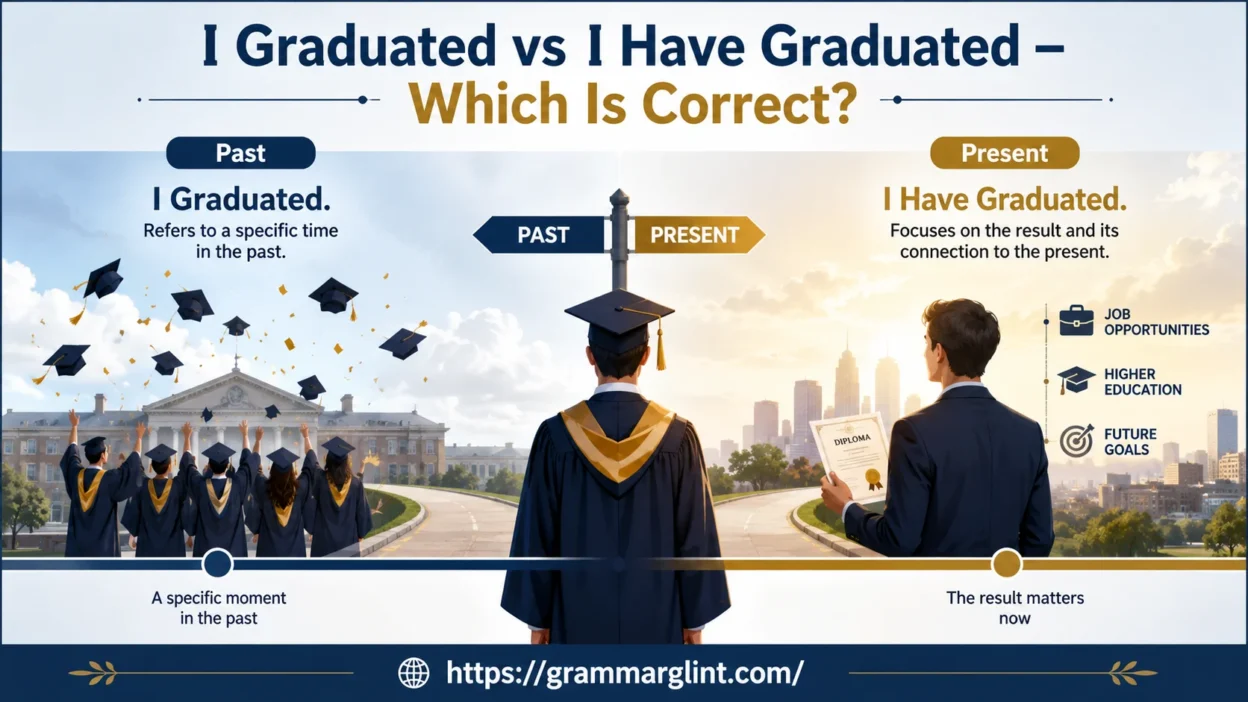
The main difference between these sentences appears when we look at time and connection. I graduated usually describes a past event that happened at a particular moment. It tells the listener that the person completed their studies in the past. On the other hand, I have graduated focuses more on the result of the action and connects the completed action with the present relevance.
The sentence structure of these expressions uses an auxiliary verb or helping verb like have with an other verb form. The phrase I graduated can refer to a finished graduation from a college or university at a specific time in the past. This structure follows common rules of English grammar and helps speakers express their thoughts clearly.
When people use I have graduated, they often emphasize an achievement connected to education and study. The present perfect tense shows that the graduation is important now, even though the action happened before. This explanation of usage, rules, and expressions gives a clearer comparison between the two forms.
Learning these verb forms improves understanding of grammatical phrases, language, and sentence patterns. By studying these examples, learners can recognize how small changes in a sentence create different meanings. These ideas make communication more accurate and help people use English naturally in daily conversations and formal writing.
Quick Answer
If you’re in a hurry, here’s the simplest rule you’ll ever need:
- I graduated → Use this for a completed event in the past.
- I have graduated → Use this when the result still feels relevant now.
Most of the time in real life, people say:
👉 “I graduated.”
It sounds clean, natural, and complete.
But “I have graduated” is still correct. It just carries a slightly different emotional tone. It connects the past action to your present life.
Think of it like this:
- “I graduated” = I closed that chapter.
- “I have graduated” = That chapter just changed my current life.
Simple, but powerful difference.
Understanding “I Graduated” (Simple Past Explained Clearly)
When you say “I graduated,” you are talking about a finished action in the past.
No connection to now is required. The event is done and settled.
What it really means
“I graduated” means:
- The graduation happened at a specific time in the past
- That event is complete
- You are simply reporting a fact
Examples you’ll actually hear
- I graduated in 2022.
- I graduated from college last year.
- I graduated after four years of study.
- I graduated before moving to Lahore for work.
Notice something important?
Every sentence either mentions time or implies it.
When people usually use it
You’ll hear “I graduated” in situations like:
- Job interviews
- Formal introductions
- Resumes or CV discussions
- Storytelling about your education
Read More: Literature or Literatures: What Is the Plural of Literature?
Why it feels natural
English speakers like clarity. The simple past gives a clean timeline.
No emotional link. No extra meaning. Just fact.
A native speaker would almost always choose this sentence:
“I graduated from university in 2021.”
It sounds natural because it’s direct and complete.
Understanding “I Have Graduated” (Present Perfect in Real Life)
Now let’s talk about “I have graduated.”
This one is slightly more emotional and less about timing.
It focuses on the result, not the exact moment.
What it really means
“I have graduated” suggests:
- The graduation is recent OR still important now
- The result affects your current situation
- The exact time is not important
Examples in real use
- I have graduated, so I’m looking for a job now.
- I have graduated and started preparing for exams.
- I have graduated recently, so everything feels new.
- I have graduated, and it feels like a big change in my life.
Where you’ll see it most
This form appears in:
- Social media announcements
- Personal updates
- Conversations about life changes
- Emotional or reflective statements
Why it feels different
It carries a sense of “this just happened and it matters now.”
It’s not just information. It’s experience.
A natural example:
“I have graduated, and I’m finally stepping into the real world.”
That sentence feels alive. It connects past and present.
Key Differences Explained Simply
Let’s put both forms side by side so the difference becomes crystal clear.
| Feature | I Graduated | I Have Graduated |
| Grammar tense | Simple past | Present perfect |
| Focus | Past event | Present result |
| Time reference | Specific or implied | Often not stated |
| Emotional tone | Neutral | Reflective or personal |
| Common usage | Very common | Less common |
| Example | I graduated in 2020 | I have graduated recently |
Here’s the easiest way to remember it:
- If you care about when, use I graduated
- If you care about now, use I have graduated
That’s it.
Why “I Graduated” Is More Common in Everyday English
Here’s something most learners don’t realize.
Even though both are correct, “I graduated” dominates real conversation.
Why?
Because English speakers prefer simplicity.
Graduation is already understood as a finished milestone. So adding “have” often feels unnecessary.
Think about it like this
Imagine someone asks:
“Did you finish university?”
You’d most likely answer:
“Yes, I graduated.”
Not:
“Yes, I have graduated.”
The first one sounds more natural because it’s straightforward.
Real-world pattern
In daily English, people usually prefer:
- I graduated from school
- I graduated last year
- I graduated in 2023
Not the present perfect form.
When to Use Each One (Real-Life Situations)
Let’s make this practical. Grammar only matters when you can use it correctly in real life.
Job interviews
Use:
- I graduated in 2021 with a degree in Business Administration.
Why? Because interviewers care about facts and timelines.
Social media posts
Both can work, but tone matters.
- “I have graduated!” → emotional, celebratory
- “I graduated 🎓” → simple, clean, confident
Resume or CV
Only use:
- Graduated from XYZ University, 2022
Not:
- I have graduated from XYZ University
Why? CVs avoid personal tone.
Casual conversation
Most natural options:
- I graduated last year.
- I graduated from college.
If you want emotional tone:
- I have graduated and it still feels unreal.
Email or formal writing
Use:
- I graduated in 2020 and have since worked in marketing.
This mixes both forms naturally.
Case Study: Two Students, Two Different Choices
Let’s make this real.
Student A: Ali
Ali is applying for a job. He writes:
“I graduated in 2023 with a degree in Computer Science.”
His application sounds professional and clear.
Student B: Sara
Sara posts on Instagram:
“I have graduated, and I can’t believe this journey is over.”
Her message feels emotional and personal.
What we learn
- Ali focuses on fact → simple past
- Sara focuses on emotion → present perfect
Same event. Different intent.
That’s the real difference.
Common Mistakes People Make
Many learners overthink this topic. Let’s fix the most common errors.
Using present perfect everywhere
Wrong:
- I have graduated in 2020
Why it’s wrong:
You already gave a specific time. That requires simple past.
Correct:
- I graduated in 2020
Thinking both are interchangeable
They are not.
They overlap in meaning but not in usage.
Adding “have” in formal contexts unnecessarily
Wrong:
- I have graduated from university last year
Correct:
- I graduated from university last year
Ignoring time clues
Words like:
- last year
- in 2022
- yesterday
Almost always signal simple past.
What Native Speakers Actually Do
Here’s the honest truth.
Native speakers rarely think about grammar rules when choosing between these two forms.
They rely on instinct.
What they typically say:
- I graduated from college in 2019
- I graduated last summer
When they use “I have graduated”
Only when they want to:
- Announce news
- Emphasize a life change
- Connect past to present
Example:
“I have graduated, so I’m moving to a new city.”
That’s natural because it ties two ideas together.
Easy Decision Rule You Can Always Follow
Let’s simplify everything into one mental shortcut.
Ask yourself this:
👉 Am I talking about WHEN it happened?
- Yes → Use I graduated
👉 Am I talking about NOW and how it affects me?
- Yes → Use I have graduated
That’s your rule.
No exceptions needed for daily English.
Quick Practice Section (Test Yourself)
Try filling in the blanks:
- I ______ in 2021.
- I ______ so I’m looking for a job now.
- I ______ last summer from university.
- I ______ and everything feels different.
Answers:
- graduated
- have graduated
- graduated
- have graduated
If you got at least 3 right, you’re already using it naturally.
FAQs
1. What is the difference between I graduated and I have graduated?
I graduated refers to a completed action in the past, while I have graduated uses the present perfect tense to connect the graduation with the present situation.
2. Is I graduated grammatically correct?
Yes, I graduated is grammatically correct and commonly used when talking about a specific time or completed event in the past.
3. Is I have graduated correct in English?
Yes, I have graduated is correct and uses an auxiliary verb with the past participle form to show a completed action with present relevance.
4. Can I use I graduated and I have graduated interchangeably?
Sometimes they can express a similar idea, but the context changes the meaning. One focuses on the past event, while the other highlights the current result.
5. Which tense is used in I have graduated?
The phrase I have graduated uses the present perfect tense, which connects a past action with the present.
6. When should I use I graduated?
Use I graduated when you want to mention the time, place, or specific moment of completing your education.
7. When should I use I have graduated?
Use I have graduated when the fact of completing your degree or education is important in the current situation.
8. What role does have play in I have graduated?
Have works as a helping verb or auxiliary verb that forms the present perfect structure.
9. Do students often confuse these two phrases?
Yes, many students and learners confuse them because both describe graduation, but their grammar and usage are slightly different.
10. How can I remember the difference between these verb forms?
Think about time: I graduated points to the past, while I have graduated focuses on the completed achievement and its connection to now.
Conclusion
Understanding I Graduated vs. I Have Graduated helps you choose the correct verb tense based on the message you want to convey. If you are talking about a completed event at a specific time in the past, I graduated is the right choice. If you want to emphasize that your graduation has relevance to the present, I have graduated is more appropriate. Knowing this distinction makes your writing sound more natural and grammatically accurate.
Although the two expressions refer to the same achievement, they serve different purposes in English. Paying attention to context, time references, and sentence structure will help you use each form with confidence. With regular practice, you will avoid common tense mistakes and communicate more clearly in academic, professional, and everyday conversations.

Aria Jane is a senior language writer and grammar specialist at Grammar Glint. She focuses on English grammar, spelling variations, vocabulary, and writing clarity. Through detailed research and practical examples, Aria helps readers understand language rules and avoid common mistakes. Her articles are designed to make English learning accessible for students, professionals, and everyday writers seeking reliable language guidance.